




Fiji Trip Report October 2025
Fiji aboard the Nai'a
Words and Images by Trip Leader Mark Strickland
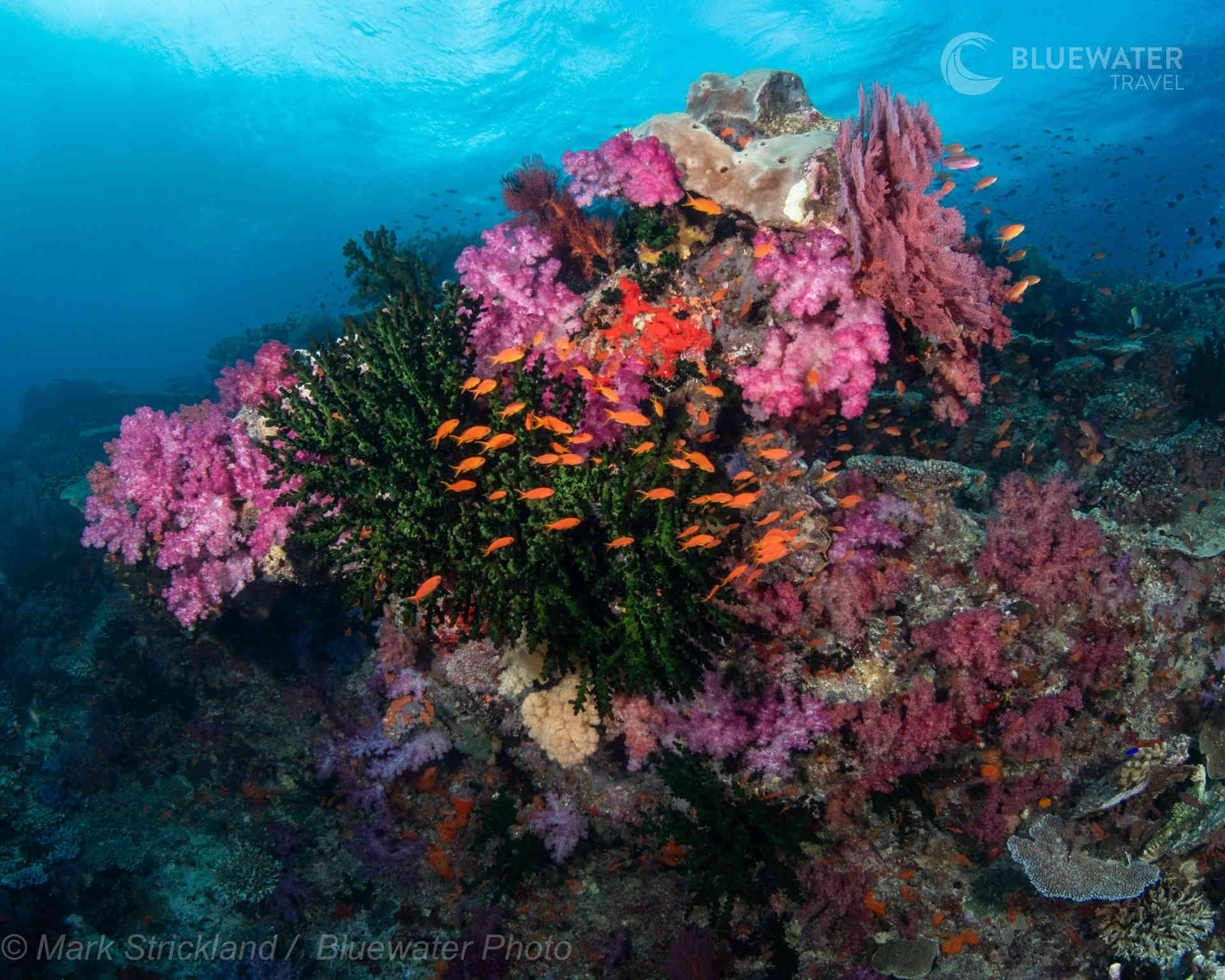
Welcome Aboard the Nai’a
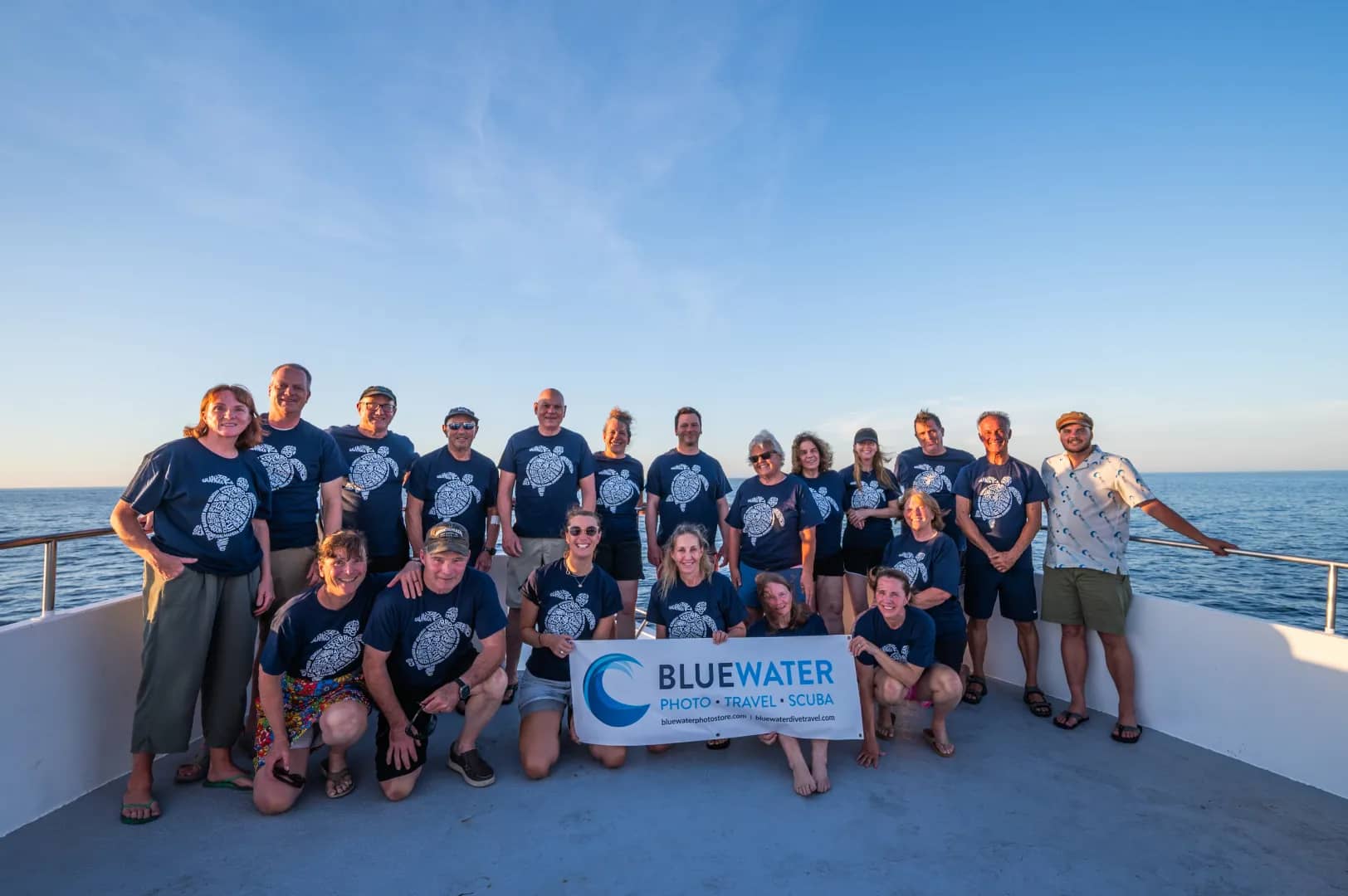
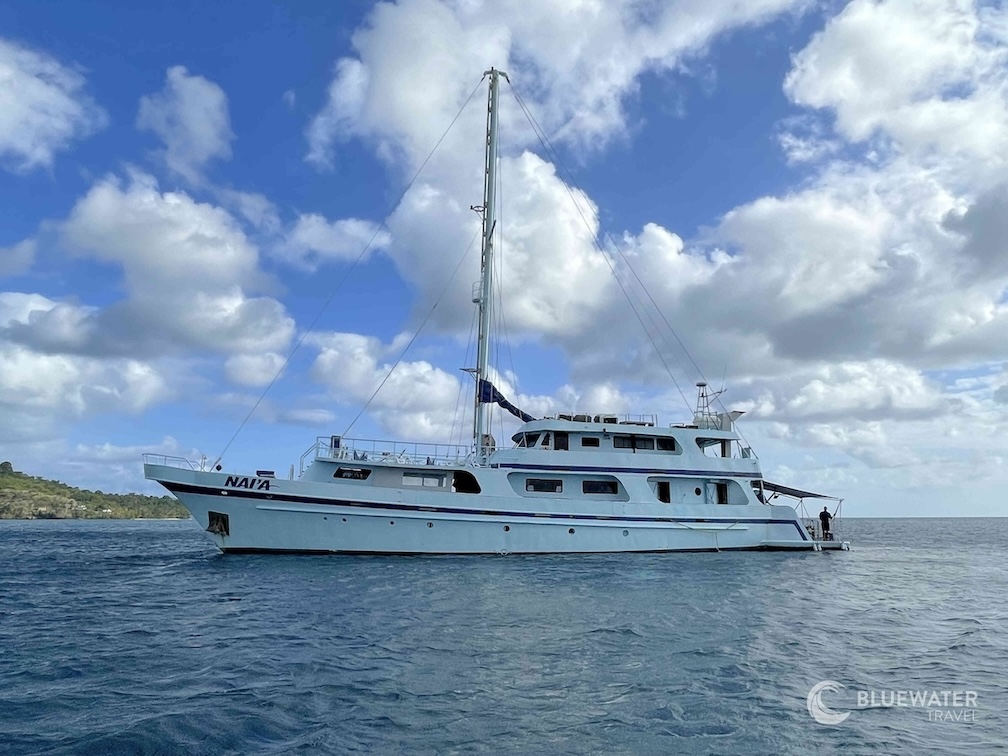
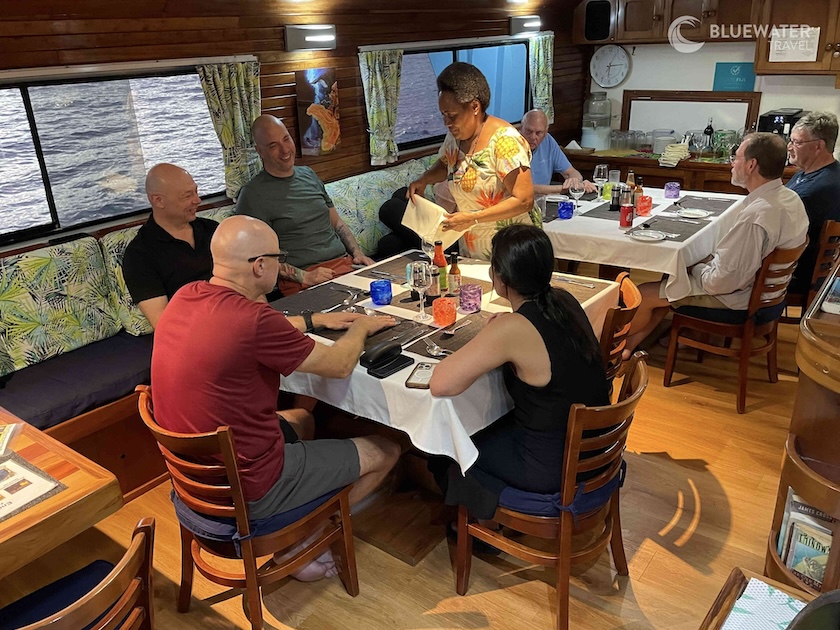
Our Bluewater Travel Photo Workshop began with an early afternoon transfer to our vessel's home port on Fiji's main island, Viti Levu, as our group of 16 was treated to a warm welcome that included snacks and a refreshing beverage. Once everyone was comfortable, we settled in for an extensive orientation by cruise directors Chris and Claudia ("Clau"), who covered safety considerations, dive operations, and pretty much all aspects of life onboard. Our floating home for the next 10 days would be the venerable Nai'a, a lovely, family-owned 120-foot steel-hulled motor sailor that has been operating here since the early 1990s. Some of the crew members have been aboard for many years, and the owners themselves are keen divers, so the level of local knowledge - so important for any dive operation - is exceptional.
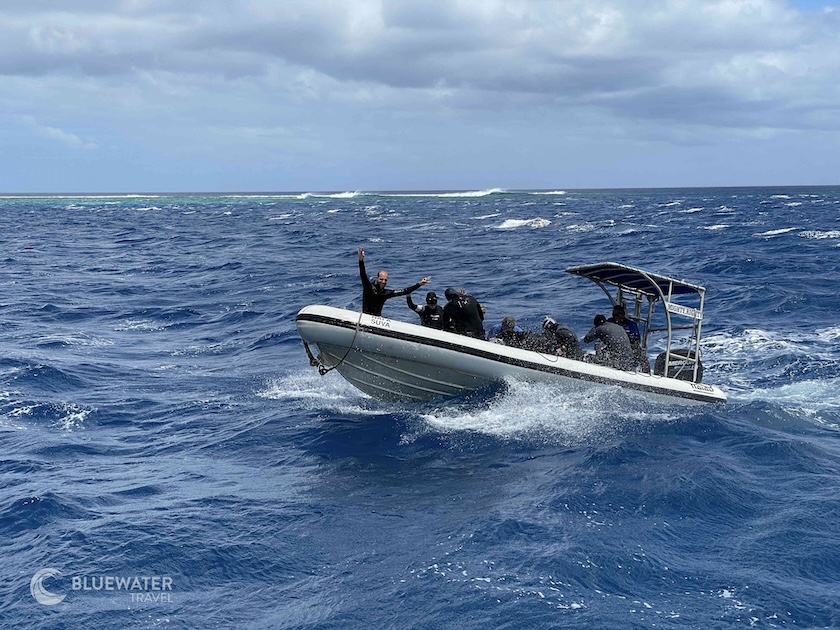
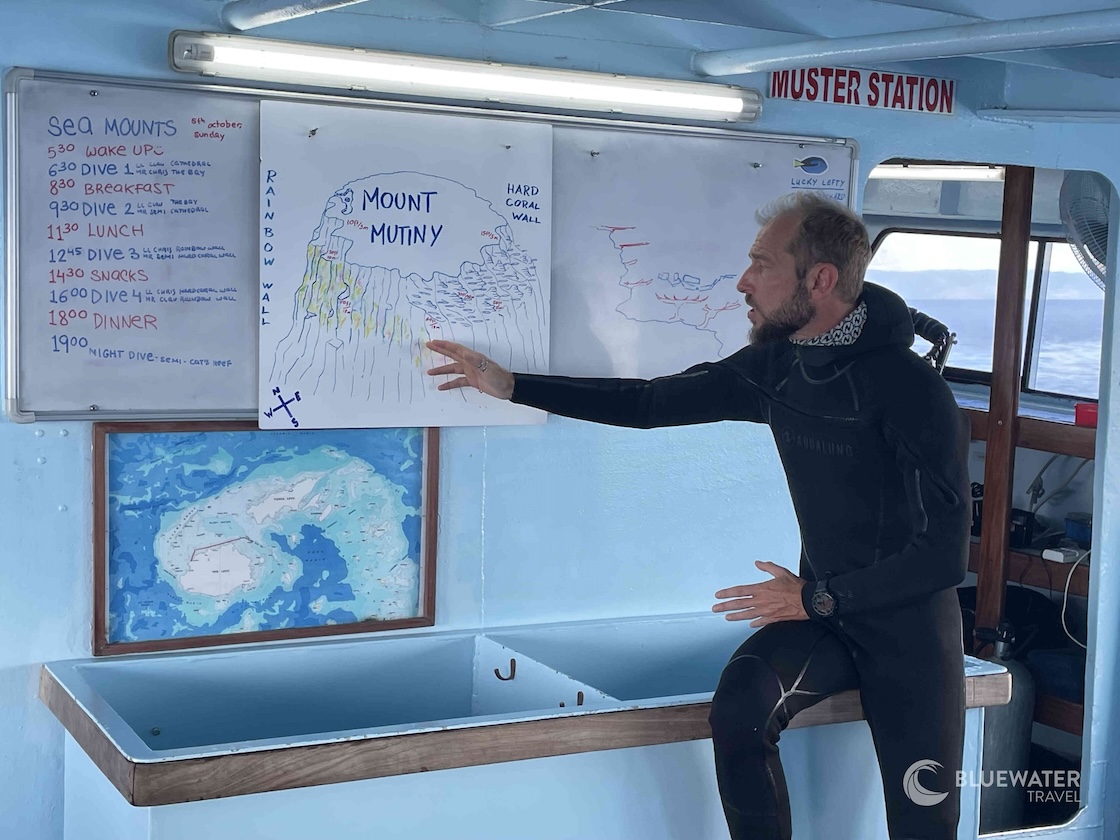
All diving from Nai'a is done via two large and comfortable rigid hull inflatable skiffs. For most sites, the skiffs alternated sites to avoid overcrowding, an approach that was well appreciated by our group. Like any good dive operation, each dive started with a thorough briefing, complete with a detailed dive site diagram. There was always an option to join the guide for a tour of the reef, but thankfully, that was not a requirement.
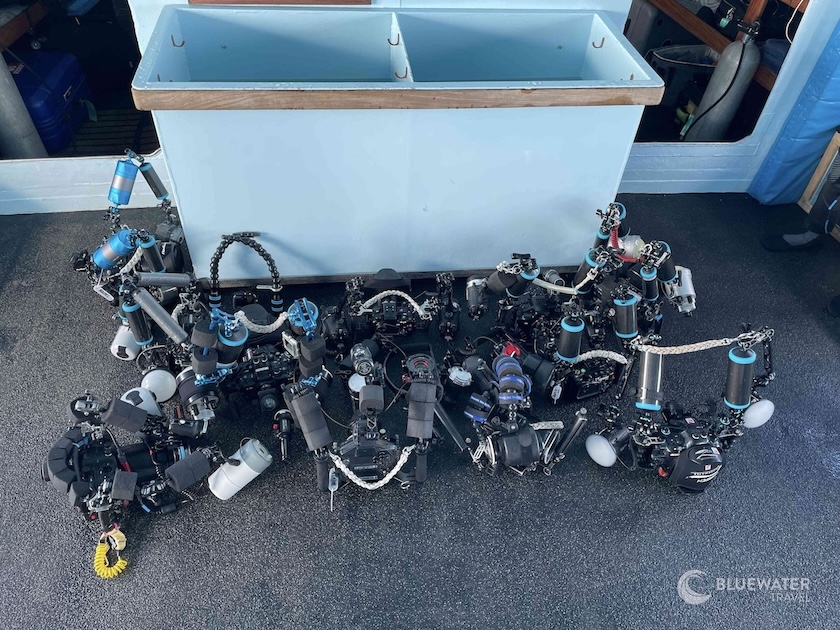
First Diving Day: Exploring E6 and Mount Mutiny
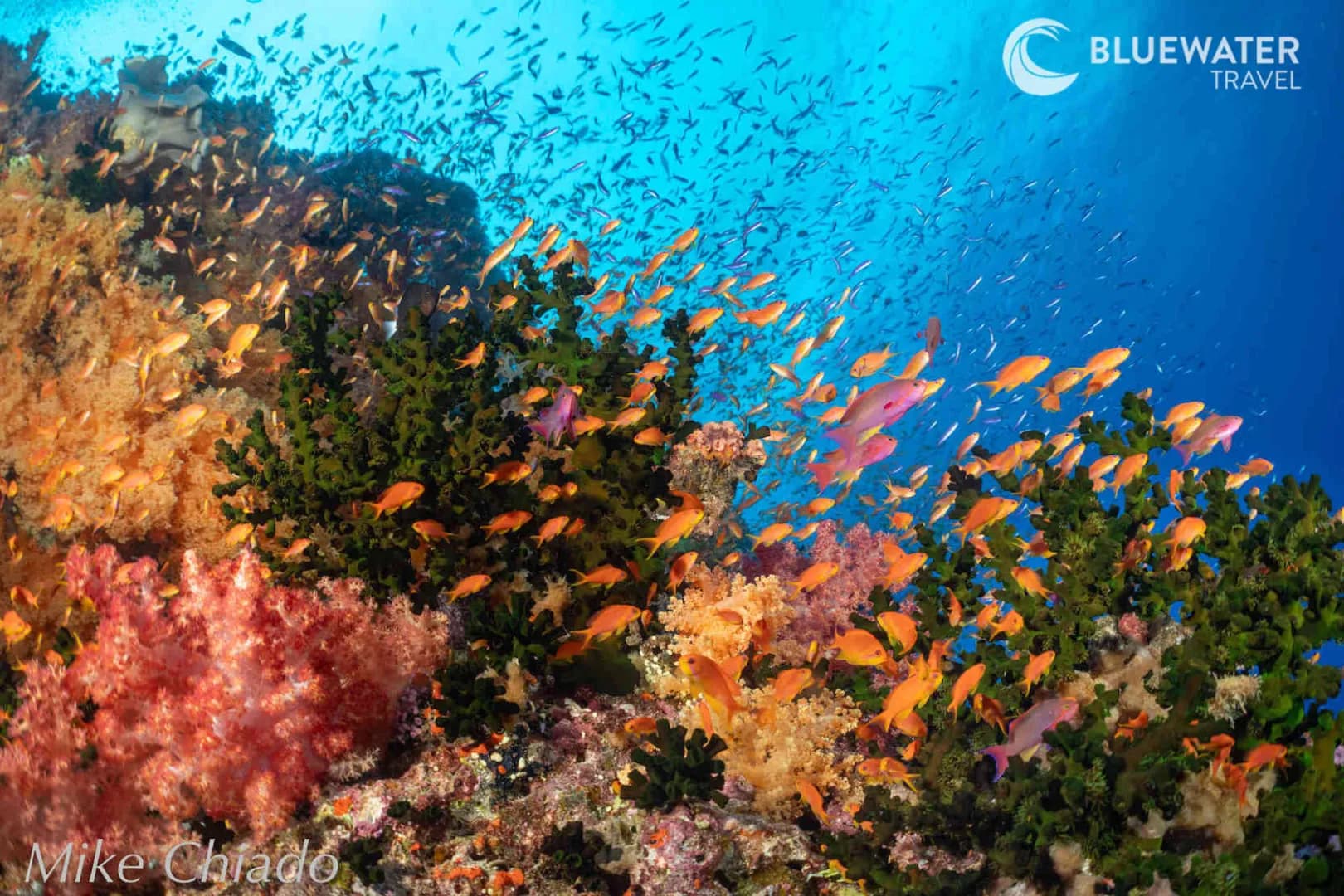
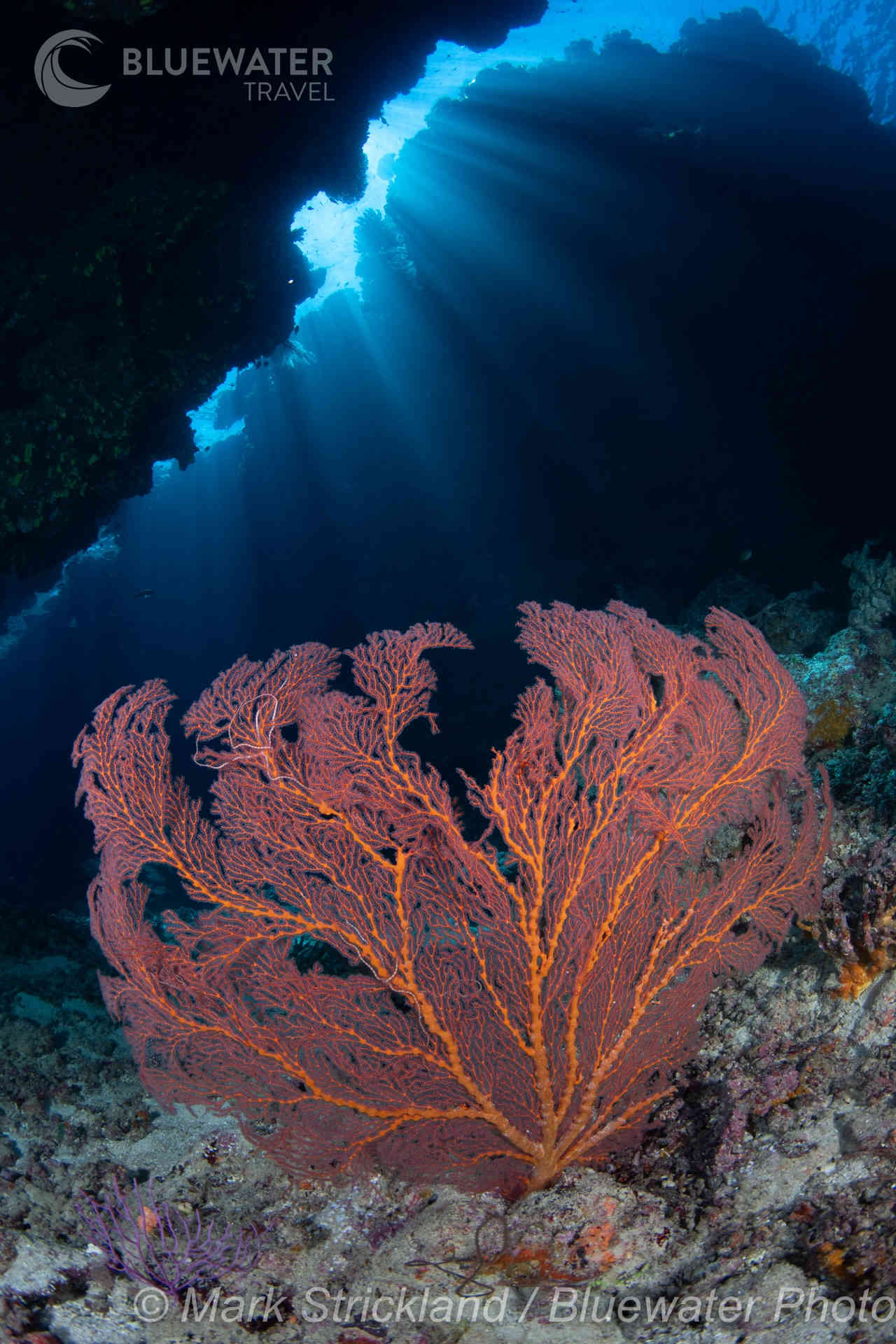
On our first diving day, we awoke to beautiful, calm seas, a necessary prerequisite for the sites we'd be visiting - a pair of seamounts in the Bligh Water region that rise to within a few feet of the surface from over 3000-foot depths. For the morning dives, we split our time between two sections of an iconic site named E6, where a coral-covered pinnacle drops off into the abyss. There are two distinct dive sites here - on one side, there's a shallow bay that's populated by a forest of stunning hard coral formations. The opposite side, however, is a small area known as the Cathedral, where the reef is riddled with swim-throughs and passageways, accented by colorful fans, gorgonians, and soft corals. Beams of early-morning sunlight burst from behind the reef-top, creating an otherworldly effect when viewed from the confined quarters of the caverns. As a photographer, one could easily spend the entire dive just exploring this small area, but both sites also offer dramatic walls where predators like jacks and dogtooth tuna periodically charge through schools of anthias and fusiliers, as more reclusive species shelter in the many ledges and crevices. Among the more interesting finds on the first dive were vividly colored hawk anthias and the endemic blue bell angelfish, along with a myriad of other colorful reef fish and a pair of painted crayfish (spiny lobsters) that waved their long antennae at passing divers. At the end of each dive, a special bonus was the stunning reef-top to be explored at depths of 10 feet or less, where we practiced "scuba snorkeling" amidst a wide variety of pristine hard corals.
For the afternoon dives, we moved to another legendary site known as Mount Mutiny, a massive pinnacle that's about 1000 feet in diameter and rises vertically from thousands of feet to within a couple of feet of the surface. The topography alone makes this a compelling site, but like E-6, the shallow, hard coral reef top is absolutely stunning. Once again, we dived two different sections, with each tender alternating sites from one dive to the next to avoid crowding underwater. One side of the seamount features a sloping bay that's dominated by hard corals, offering great scenery at every depth. But what makes Mount Mutiny special is the wall on the opposite side, where, at depths of 50 to 80 feet, there is an amazing concentration of vividly colored Chironepthya corals. Similar to gorgonians, they are somewhat flexible, but unlike the translucent Dendronepthya soft corals that Fiji is most famous for, they remain fully erect even when there is no current. Decorating the ceilings of overhangs as well as the vertical wall, they come in just about every color in the rainbow, with yellow, lavender, purple, and orange being the dominant hues. Fish life is abundant in both areas, with a wide range of reef species represented, including slingjaw wrasse, golden damselfish, Moorish idols, and regal angelfish being especially common, as well as predators like Spanish mackerel and dogtooth tuna. Being a pinnacle surrounded by deep water, it's also the kind of place where almost anything could show up, including a large scalloped hammerhead that made a brief pass on the wall.
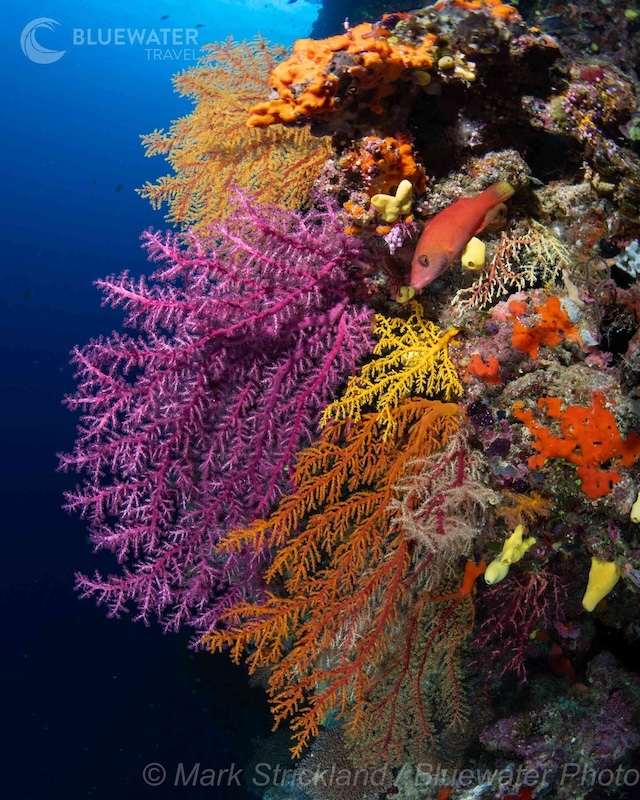
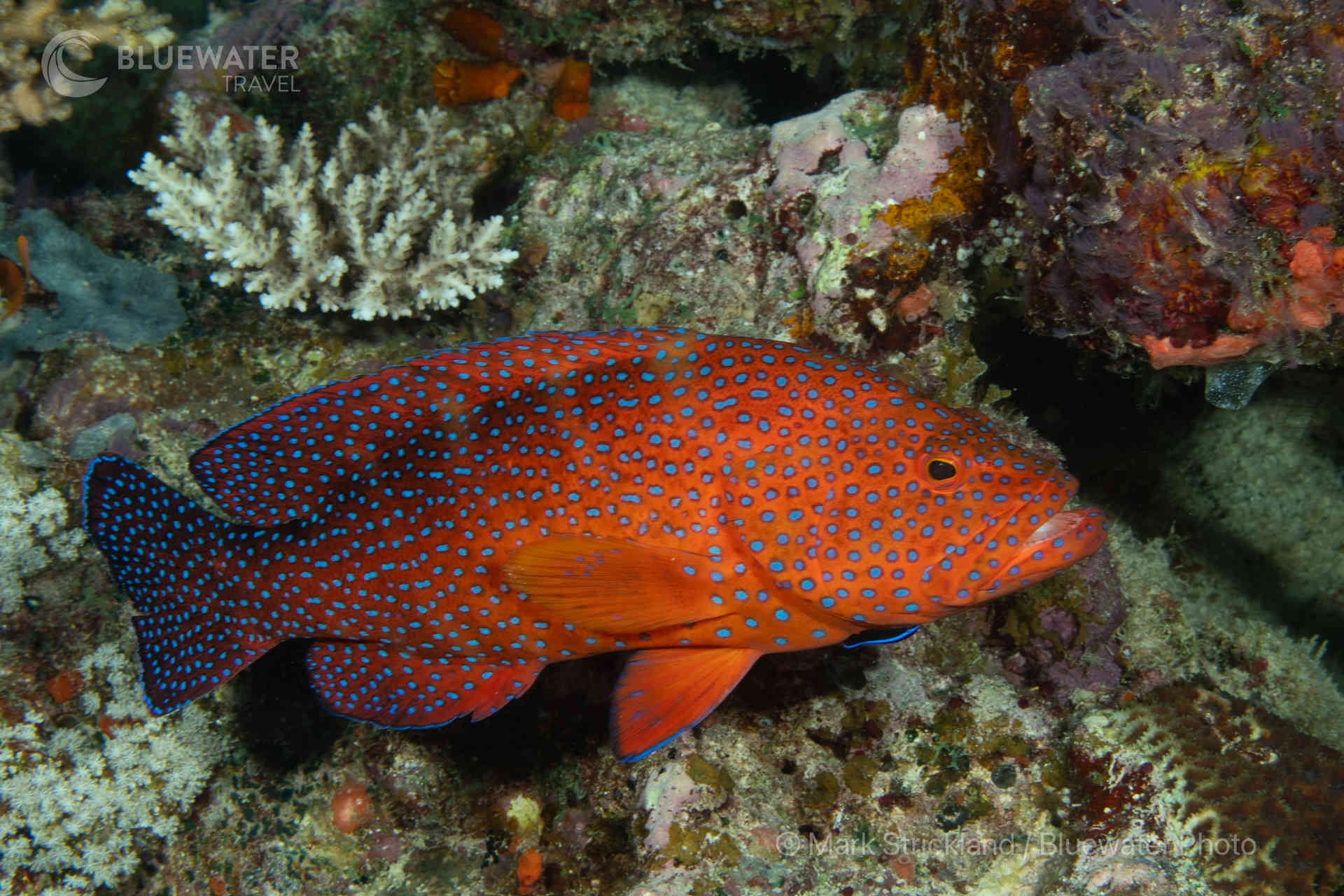
Amazed by the stunning corals? Check out our list of the Best Coral Reefs in the World!
Namena Marine Reserve: The Pinnacles and Reefs
After an overnight passage to Namena Marine Reserve, our second diving day started by alternating between several neighboring dive sites, including Tetons, Magic Mushrooms, and Two Thumbs Up. All are excellent sites with very similar topography, each consisting of two or more cylindrical pinnacles that rise from roughly 90 feet up to 20 or so, making for great multi-level profiles. As with most such compact, high-profile sites, the preferred dive strategy starts with circumnavigating the base, then slowly corkscrewing upwards around the pinnacle, taking plenty of time to explore among the many crevices, ledges, and holes along the way. Fish life included a juvenile saddleback grouper and a pair of courting adults, a squadron of baby gray reef sharks, juvenile ribbon eel, several species of pygmy angelfish, many-spotted sweetlips, orange-streak surgeonfish, and lunar wrasse, to name just a few. Visibility was at least 100 feet on both dives, with just enough current to keep things lively, as squadrons of orange-spotted and blue-fin trevally terrorized the clouds of colorful anthias in the shallows.
We then moved to another pair of iconic sites, Kansas and Schoolhouse. Named for a large patch of beige-color leather corals at safety-stop depth that sway in the current like a field of wheat, Kansas also offers a small swim-through at roughly 40 feet that is nicely framed with colorful gorgonians, sponges, and soft corals. Reef fish here were abundant and quite relaxed, with most species allowing us to get within easy photo range. The nearby site of Schoolhouse, however, is quite different, consisting of several coral-encrusted pinnacles that are perched on the edge of a deep wall. When timed with an incoming current, this area comes alive with all kinds of schooling fish, from flowing rivers of fusiliers and bigeye jacks to pinjalo snappers and clouds of colorful bannerfish.
That afternoon, we moved to what is often the most exciting site in the area, a series of coral pinnacles and valleys that, much like Schoolhouse, rise to within safety stop depth on the edge of a very deep wall. Descending on the edge of this precipice as the current flowed in from the depths, we were almost immediately surrounded by schooling red-tooth triggerfish, bigeye jacks, and gray reef sharks, followed by several young dogtooth tuna and a handful of rainbow runners. Watching this constant parade of pelagics was mesmerizing, and it was a real temptation to go no further. But knowing that there was much more to be seen, we swam away from the wall, towards another signature feature - a huge archway that's large enough to drive a small truck through. From there, we swam along the edge of the drop-off at right angles to the considerable current to several coral-covered ridges that rise as shallow as 20 feet, making for excellent multi-level profiles. It was hard work holding position there in the shallows, but our efforts were well rewarded with varied and abundant fish life, including bannerfish, coronetfish, blue palette surgeonfish, and both emperor and semicircle angelfish. Some areas of these ridges are covered with nearly perfect hard corals; other areas are dominated by prolific soft coral colonies. The schooling fish action and stunning scenery continued until our dwindling air supply forced a reluctant return to the surface.
Night dives were offered on most evenings, and included several sightings of reef octopus, moray eels, lionfish, and sleeping pufferfish, along with an ornate ghost pipefish and many different crabs and shrimp.
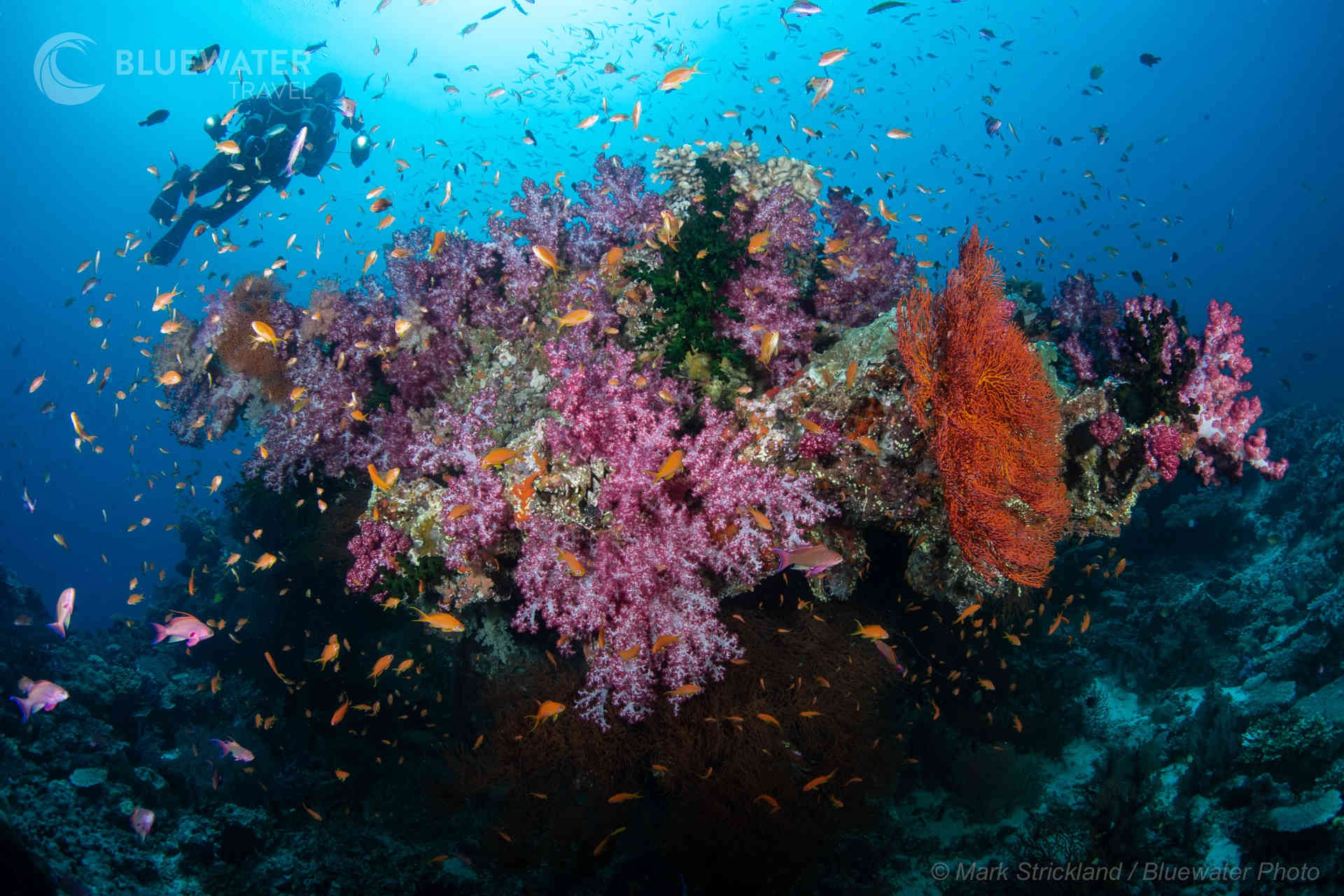
More from Namena: Magic Mushrooms and Schoolhouse
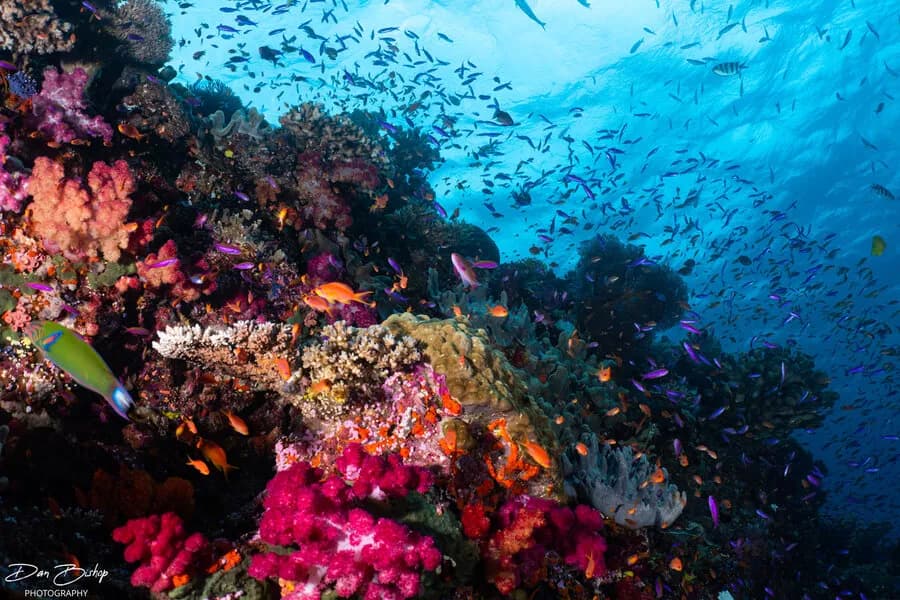
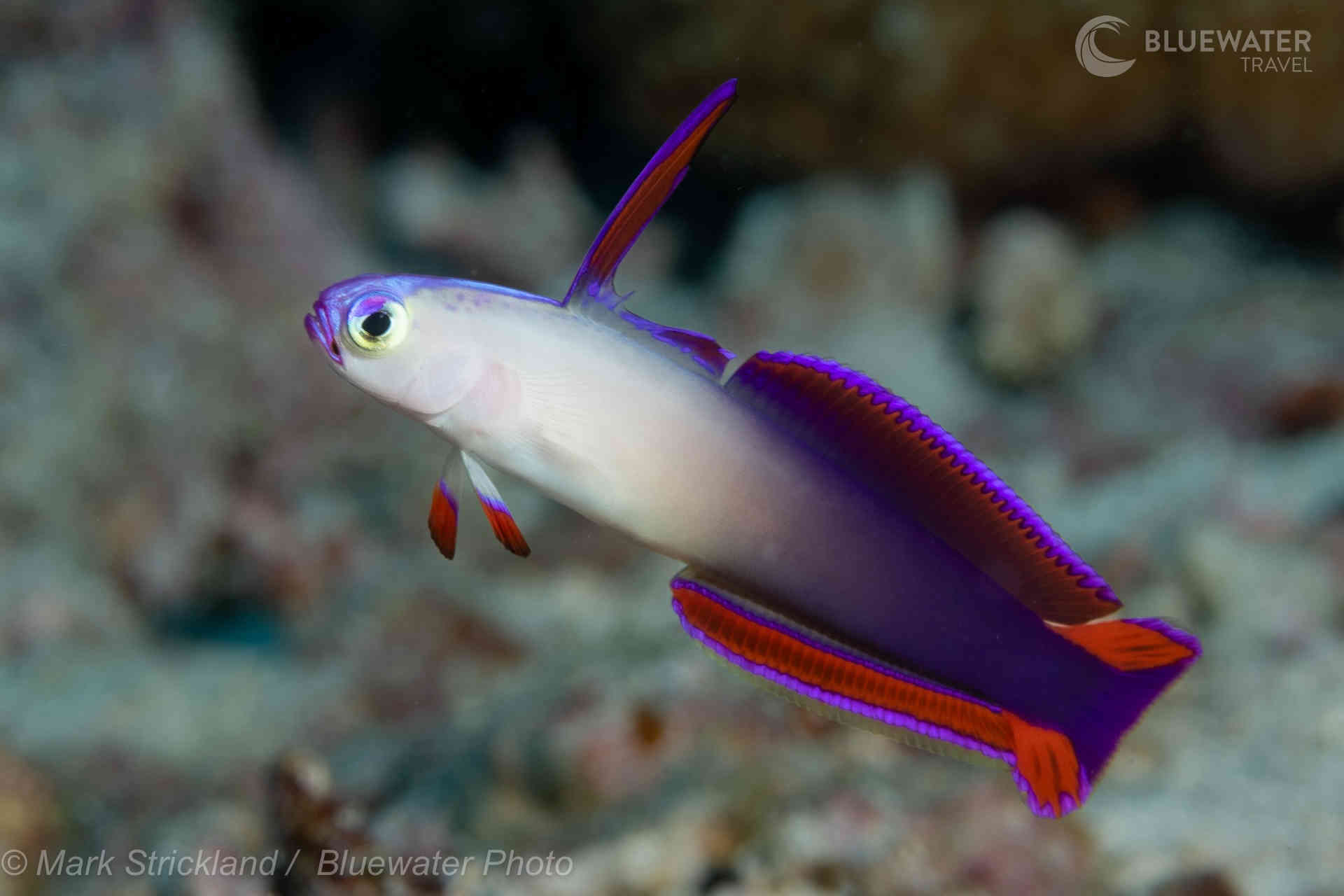
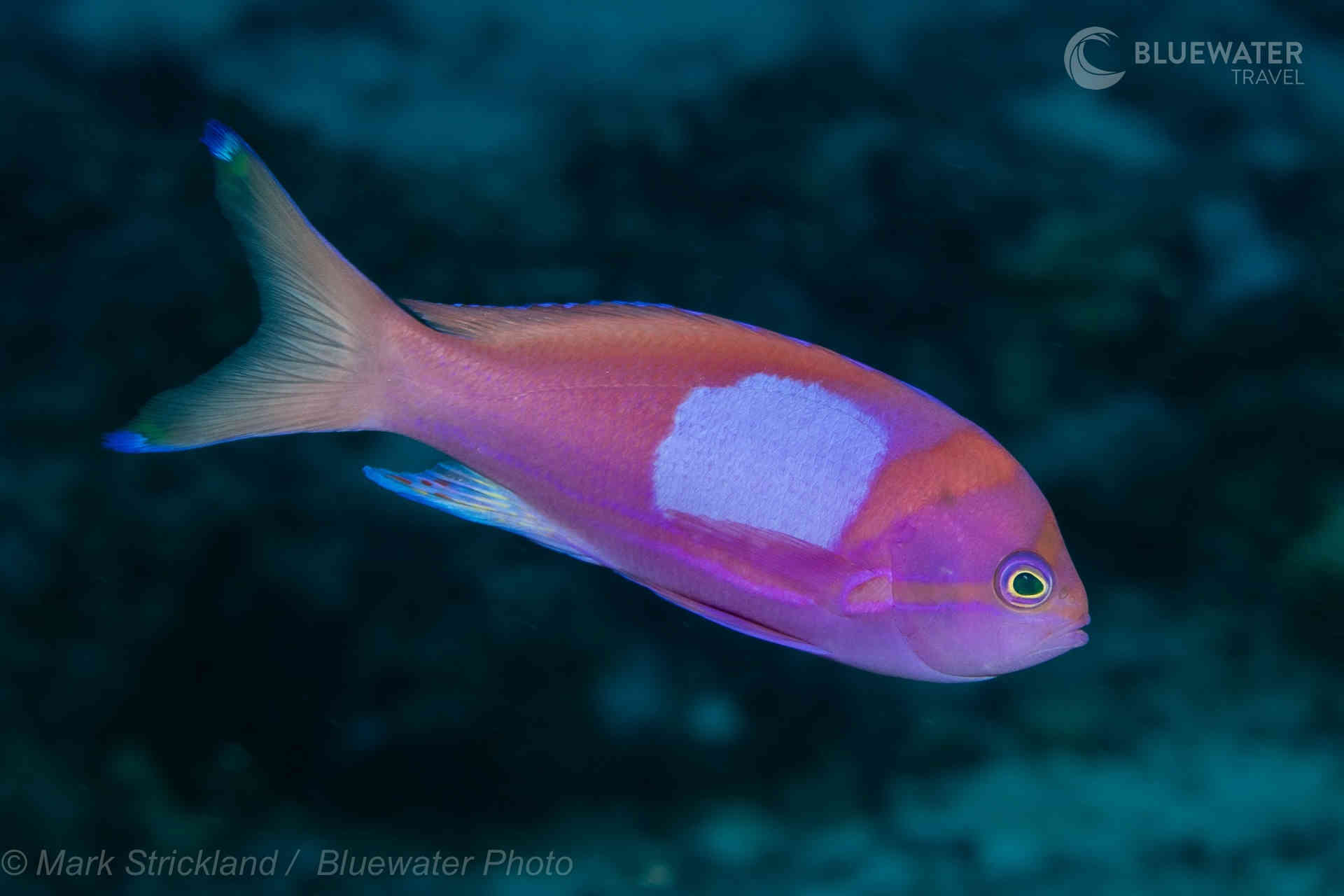
Despite overcast skies and gradually increasing wind speed, Namena continued to deliver great dives the following day as we returned to the same sites of the previous day, allowing everyone to see each site at least once. Another favorite among these was Magic Mushrooms, which consists of several small pinnacles sitting on the edge of a steep dropoff, each rising dramatically from the sea floor to small, relatively shallow plateaus. Near the edge of the wall, a dozen or so female square-spot anthias dashed about in mid-water, showing off their brilliant orange coloration, accompanied by a smaller contingent of males, which stood out even more due to their gorgeous purple hues and the distinctive pink square on their mid-bodies. Nearby, a lone decorated dartfish hovered nervously over its burrow, offering great photo ops for those with long lenses and the patience to make a slow approach. As we gradually wound our way upward around the cylindrical bommie, the scenery became even better, as nearly every inch of space was occupied by colorful gorgonians, sponges, crinoids, and soft corals, complemented by clouds of purple and yellow anthias that seemed to pulsate in the steady current. The main pinnacle tops out at about 30 feet, and is nearly covered in small, healthy hard corals and occasional anemones, which were home to both orangefin anemonefish and the endemic Fiji anemonefish.
Taking advantage of the incoming tide, we returned to Schoolhouse that afternoon, where we enjoyed 100-foot+ visibility, but had to kick steadily to avoid being swept into a less interesting area inside the reef. Descending on the edge of the wall, we were immediately greeted by a half-dozen gray reef sharks and large schools of bigeye jacks, milkfish, and pickhandle barracuda. As the name implies, the main attraction here is schooling fish, but there are also lovely soft corals and plenty of colorful reef fish.
Wakaya Island: Mantas and More
That evening, we again spent much of the night underway, moving to the island of Wakaya. Although the passage involved a bit of rock n' roll in the choppy seas, we arrived to calm seas in the shelter of the island, where we anchored up and spent the remainder of the night and all the following day. Here, the two skiffs took turns visiting several sections of the same drop-off, where a pair of coral mounds, Lion's Den and Blue Ridge, reach to within 30 feet of the surface. Both are inhabited by squadrons of cleaner wrasse and serve as a fairly reliable place to see the reef mantas that visit periodically to rid themselves of bothersome parasites. The less reliable but more scenic of these sites is known as Lion's Den, where healthy colonies of gorgonian fans line the top of the drop-off, and a wide variety of reef fish reside, as well as pickhandle barracudas and a sizeable school of pinjalo snappers. This is also where the elusive Helfrich's dartfish was last sighted about a year ago, but our efforts to find one were for naught. The main reason for coming here, however, is the possibility of mantas. The primary cleaning station is known as Blue Ridge, where both groups saw several mantas, although they were very shy, mostly staying beyond photo range. On the afternoon dive, most of the group returned to Blue Ridge and had better luck with the mantas, including one individual that returned over and over again, circling the divers in mid-water.
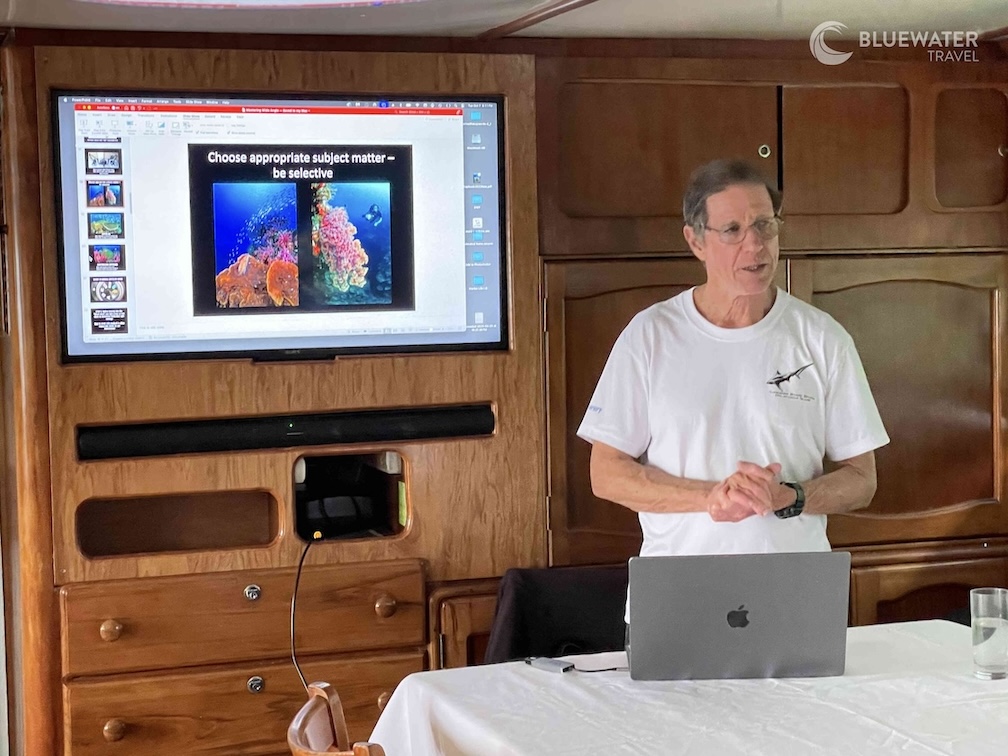
Being a photo workshop, it seemed that every spare above-water moment that didn't involve eating or sleeping had something to do with photography. In addition to all the usual rituals of lens changes, battery charging, and image editing, every day included a presentation on one photo-related topic or another. But of course, the whole point of capturing images is to share them with others, so several evenings were devoted to image reviews, allowing participants to share a few glimpses of their work with the group. These "sneak previews" were a great chance to not only celebrate successful captures, but also to consider possible improvements should a similar opportunity occur in the future.
Gau Island: Anthias Avenue, Nigali Passage, and the Village of Somo Somo
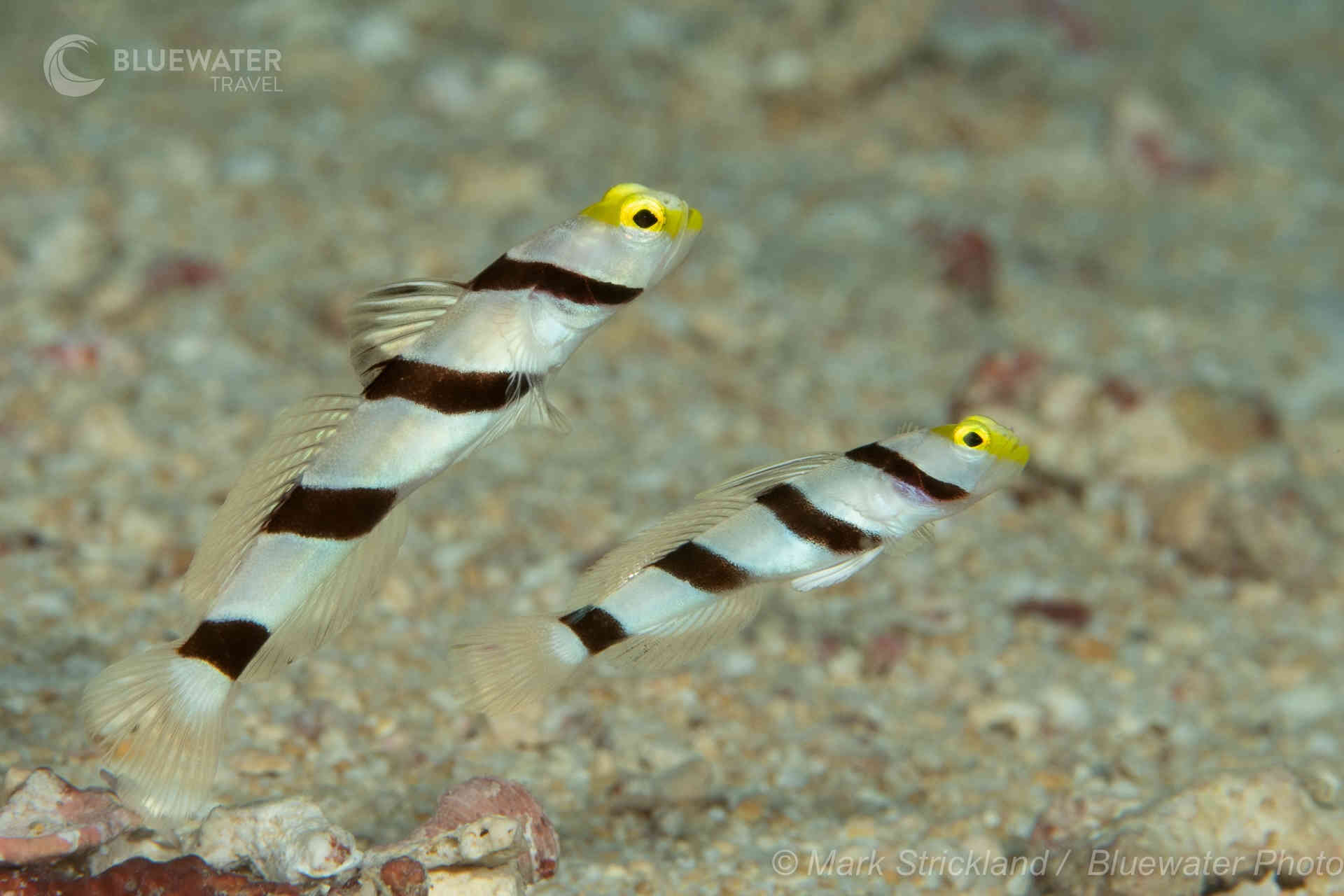
That evening, once again found us underway, this time to the island of Gau. As dawn arrived, the brisk wind continued, but the island provided good shelter, and the overcast skies that we'd seen the last few days made way for brilliant sunshine - a most welcome change. Our first dive offered a choice of Anthias Avenue and Jim's Alley, both of which consist of a cluster of pinnacles that rise from a sand bottom at roughly 80 feet to within 10 feet of the surface, with good marine life at every depth level. Visibility was stunning - at least 150 feet! In the sandy rubble, expansive fields of garden eels swayed in the current, adjacent to many pairs of gobies and shrimp, including the tiny, rarely-seen yellow nose shrimp goby. The sides and top of each pinnacle were abuzz with a wide variety of reef fish, along with passing predators like green jobfish, orange-spotted trevallies, and a sizable Spanish mackerel. The lack of current meant that the normally impressive soft corals were a fraction of their fully-inflated size, but both sites were lively and attractive nonetheless, and everyone enjoyed being able to survey all portions of the dive with virtually no effort required. Our next dive, however, at Nigali Passage, was timed specifically to coincide with a vigorous incoming current that flows through a gap in the outer reef that separates the lagoon from the open ocean. This channel starts at roughly 300 feet wide, but gradually narrows down to only 100 feet or so as you drift into the lagoon. And drift we did, as planned, allowing the increasingly vigorous current to provide a free ride. As the current whisked us along, we encountered sizeable schools of black snappers and bigeye barracuda, along with various reef fish and a white-tip reef shark or two. But the main attraction is where the channel splits in two, creating a perfect habitat for all kinds of corals and fish life. Right where the current splits is a set of small ledges at 55 feet or so, known as "The Bleachers". Following the instructions we received at the briefing, we all took our places on this ledge, which is a great observation platform for the parade of passing gray reef sharks. Then, as air and bottom time dictated, we ascended in one of the narrow channels that lead to the inner lagoon, sailing along with the increasingly vigorous current. Having ascended to roughly safety stop depth, there was one more compelling subject to be photographed before being swept into the lagoon, a massive, very healthy formation of greenish-yellow cabbage coral. As with any excellent dive, we all agreed that it would be great to dive this site again. Cruise directors Chris and Clau fully agreed, and arrangements were made to dive it again the next day.
This afternoon's activities, however, would be a departure from the usual routine, since we'd be skipping the afternoon dive in favor of a time-honored tradition on Nai'a - a shore excursion to visit the small out-island village of Somo Somo. After a quick briefing about what to expect, we all donned colorful sulus (sorongs) that were provided for us and headed ashore, where the local schoolteacher and a contingent of young kids, all dressed in their Sunday best, greeted us with big smiles and honored us with a village tour, including the church and a well-appointed one-room schoolhouse where the youngest children begin their education. We were then shown to a spacious community center, where we were welcomed with a lovely prayer, followed by a lively series of traditional songs and dancing. At one point, we were invited to join in the festivities, which several guests did with great enthusiasm. After everyone had their fill of dancing, each of us was offered coconut shells filled with kava, a mildly narcotic beverage made from the roots of a pepper plant. The appearance and taste are reminiscent of muddy water, but the effects are quite pleasant, causing a slight numbness of the lips as it is consumed. The villagers were very curious about each guest’s background, and some nice conversations ensued as we sat around the kava bowl. As the sun set, we headed back to Nai’a as our new friends stood on the beach waving goodbye.
Return to Gau’s Reefs
For our first dives of the following day, we returned to Jim's Alley and Anthias Avenue, but with each tender visiting whichever site they had not already seen. Once again, visibility was excellent - easily 100 feet or more. To the delight of some but disappointment of others, however, the current was almost non-existent, making for very easy diving, but the scenery was not as compelling as it might have been with a steady current. But there was still plenty to see, from predators like bluefin and orange-spotted trevallies to colorful wrasses, hawkfish, and butterflyfish, as well as the clouds of anthias that one of the sites was named for. And, for those with the patience to make a long, slow approach, several pairs of yellow-nose shrimp gobies darted in and out of their burrows in the surrounding sandy bottom.
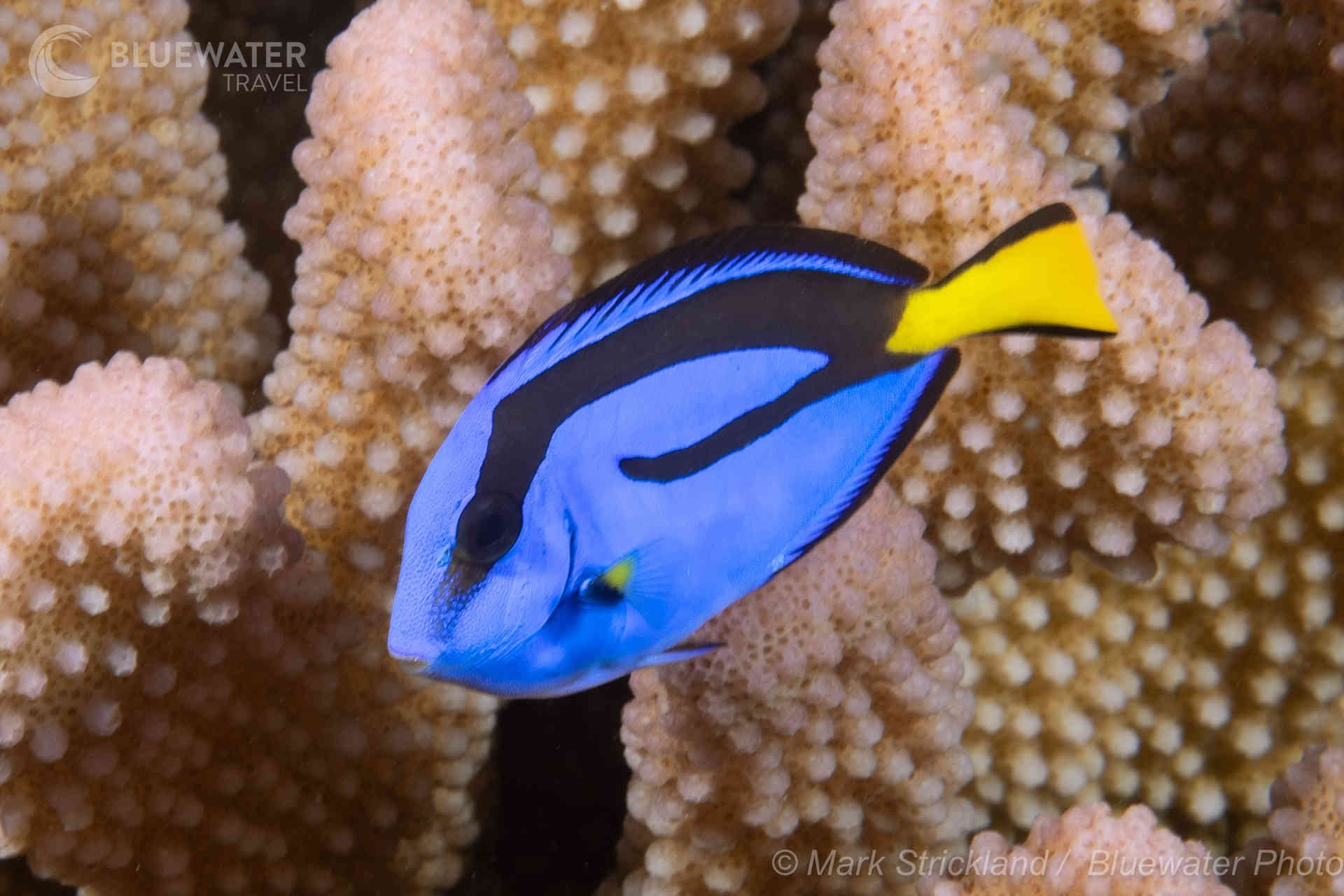
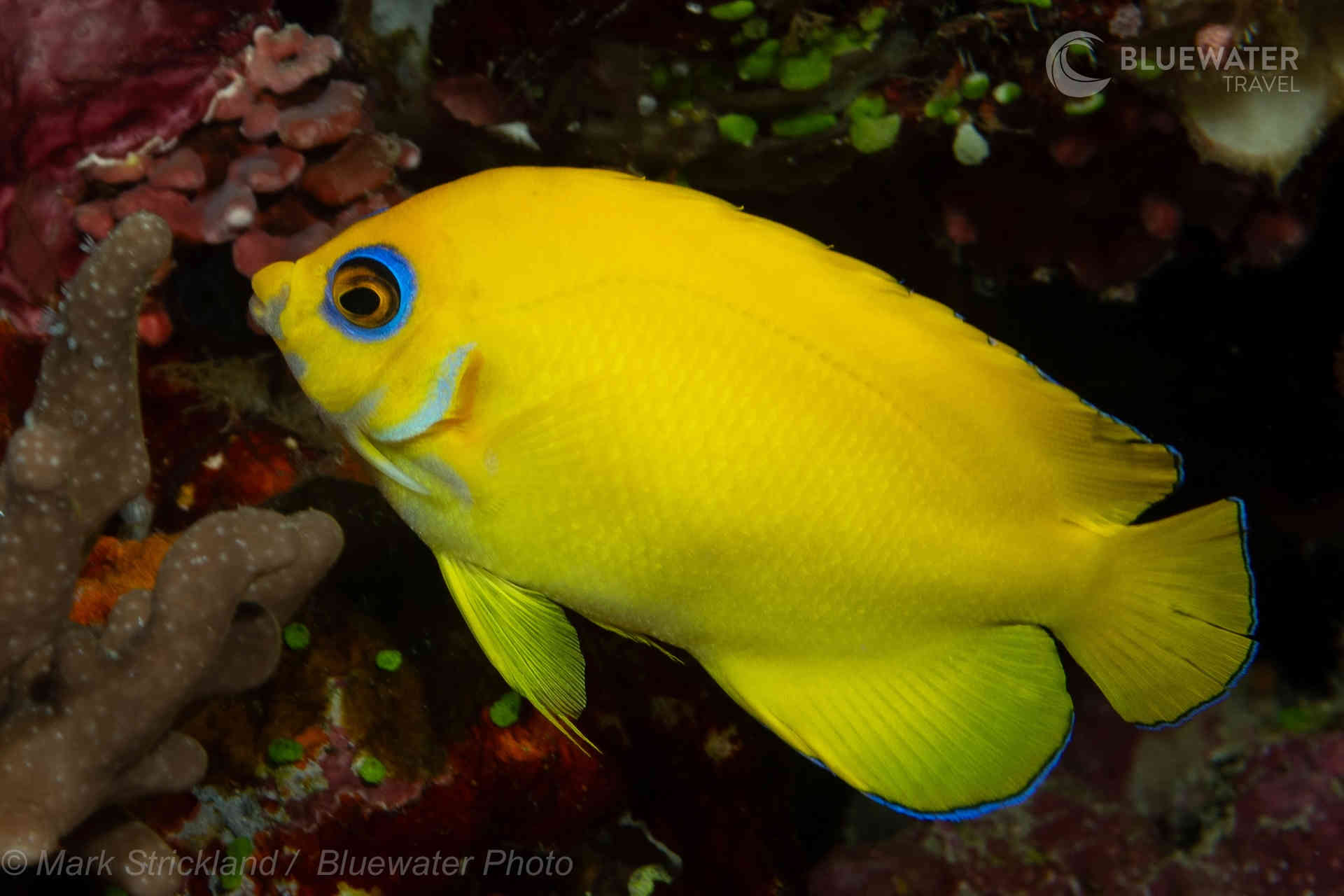
The next dive was a relatively new site for Nai'a, consisting of a coral-covered pinnacle that's perched on the edge of a deep drop-off. The offshore side plunges several hundred feet vertically into the depths, no doubt inspiring the site's name of Cliff Jump. While we did see two hawksbill turtles, the main attraction here is a great variety of small, colorful reef fish. Many of us never moved from the place we first descended, as the fish life was so abundant and approachable that we just descended to 80 or 90 feet, then slowly zig-zagged our way back up the wall. Among the notable fish species were bicolor, regal, lemonpeel, and twin-spine angelfish, longnose butterflyfish, magenta dottybacks, squarespot, and purple queen anthias, to name just a few. And, with almost no current, conditions could not have been easier.
Drift Diving at Nigali Passage
In stark contrast to the tranquil conditions on the morning dives, our afternoon dive was a return to Nigali Passage, which once again lived up to its reputation for vigorous currents. For almost all of the dive, however, no effort was required, as we just sailed along with the flow, barely needing to kick at all. The resident gray reef sharks were relatively scarce, so we only spent a few minutes at "The Bleachers," opting instead to explore among the shallow hard coral gardens while being swept into the lagoon.
After dinner and a night dive were concluded, it was time to begin another overnight passage, this time with following seas as we headed to what are arguably the most stunning reefs of the trip at the Vatu-i-ra Marine Reserve, which lies within the larger region known as Bligh Water.
The Vatu-i-ra Marine Reserve
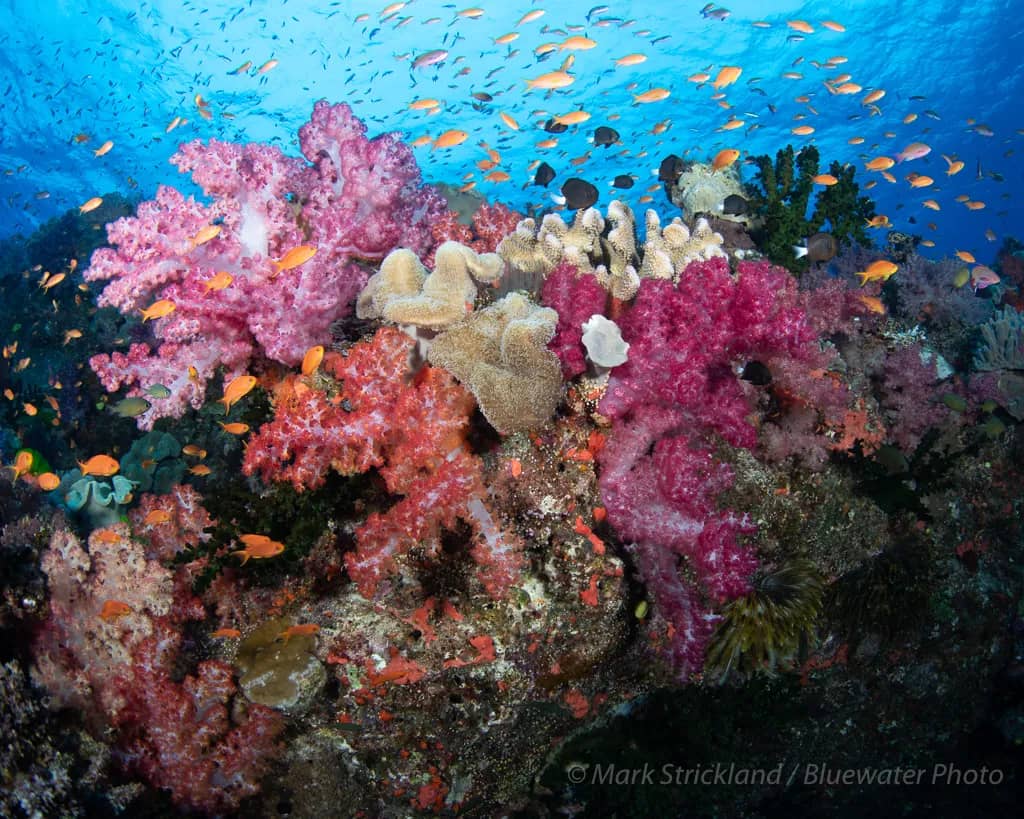
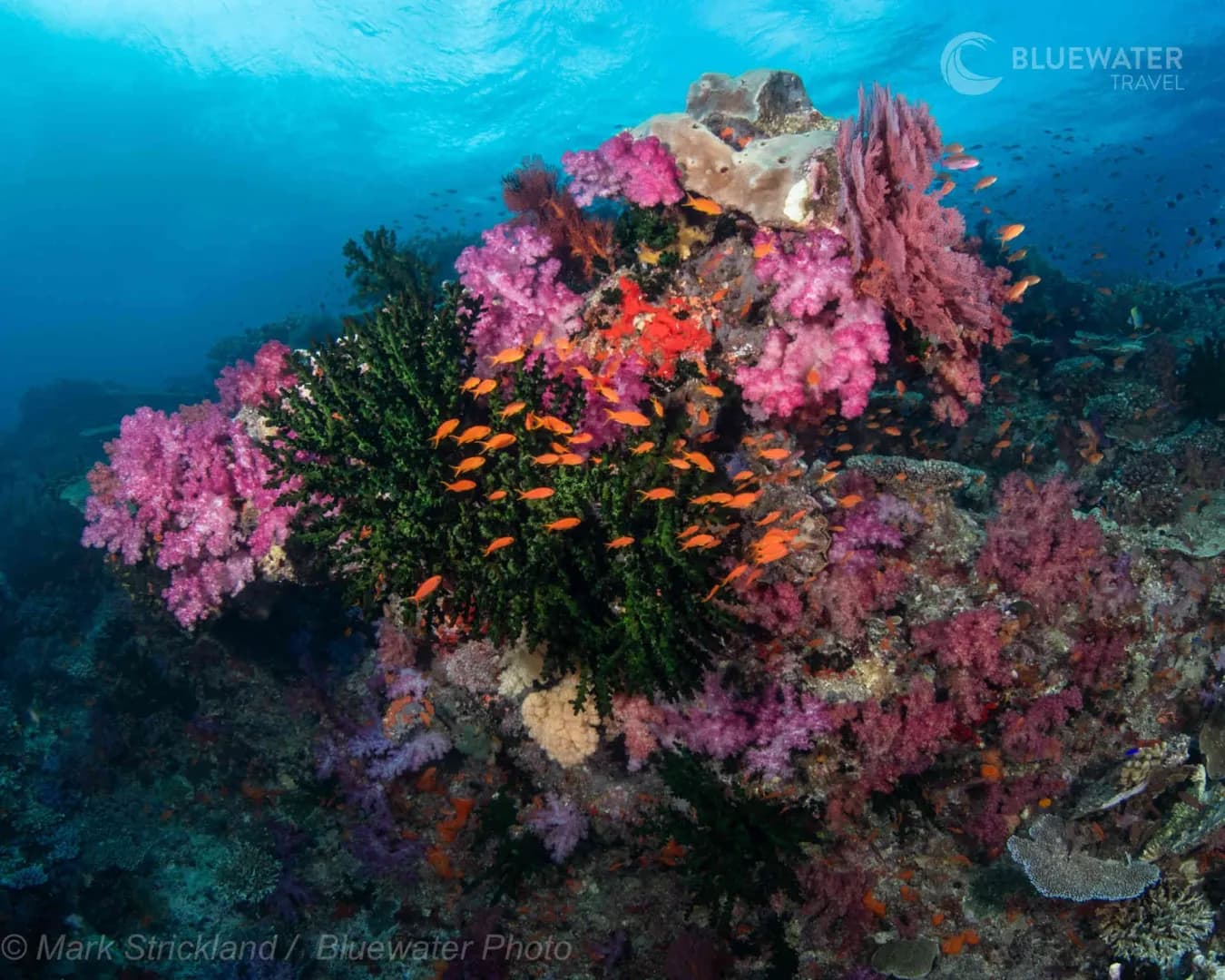
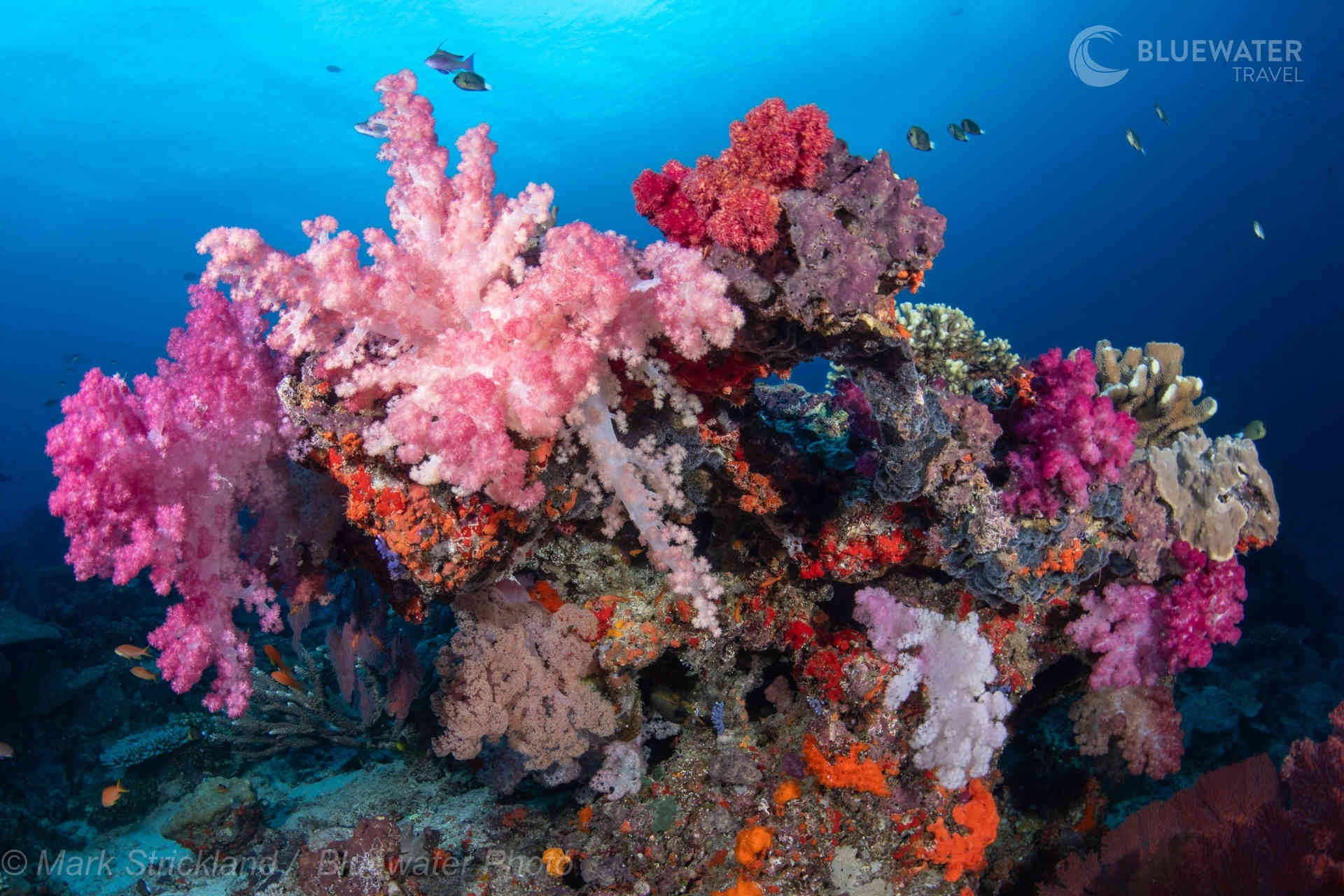
The next morning, we awoke to find that overcast, windy conditions had returned along with scattered rain showers, but the underwater world was as beautiful as ever. For the day's first dive, we visited two of this area's most celebrated sites: Mellow Yellow and Coral Corner. Like nearly all of Fiji's dives, these reefs are at their best with a steady current flowing, ensuring that the magnificent soft corals are fully inflated and fish activity is at maximum intensity. Sometimes these currents can be a bit much, but there's always the option of sheltering on the down-current side of the bommie, where there is little current. For this dive, however, the timing was perfect, as there was just enough flow to keep things lively without the need to hide from the current. At both sites, nearly every surface was covered with colonies of the translucent pink, yellow, and red Dendronepthya soft corals that Fiji is famous for. But there are also plenty of crinoids, sponges, and dark green Tubastraea hard coral trees, as well as the brilliant yellow, orange, and purple Chironepthya corals that make sites like Mount Mutiny so colorful. Reef fish were abundant at every depth level, but their activity level increased noticeably the shallower we got, culminating with an absolute frenzy among the clouds of anthias that dashed about just above the healthy hard coral-covered plateau at safety-stop depth.
For the second dive, one skiff visited an expansive, super-healthy site called Whole Shebang, while the others dived another signature site called Maytag — another compact, doorknob-shaped pinnacle named for the crazy, washing-machine-like currents that sometimes occur there. Once again, however, there was just enough current for lively fish action and stunning scenery among the fully inflated soft corals, fans, and sponges. At Whole Shebang, we started on the up-current end of a sloping reef that is home to many amazingly vibrant soft corals, gorgonian fans, and Chironephthya corals. The brisk current made it somewhat challenging to stay in one place, but it was well worth the effort, as the marine life was humming with activity. Soft corals were standing at full attention, and the clouds of anthias hovering above the coral heads were dashing frantically to and fro as they gobbled up passing bits of plankton. Before we knew it, however, this pulsating reef slope transitioned into a wall, which also featured some colorful sponges and soft corals, but it didn't come close to the beauty of the sloping reef. The current provided a free ride, allowing us to cover quite a distance before reaching the end of the reef. At this point, we all tucked into a sheltered, relatively shallow bay to do our safety stops amidst an extensive forest of hard corals of all shapes and sizes.
For the afternoon dive, those who hadn't already dived it went to Whole Shebang, while the rest visited another outstanding site that is quite similar in size and structure — Howard's Diner, named for famed underwater filmmaker Howard Hall. Here, several deep crevices in the vertical wall are crammed with huge, healthy gorgonian fans, but perhaps even more compelling are the rainbowed hues of Chironepthya and Dendronepthya soft corals clinging to almost every surface between 60 and 80 feet at the down-current tip of the reef — truly a visual feast!
While a night dive would have been possible this evening, we instead opted for another Nai'a tradition — an onboard kava party. After dinner, everyone once again donned their colorful sulus and headed for the dive deck, where the crew had already gathered with guitars, ukuleles, and various percussion instruments, along with the requisite carved wooden kava bowl. Over the course of the next hour, many stories were told, songs were sung, kava was downed, and a good time was had by guests and crew alike.
There were other healthy reefs within striking distance, but knowing that we had barely scratched the surface of the world-class sites at Vatu-i-ra, the obvious choice was to stay put for the remaining day and a half and explore this amazing area more thoroughly. Adding to the appeal, the sun finally came out to stay for the remainder of the trip, allowing us to more fully appreciate the dazzling colors and profusion of life as we repeated our favorite sites and explored new ones, such as the stunning, technicolor wall at Vatu Express.
Until the Next Dive Adventure!
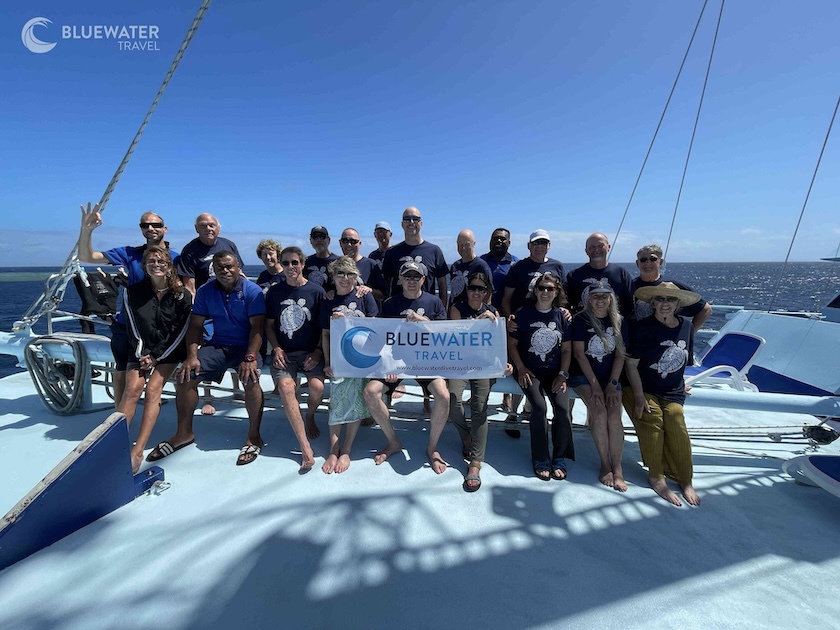
As our final dive concluded after enjoying near-perfect conditions at Coral Corner, as with previous trips here, I was filled with a strange mix of emotions — feeling sorry that it was over, but also being very grateful to have an opportunity to experience such incredible diving with a great group of like-minded souls. After another delicious dinner while steaming back to port, we all gathered for a comprehensive end-of-trip slide show, video presentations, and photo contest — yet another chance to reflect upon and celebrate Fiji's amazing underwater world. When can we go again?!
Interested in Diving in Fiji? Check out our Recommended Scuba Gear!
Download our full scuba gear guide to Fiji, Bluewater Travel guests receive 10% OFF! Click the image below to download (PDF).

- 3mm wetsuit. Browse Wetsuits at Bluewater Photo
- SMB. The Mares Dive Marker Buoy is our choice!
- Skins. Check out these sharkskins
- Snorkel gear. We recommend the Cressi ZS1 & Corsica Snorkeling Package
- Travel BCD. Read our Best Travel BCD Article
- Travel regulator. We suggest Mares Ultra 62X Dive Regulator
-optimized.webp&w=640&q=75 "Moorea Trip Recap August 2026")


-optimized-optimized.webp&w=640&q=75 "Solomon Islands Trip Recap 2026")