

$334 OFF
Special
The Junk Special Packages
4|5
Expert advice on diving,
seasons, and logistics
Free planning help
when you’re ready to book
Exclusive dive packages
tailored for you

Special

Special
Special
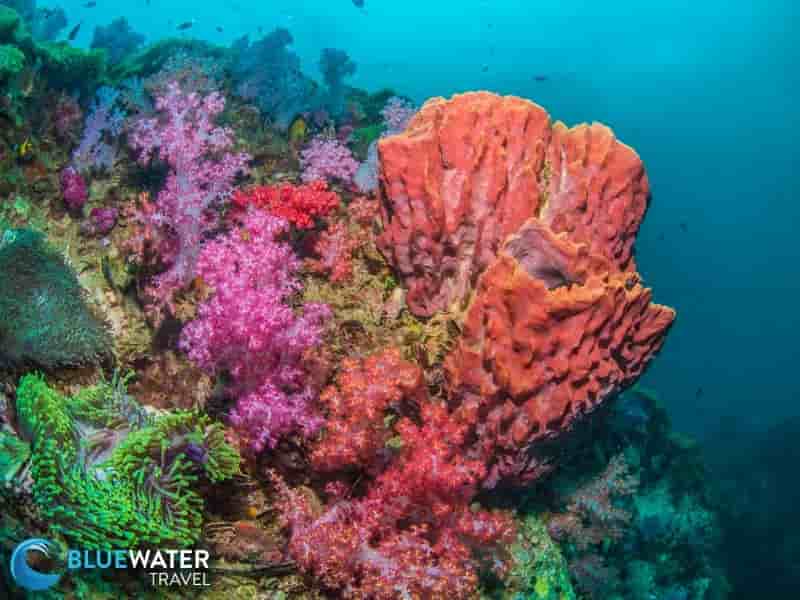
Hosting divers in both the Andaman Sea and the Gulf of Thailand from over 1200 miles of coastline, this scuba destination is a great fit for divers of any level. Scuba diving in Thailand is popular due to the opportunity to dive with whale sharks and manta rays. You can see many pelagics but also smaller fish and critters. Many dive sites have beautiful hard and soft coral and abundant marine life.


Thailand dive schools have a great reputation, which is why it is also known as one of the best destinations to learn scuba diving or develop new skills as a certified diver. A combination of big and small marine life, wrecks and dive sites for a variety of levels makes Thailand one of the best scuba diving destinations in Southeast Asia.
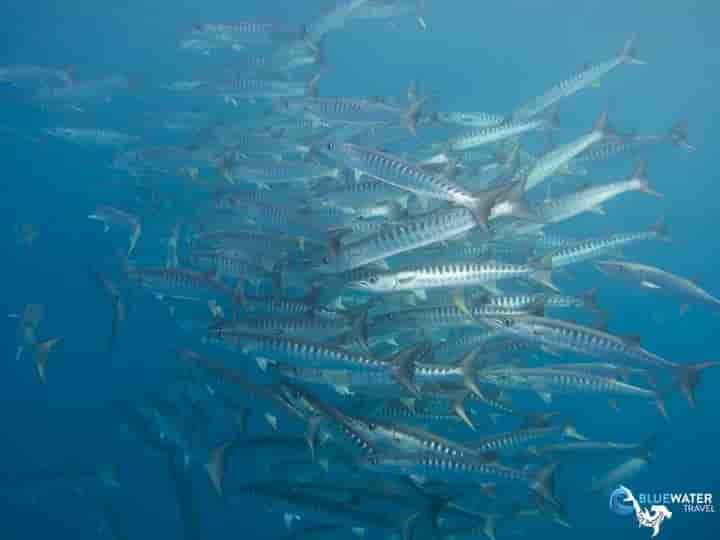
On our last Similan and Surin liveaboard we had classic Andaman conditions – 20–30 m viz, four dives a day and long, relaxed drifts along seamounts like Koh Bon and Richelieu Rock. One morning we spent an entire safety stop in the middle of a barracuda tornado; another dive we had a manta circling the cleaning station for almost 20 minutes. On the Gulf side we’ve had very different, but equally fun days – shorter boat rides from Koh Tao, easy training dives mixed with deeper trips to Chumphon Pinnacle and Sail Rock, and whale shark surprises when the plankton lines up.
Can't wait to start planning your trip to Thailand? Get in touch with us to help you plan your trip!
Head to the Gulf of Thailand to visit the small island of Koh Tao - the perfect place to try scuba diving for the first time, get your dive certification, or hone your skills underwater. While neighbouring Koh Phangan is infamous for its full moon parties and Koh Samui has long been a favourite of backpackers and luxury travellers, Koh Tao is the hotspot for scuba diving in the region.


People flock to Koh Tao to begin their underwater journeys and get scuba certified, earning the island a reputation for its great dive schools. With easy conditions, beautiful dive sites, and inexpensive dive courses, it's hard to find a better place to learn to scuba dive or continue your dive education. Diving in Koh Tao is done by boat to various dive sites surrounding the island. Expect good visibility and encounters with colourful reef fish, turtles, barracuda, and macro critters such as nudibranchs, shrimps, and crabs. Lucky divers may even meet a whale shark!
For a comfortable stay near Koh Tao’s main dive sites, consider the Koh Tao Montra Resort, offering modern amenities and easy beach access. Local operators such as Coral Grand Divers run both beginner and advanced trips, including reef dives and trips to signature sites like Chumphon Pinnacle and Sail Rock.
You may also want to check out our list of the Best Liveaboard Destinations for Beginner Scuba Divers.
Booking with us is free
Trusted by 10,000+ Divers worldwide
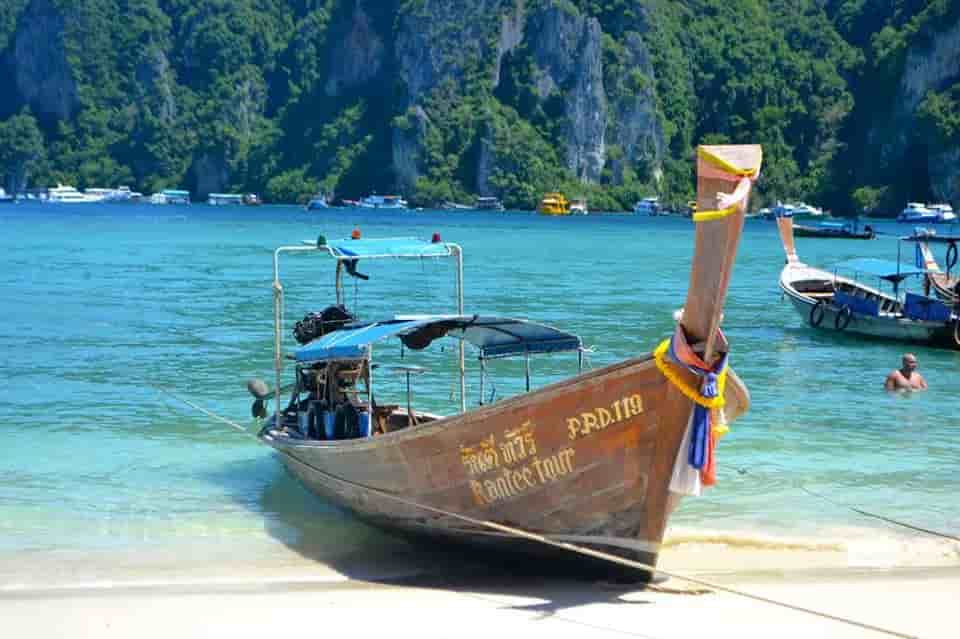
Visit Thailand's west coast white-sand paradise, the Koh Phi Phi Islands, to experience land-based diving in the Andaman Sea. Shortly after the movie "The Beach" was released in 2000, Koh Phi Phi Don soared in popularity among backpackers and gained a reputation as a party island. However, the island boasts a variety of accommodation options from budget to luxury and attracts all types of tourists seeking picture-perfect white-sand beaches and clear blue waters. Phi Phi is mostly dived from land-based operations, however, some liveaboards offer short itineraries around the islands.


Expect to encounter leopard sharks as you explore the dive sites surrounding the Phi Phi Islands, and if you're lucky, you could also see whale sharks and manta rays. Turtles, barracuda, reef sharks, and moray eels are common sightings. Look for macro life on the reefs, where seahorses camouflage and peacock mantis shrimp dart in and out of crevices. Travel by boat to various Phi Phi dive sites boasting beautiful corals and fascinating rock formations. Conditions are suitable for divers of all experience levels, so it's a great place to get your scuba certification or explore deeper dive sites if you're more experienced.
Travel further south on Thailand's west coast to the small, idyllic island of Koh Lipe to escape the crowds and explore less frequented dive sites. Stay at a budget hostel, a luxury pool villa, or any of a range of accommodation options. Embrace the barefoot lifestyle on picturesque white sand beaches straight from a postcard and dive into the protected dive sites surrounding the island.

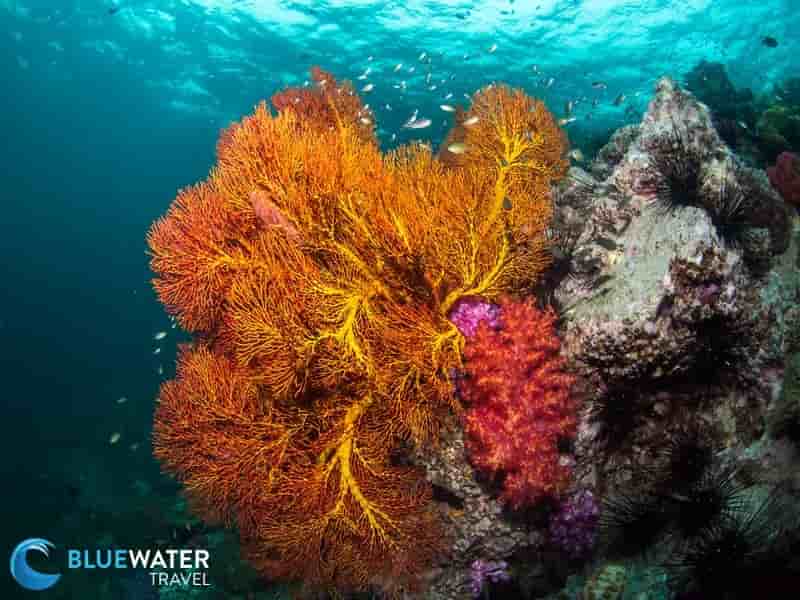
With fewer visitors than Koh Phi Phi and Phuket, the coral reefs around Koh Lipe are better preserved, which makes it a fantastic diving destination. Dive sites around Koh Lipe boast some of Asia's most beautiful soft corals. Koh Lipe is part of the Tarutao National Marine Park, home to many dive sites suitable for divers of all experience levels. Expect to see various tropical fish species, turtles, and dolphins. If you're really lucky, you could even see dugongs and sperm whales! Besides amazing marine life, it also has nice pinnacles and rock formations. Boat diving from land-based operators is the norm in Koh Lipe, and dive sites are reachable within 20-60 minutes. Some liveaboards offer itineraries that include Koh Lipe.
For another great whale destination, check out diving in the Dominican Republic.
Embark on a liveaboard to the Surin Islands, a remote region in the Andaman Sea that is protected by the UNESCO Environmental Program. Choose from a range of liveaboards from low-budget to ultra-luxurious, with most itineraries between four and seven nights.


The Surin Islands' dive sites boast amazing hard coral diversity and bountiful soft coral and are rich in marine life. The remote islands are not as popular among tourists, so you can find some fish species here that you cannot see in other dive destinations in Thailand. You might spot bump head parrotfish, Napoleon wrasse, tomato anemonefish, yellow-masked angelfish, and barramundi. The Surin Islands can be explored by dive liveaboards that mostly run from October to early May. The Mu Ko Surin Marine National Park is closed to divers for the rest of the year.
New to liveaboards? Let's help you get started with our Guide to Liveaboard Diving.
Dive into Thailand's most renowned dive sites around the Similan Islands in the Andaman Sea. Visit the famed Richelieu Rock, a dive site on our list of Top 20 Dive Sites in the World. Join a liveaboard out of Phuket to explore the region on a four to seven-night itinerary.


A dive liveaboard is the best way to get the most out of Similan Islands diving. Abundant marine life, big pelagics, soft and hard coral, easy diving conditions, warm waters, and relatively good visibility are reasons many scuba divers are fond of this destination. There are also plenty of macro subjects, but most divers visit the islands to look for manta rays and whale sharks. Moreover, you can see a number of shark species when scuba diving in the Similan Islands.
Interested in diving in the Similan Islands? You can read more about the destination from our Similan Islands Dive Travel Guide or Similan Islands Liveaboards page.
Diving in Phuket gives scuba divers many options. You can find some secluded luxurious dive resorts or budget-friendly accommodations, make some day trips to the local reefs, or hop on a liveaboard and let local Thai divers show you some of the best dive sites in Thailand.


Phuket has great sites for experienced divers and options for total beginners to start their diving journey. When diving in Phuket, you can find some great deep drop-offs, pinnacles covered with coral, some caverns and caves, and even some wrecks. The marine life around Phuket ranges from big animals to small creatures. You can meet manta rays, whale sharks, and leopard sharks, but also anemone fish, harlequin shrimp, and ghost ornate pipefish to name a few.
Pattaya is popular with Bangkok residents due to its seaside location, a mere two-hour drive from Thailand's biggest city. Don't mistake Pattaya for a quiet seaside town; it's a large city with pros and cons. The biggest 'pro' is that there is scuba diving in the area, and if you can't make it to the more popular dive regions or just want to sneak in a couple of days of diving on a short trip to Thailand, Pattaya is a convenient option.


Scuba diving in Pattaya is known for its excellent wreck dives and nice coral dive sites. One of the most famous coral dive sites is at Koh Man Wichai, where the coral resembles a giant hand and thus has been named as the "fingers". While diving around the beautiful corals, you can spot pufferfish, stingrays, angelfish, and many more. The Pattaya wrecks are also covered with reefs, where you can spot rays, barracudas, batfish, and even sharks. The wrecks are most suitable for advanced divers, as they lay around 100ft (30m) or more.
Like nearby Koh Tao and Koh Phangan, Koh Samui is a popular holiday destination and more crowded than some other locations in Thailand. You'll find a huge range of accommodation options, from hostels to the Ritz-Carlton, food options from street markets to fine dining, and plenty of activities. Scuba diving is done by boats making day trips to the beautiful dive sites around Koh Samui and Koh Tao.


Some of the best dive sites in Thailand, like Sail Rock, are very close to Koh Samui. A highlight of diving around Koh Samui is the chance to spot whale sharks. You can also see many barracudas, turtles, jackfish, and various nudibranchs and shrimp for macro lovers. Additionally, the diving conditions in the Gulf of Thailand are great throughout the year, with calm waters and generally good visibility.
Many scuba divers will say these are their favourite dive sites. They offer great wall dives and caverns, as well as big pelagics and lots of other beautiful marine life. You may even spot manta rays and whale sharks here. Colourful soft corals are all around, and you can see many schools of fish. Be aware that the currents can be strong; thus, it is recommended for more advanced divers. Both of the dive sites are located outside of the Similan Islands.
If you love sharks, then this is the spot for you! Located about a 90-minute boat ride away from Phuket, the dive site is home to many leopard and bamboo sharks. Besides great shark diving, there are lots of other marine life to see, like moray eels, seahorses, snake eels, mantis shrimp, and more.Plus, the dive site has three main pinnacles covered withsoft and hard coral and anemones.
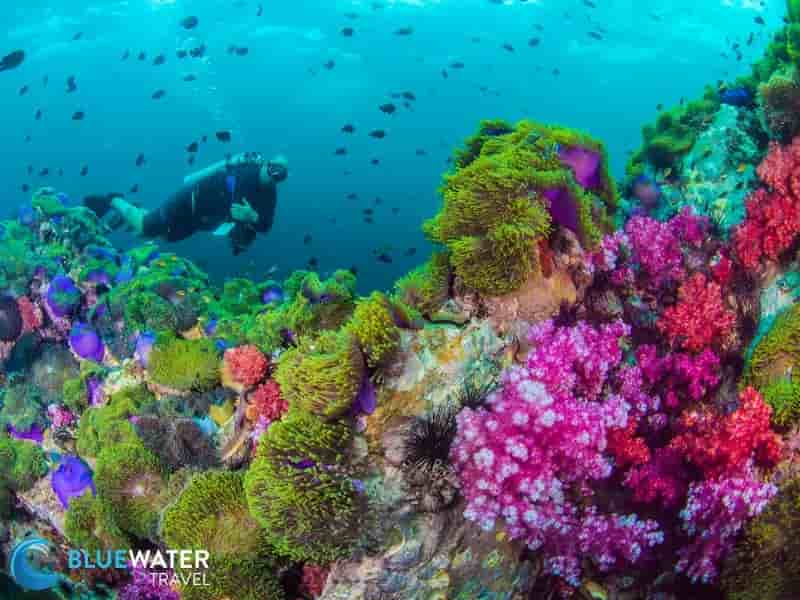
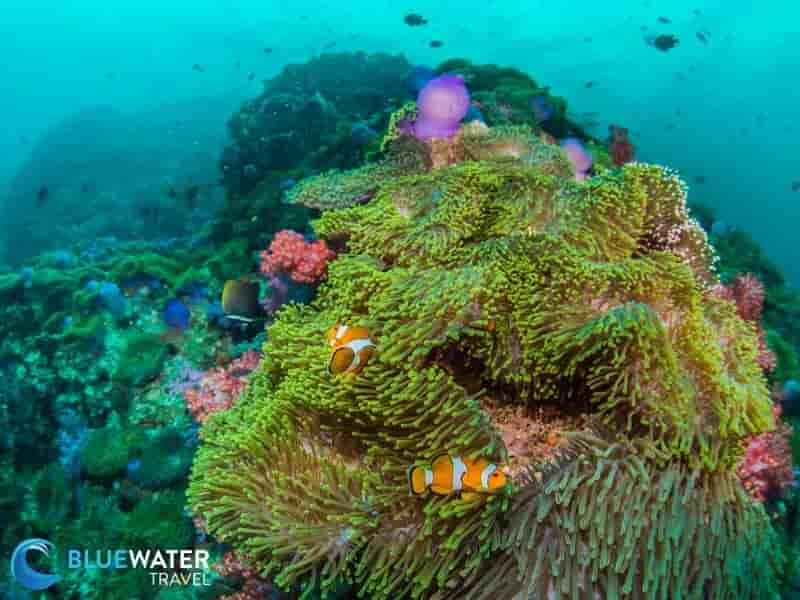
As the name says, you can expect to dive past beautiful blue and green coloured anemones. As part of a marine sanctuary, Anemone Reefs' marine life is very colourful. The site itself lies near Shark Point, which is why you can encounter reef sharks and leopard sharks at the dive site. Besides the sharks, you can spot some turtles, giant moray eels, lionfish, and even some seahorses, nudibranchs, and porcelain crabs for macro lovers. Along the anemones, you can see some beautiful soft pink and purple corals.
Check out our guide to diving Alor's Anemone Valley.The dive site is located between Surin & Similan Islands and is the best place to see schools of barracudas, many tropical fish, whale sharks, and manta rays. Because of nutrient full planktons, there is a high chance to scuba dive with whale sharks. The dive site is a horseshoe-shaped rock covered with soft corals, anemones, sea fans, and sponges. The dive spot attracts lots of marine life, and you may see cuttlefish, seahorses, and pipefish, just to name a few.
One of the most popular dive sites in Koh Tao, this huge pinnacle is covered with pink anemones, where pink anemonefish come around, as well as some scorpionfish, moray eels, crabs, and shrimp. Besides them, along the pinnacle, you can see some barracuda, bannerfish, mackerels, trevally, big-eyed jacks, and many more. Even whale sharks can make an appearance there.
Another popular dive site in Koh Tao with a rock wall drop. Being further from the main island and away from the masses, it attracts abundant marine life. Batfish, soldierfish, crabs, giant groupers, giant moray eels, blue spotted trout, and nudibranchs are just a few examples of marine life you might see. What is special about this dive site is that you can actually dive inside a rock! There is an interesting swim-through called the chimney, which is very fun to dive, but it is more suitable for experienced divers, who have good buoyancy control.
Laying at a depth of 100ft (30m), this wreck is surrounded by colourful marine life and is considered one of Thailand's best wrecks. It has three canons, cabins, and rooms to explore and to see its many resident fish. You can spot groupers, snappers, sweetlips, barracudas, blennies, moray eels, butterflyfish, and more.

The Southeast Asian country with a tropical climate and warm waters is known best for its beautiful white-sand beaches, stunning temples, rich culture, and delicious food. It is not hard to guess why many people are attracted to visit Thailand. Most of the best scuba diving sites are in the southeast of Thailand, in the Andaman Sea. On the east coast, on the Gulf of Thailand, lies Koh Tao, one of the most popular destinations for dive certifications.

All around Thailand, you can find diverse marine life and beautiful corals. The destination offers many opportunities for scuba divers to dive at beautiful reefs, explore wrecks, deep drop-offs, caverns, pinnacles, walls, and tunnels. Besides scuba diving, Thailand offers plenty of topside activities. Some of the islands offer great nightlife, while some others are quieter and great for relaxing.
In general, the Andaman Sea boasts a larger variety of fish species and coral. As to what you can expect to see - the coastline and islands stretch over a large distance so it greatly depends on where you choose to dive. Manta rays, whale sharks, black/white tips, and turtles are just a few of the "big things" to expect. Not only a great destination to see big fish, but Thailand also has many macro photography subjects.
Here is a list of the marine animals you are likely to see when diving Thailand's best dive spots:
Many of Thailand’s top sites lie inside marine parks and protected areas such as Mu Koh Similan, Mu Koh Surin and local sanctuaries around Phuket and Krabi. Operators must follow park rules on moorings, group sizes and approach distances, and good buoyancy plus a strict no‑touch, no‑chase approach to marine life are essential to keep these reefs and animals in good condition.
Thailand currently has six international airports, with Suvarnabhumi International Airport (BKK) in Bangkok serving as the main gateway. Other international airports include Don Mueang International Airport (DMK, Bangkok), Chiang Mai International Airport (CNX), Phuket International Airport (HKT), Krabi International Airport (KBV), and Hat Yai International Airport (HDY). From Bangkok, it is easy to connect to domestic and regional destinations across the country.
Looking for another hot dive destination in Southeast Asia? Read about scuba diving in Indonesia.
Liveaboards are available to explore the Andaman Sea and Similan Islands and reach dive sites you otherwise can't reach. Thus, liveaboard diving would be the best option for getting the most out of diving in Thailand. Otherwise, there are also dive resorts available around Thailand. The best resort destinations are Phuket, Phi Phi Islands, and Khao Lak.

For a great diving option, check our the M/V Hallelujah.
Within the Gulf of Thailand, diving is available almost year-round. November is the beginning of the monsoon season in which visibility drops and heavy rainstorms can occur but by the mid/end of December things typically have gone back to normal. On the Andaman side, dive times are more limited. Some areas are only available to dive parts of the year (like the Similians and Koh Lanta). In general October - April is the best time to dive the Andaman Sea.
You can try to "island-hop" to different destinations by comparing their offerings. Every island has its own personality, so certain islands would fit best depending on what you are looking for. Looking for a night out in the town? Koh Phi Phi on the Andaman side or Koh Tao in the gulf would be a good start. Prefer a relaxing evening instead? The Andamans, Koh Lanta, or Koh Samui in the Gulf could be better alternatives.


Thailand is known for its beautiful beaches and some impressive temples. Don't forget to visit the famous Grand Palace or Temple of the Emerald Buddha. Some of the other things to do are to see the Muay Thai boxing match, visit a floating market, go hiking, or discover their beautiful nature. Moreover, get all your tension out with a proper Thai massage. In case you have never tried a Thai massage, then just a heads up, don't expect it to be relaxing, but for sure, it will make you feel much better afterward!
Yes. Areas such as Koh Tao, Koh Samui and many Phuket day‑trip sites have sheltered reefs and easy conditions that are ideal for learning or refreshing skills. More advanced sites like Hin Daeng/Hin Muang, Richelieu Rock and some wrecks are better for divers with experience in current and deeper water.
A liveaboard is the best way to experience the Similan and Surin Islands and the more remote Andaman sites, with multiple dives a day and minimal transit time. If you prefer to sleep on land or are combining diving with a wider holiday, resort‑based diving around Phuket, Phi Phi, Khao Lak, Koh Tao, Samui or Pattaya works very well.
Thailand can be dived year‑round. Broadly speaking, the Andaman Sea (Similans, Surins, Phuket, Phi Phi, Koh Lipe) is best from around October to April, while the Gulf of Thailand (Koh Tao, Samui, Sail Rock) often has its best conditions from roughly May to September. Weather varies by year, so it’s worth matching your dates to the region you’re most interested in.
Yes, but sightings are never guaranteed. Whale sharks are most often seen at sites such as Richelieu Rock, Chumphon Pinnacle and Sail Rock, and manta rays at locations like Koh Bon, Koh Tachai, Hin Daeng and Hin Muang, mainly during the main Andaman season from about November to April.
Standard tropical dive kit is fine: a 3 mm full suit works for most divers year‑round. For the more advanced sites with current, an SMB and reel are strongly recommended, and having at least Advanced Open Water or equivalent will let you enjoy more of the deeper and more challenging dives.
You can now buy all the best scuba gear with Bluewater! Check out our wide selection of the top rated dive equipment, including Tusa dive masks, Aqualung Titan regulators, Mares BCDs, and more!
Check out these useful resources from our sister websites, Bluewater Photo, and Underwater Photography Guide
Southeast Asia's Best Underwater Photography Destinations
Top 10 Macro Photography Destinations
Booking with us is free
Trusted by 10,000+ Divers worldwide


T'Lane Spanos, CFO of Bluewater Travel and Bluewater Photo & Scuba, brings a dynamic blend of finance expertise and adventurous spirit to her role. Raised on a cotton farm in land-locked Kansas, T'Lane always had big dreams that led her to explore the world. As an avid adventurer, she thrives on exploration both above and below the water. She finds immense joy in diving adventures and has a particular passion for African safaris. Equipped with her trusty Sony A7CR camera, she loves capturing the beauty of her journeys.
In her spare time, T'Lane dabbles in acting and enjoys creating abstract paintings. She also enjoys exercising to stay fit for her next adventure. T'Lane is truly grateful to integrate her love for scuba diving, travel, and safaris with her work. It allows her to meet different people from all over the world. Forming new connections is something she cherishes.
Her top three adventures thus far include:
Thailand is not on many seasoned dive travelers bucket list, but here are a few reasons why it should be:- world class dive sites like Richelieu Rock in the Similan Islands, King Cruiser wreck in Koh Phi Phi, and the pinnacles of Hin Daeng and Hin Muang- go in the right season (Dec to Mar) and you should see a ton of marine life including big schools of jack and barracuda, whale sharks, mantas and many more- good for macro and wide angle- really friendly people and amazing thai food- great beaches, isolated islands, and fun cities to visit before or after scuba diving- very affordable and easy on the pocketI was on a liveaboard trip and that is the best way to dive Thailand as most of the thai best dive sites are a long commute from land.
My review is for diving in Kohn Phi Phi.The island is full of dive operations. Great choice prices are the same so pick one you like.Unfortunately I was there during rainy season and boat rides were rough but once under water it is one of the prettiest places to dive. Visibility was not as good as during the winter time, so I was told but otherwise a really good experience.The nice thing about Phi Phi is that once you are done diving seafood and beers are waiting on every corner
Similan Islands, Thailand.The Similan Island National Park ( Named for ‘Sembilan’, meaning nine in a local dialect of Malay) is made up of 9 islands arranged roughly 80kms North of the heaving holiday mecca of Phuket on the Eastern seaboard of the Isthmus of Thailand. The Islands of the main group are generally referred to as numbers 1-9 – though also have Thai names – with numbers 1,2 & 3 in the South closed for diving to allow for turtle hatching. Diving in the group is characterised by two distinct environments:The East coast with slopes down to 30 metres, plenty of hard coral and gentle-to-no currents. Large bommies covered in soft coral and schools of small fish dot the sandy sea floor with some such as ‘Hin Muan Daew (Roll of film) on Anita’s Reef attracting celebrity status for exhausting diver’s entire roll of exposures back in the days of shooting film. It really was that good, too.The West coast is exposed to the Indian Ocean and features dramatic piles of enormous granite boulders covered in healthy soft corals and giant fans tumbling down to the sea bed at 30-45 metres. These exposed sites experience regular currents and offer a more adventurous dive. The currents feed the oversized corals and bring in larger and more numerous schools of fish. In addition to huge schools of smaller fish expect pelagics from Tuna to Sharks.Visibility is superb on both sides of the islands with up to 30-45 metre on my trip, and though you will be regularly gazing out into the blue do not forget to look closer at the reef: the macro life here is fantastic with Frogfish, Harlequin Shrimp & a stunning array of Nudibranchs to found amongst a host of other critters, particularly on the Eastern sites.No review of the Similans would be fair without mentioning the topside experience, which is what really sets off the whole trip. The weather in the diving season is generally warm, calm & sunny. My entire trip was bathed in sun with just the right amount of breeze for cooling down in the afternoon. And the beaches. It’d be fair to say these are some of the finest beaches I’ve seen in my time; go and sit at your computer and enter ‘Similans beaches’ into a search engine. Yep. Stunning.Longer trips to the area will usually focus on the islands of the Similans and then move North to 2 Islands, Koh Bon & Koh Tachai and then the area’s masterpiece, Richelieu Rock. The former are highly regarded for more dramatic boulder diving and the chance of Oceanic Manta Rays. Richelieu Rock, closer to the mainland, is a photographer’s lens choice nightmare. Though the proximity to land and current up-wellings reduces the visibility somewhat this horse-shoe shaped reef, draped in soft corals and packed with great macro subjects, is famous for its Whale Shark encounters.The area is best explored by one of the numerous liveaboards operating out of Khao Lak, though can also be visited as a day trip on enormous, over-powered speedboats from the mainland. I have read reports of accidents with these boats due to overconfidence in rough weather and heard first hand reports of long and uncomfortable journeys, though I imagine it would be great fun in fine weather.In season there is a glut of operators offering liveaboards from cheap & cheerful through to all expenses paid luxury, anywhere from overnight trips up to a whole week. I was on a 5 night, 4 day cruise and would definitely pick this length of trip again. Any shorter would rob you of time in either the Similans or the Islands further North, while I feel any longer would have resulted in spending too long for the variety on offer.Finally, though probably not superior to some of the trips I have taken further south in the ‘Coral Triangle’, you cannot look past Thailand for relaxing and enjoyable topside experience. I travelled from Koh Tao, on the East Coast of Thailand, and thoroughly enjoyed every second of the journey; particularly as the last 60-100kms travel through the stunning hills of the Khao Sok National Park.
My four F’s for choosing a holiday destination:• Fun for all• Friendly people• Fantastic value• Photographers dreamThe last ones a stretch but I am taking it!Where you ask? Thailand of course!Boring! I hear you say. It has been done to death, but hear me out.I myself was of the same opinion, having travelled from north to south and everywhere in between, that was until I found Koh Lanta.Selfishly I was going there for the diving, but my wife (non diver) was of the same opinion. The mixture of cheap and expensive accommodation and super friendly staff gave the island a casual back packer feel but with the mod cons if you wanted them.Getting there?Fly via Bangkok into Krabi, mini bus transfer 2- 3 hoursTime to go?Peak time is November to March where everything is in full swing and the weather is at its driest. Personally I prefer to go in the shoulder season of either April or October as the accommodation is usually cheaper and more available, and the towns a little more sedate. You might cop the occasional wet season down pour, but if your reading this I am sure getting wet is never a problem! Off season many places close down and the car ferry may not operate, check before booking.Where to stay?Ban Sala Dan is the main town with modern shops and restaurants but is probably not the best place to stay.Ban Phra-Ae (Long Beach) is the most popular beach resort destination, still with plenty of restaurants, bars and shops to choose from, and only a short tuk-tuk ride into Ban Sala Dan.What to expect?Koh Lanta’s location in the Andaman Sea makes it the closest of all the islands to the world famous Koh Haa dive sites, home to everything from the smallest shrimp to the occasional whale shark.Unfortunately I was only able to squeeze in 3 days of diving but the variety of reefs, marine life, caves and swim-throughs was unbelievable, and left me wanting more and more. There is a huge range of dive sites suitable for all levels of experience, with water temperatures of 28 C and average visibility of 20 – 30m, writing this makes me wish I was back there now.Giant Moray, Sea moths, Common Lionfish, Spotted Lionfish, Scorpion fish, Cuttle fish, File fish, Squid, Cod, Banded Sea snake, Cleaner Shrimp, Mantis Shrimp, Yellow Snapper, Grouper, Rainbow runners, Trumpet fish, Barracuda, Peacock Flounder, Rock mover Wrasse, Porcupine fish, Trigger fish, Sand Lizard etc etc.These are only some of the creatures listed in my log not to mention the ones I didn’t, as well as the outstanding reefs and swimming through the iconic ‘chimney’ and ‘cathedral’ sites.Other ActivitiesThere is almost as much to do and see above the water as below it, with great beaches, hikes, food, markets and people to experience.Try your hand at the cooking school, or visit the local markets for a taste of Thai life.There is a fantastic rescue shelter running for stray cats and dogs, which you are more than encouraged to volunteer your time to help walking, cleaning feeding and even adopting these beautiful animals.
Hin Daeng and Hin MuangHin Daeng and Hin Muang are widely considered the best dive sites in Thailand outside of the Similans. Hin Daeng and Hin Muang are two dive sites on the west coast of Thailand that can be accessed by either live aboard or by day trips out of Ko Phi Phi or Ko Lanta. These two sites are best known for their frequency in Manta Ray and Whale shark sightings. Both scuba dive sites are remote deep water pinnacles. Hin Deang just barely breaks the surface, where as Hin Muang is a submerged pinnacle with its base on one side leveling out around 60 meters, and the other side is a vertical wall that plunges into a deep abyss. Both sites are more advanced sites, and Hin Muang often has relatively strong currents. Both sites are right next to each and always dived together in one trip. At both dive sites you will see huge schools of fish, pelagics, lion fish, nudibranchs, Manta Rays, whale sharks, and reef sharks. Both sites are within the boundaries of a marine park and attract a massive amount of life. The ride out to the dive diving spots can be rough, and if you are doing a day trip out of Ko Lanta/ Ko Phi Phi it will take about 2 1/2 hours to make it out to the site. Diving these two sites in Thailand on a day trip will take up an entire day. Due to the remoteness of these two sites, crowds are not something you have to worry about when scuba diving here. Anyone diving on the West coast of Thailand should not miss these two sites.
This is a very honest review of Koh Tao.As an experienced diver based in Indonesia, I found the diving in Koh Tao completely underwhelming. I only did four dives during a weeklong stay, and that was at least two more than I needed to get a good picture of the diving scene in Koh Tao. I will caveat this by explaining that the visibility was poor in late October, sometimes down to just a few meters. The four sites I visited were Red Rock, Green Rock, White Rock, and Twins. The most interesting part of the dives tended to be when we headed up for our safety stop, and there were hundreds of Christmas tree worms, which were not at all disturbed by me getting up close for a good look, unlike those in Indonesia that tend to hide if you get close. I mostly encountered other divers underwater, with instructors hauling DSDs directly overhead or large groups of new divers cutting directly through the middle of our group. Every dive site was crowded.In my experience, the dive operations are a bit chaotic. We boarded the enormous wooden boat from a small tender that left the beach in front of the dive resort, and once onboard, we would go upstairs for a boat briefing, then down to set up our equipment, and back upstairs for the duration of the cruise to the dive site and a site briefing. Fortunately, the boat was far from full when I was there because I definitely would not have joined a second day if it were at capacity. The dives were all led by inexperienced, newly-certified, mostly American divemasters. As such, the dive experience varied between guides. The surface interval was spent on the boat, with cookies, tea, and coffee available. The chaotic logistics began after completing the second dive, when we headed for a major pier (we were not forewarned and had not brought shoes). The boat then tied onto another boat and we were instructed to form a chain across several huge boats to pass the bags of dive equipment to the pier. This was very unexpected. Once we climbed through several boats, we disembarked on a rusty pier and walked to a parking area, where local taxi trucks picked us up and delivered us back to the dive resort. All of this was fine for me but would be problematic for anyone with mobility issues.I visit Thailand regularly because I love the food. Koh Tao did not disappoint on that front, and I savoured dishes like laab moo, the best masaman curry I've had, a Southern attempt at khao soi, and a variety of tasty western dishes at the restaurant located at our hotel. I spent most of the time working on my laptop in my room or at the beachside restaurant, so this was a cheap destination that suited my purposes while my friend was out diving daily. It was relatively easy to get to, flying to Samui via Singapore, then booked a taxi and ferry with Lomprayah at the desk at the airport. There were ATMs at the Samui airport, as well as a money changer. The ferry was not that comfortable, with hard plastic seats, and we had to carry our suitcases to the front of the ferry and then collect them while everyone else was trying to do the same and disembark. On the return, we booked a catamaran instead, and it was much more comfortable and organized, although the boat swayed more than the ferry (for those who get seasick, the ferry would be a better option). Koh Tao was almost entirely cash only, which caused some problems for us because the ATMs ran out of cash midway through our stay.Overall, I can see why Koh Tao is so popular with young backpackers looking to party and try scuba diving or get certified. I recommend skipping for experienced divers, mature travelers, and those with higher budgets.