April 24, 2026|Author: Katie Yonker|Reading time: 10 mins
Florida offers an incredible range of warm-water diving and some special treats for both novices and already experienced divers. There are dive sites for all types of scuba divers. The dive destination has some excellent wrecks, among which is also one of the largest artificial reefs in the world, the USS Oriskany.
Florida has dive sites with colorful marine life swimming in the mix of hard and soft corals. You can dive in rivers and even do some cavern and cave diving in sinkholes. Florida has a high number of large shark species, making it an excellent shark diving destination. And, of course, don't forget about the unique opportunity to swim with its adorable manatees.
Intro To Florida Diving
The southernmost state in the United States, also known as the sunshine state, offers its visitors plenty to do above and below the surface. It entertains you with its thrilling attractions, presents beautiful nature, and blows your mind with its diverse underwater world. Its a perfect holiday destination for all types of tourists and there is always something to do. The warm climate and water temperatures are a suitable home for tropical fish. The variety of bodies of water brings much diversity to its marine life.
When To Go
The best time to dive in Florida is from spring until autumn. The water temperatures during this period are the warmest and the visibility the best. The diving conditions are generally good all year round. However, during the winter months, you do need a thicker wetsuit.The water temperatures stay warmer further south, but be aware of the hurricane season from late summer to autumn.
Having a long coastline, biodiverse rivers, and plenty of lakes, Florida's marine life is very diverse. Divers can see both small and big marine life.It also has one of the highest shark populations in the world attracting shark diving enthusiasts from all around. You can even swim with manatees!
Here is a list of some of the marine animals you might spot when scuba diving in Florida:
Dolphins
Manatees
Crabs
Turtles
Pufferfish
Octopus
Jellyfish
Sea Cucumbers
Butterflyfish
Parrotfish
Gobies
Jawfish
Bull Sharks
Tiger Sharks
Scalloped Hammerhead Sharks
Mako Shark
Shark Diving In Florida
You can find some of the best shark diving in the United States just here in Florida. There are many different shark species to see, from bull sharks to nurse sharks. Some divers have even been lucky enough to spot the great white shark during their dive. People can choose between various options to dive with sharks in Florida. Besides jumping in the water with your tank, you can also go shark cage diving or freediving. Shark encounters in shallow waters are also possible, and you don't even need to own a diving certification to experience this.
Best Dive Sites
Here are some of the top dive sites and dive areas in Florida.
1. Blue Heron Bridge - Blue heron bridge is a world-class muck/macro dive. There is a large grouper aggregation during certain times of the year, and a lot of sharks in this area. From the surface, the bridge might not seem like an exciting dive site, but it is definitely a favorite of underwater photographers. It is even considered one of the best dive sites in the world.
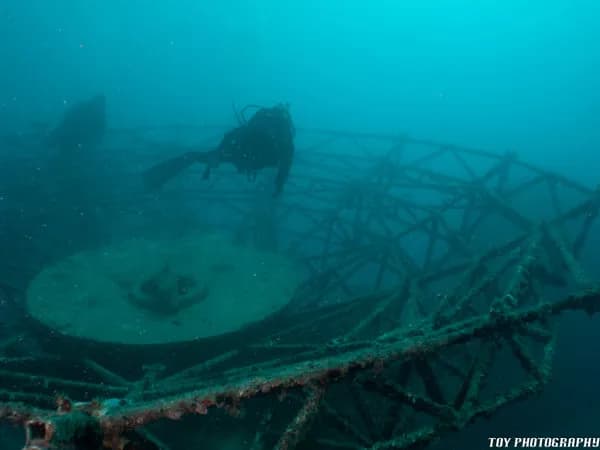
2. Spiegel Grove Wreck - The Spiegel Grove, in Key Largo, is known as one of the world's top wreck dives. The bottom is at 134ft, the top at 60ft. It is incredibly huge at 510ft long and is diveable all year round. It often has large tarpon swimming around it, and in August, bull sharks sometimes visit. It also has lots of easy penetration points.
3. USS Oriskany - Another top shipwreck to dive in the world. The USS Oriskany is also known as the world's largest artificial reef. The shipwreck is also one of the very few aircraft carriers that can be explored by divers. It lays deep, and the conditions are often changing. Thus, it is more suitable for experienced divers.
4. Rainbow River - For a unique drift dive, head to Rainbow River to enjoy its diverse ecosystem and a chance to spot lots of turtles. It resembles an underwater garden with flowers, fallen trees, and rocks in all shapes and sizes and dive between the bubbling spring boils.
5. Williston Springs - Although the cenotes in Mexico offer some of the best cavern diving, these sinkholes in Florida grant a unique diving experience. In Ginnie Springs you can even do some proper cave diving. Blue Grotto and the Devils Den are other great places to explore the clear waters.
6. Hog Heaven - This is not your usual reef dive, as the artificial reef was accidentally placed upside down. That makes the dive site unique and would be a sin to miss when scuba diving in Florida. It is a shallow dive, which makes it also enjoyable for beginners.
7. Christ of the Abyss - As you can guess, the main highlight on this dive site is a bronze sculpture of Jesus Christ. The statue is 8ft (2.4m) tall and surrounded by beautiful coral that attracts plenty of marine life. The most beautiful moment is when the beam of sunlight comes through the water to create a halo around the statue.
8. Crystal River - This is the place to see lovable manatees. Only snorkeling and swimming with manatees is allowed here. Nevertheless, the Crystal River offers terrific spots for cavern diving. The manatees, though, remain the main attraction and something not to be missed.
9. Jupiter - All shark divers gather here for the annual migration of lemon sharks during the winter months. You can often spot them around wrecks going up all the way to West Palm Beach.
Florida Diving Conditions
Water Temperatures: Range from 68 - 86F (19-30C)
Visibility: Depends on the dive site. It can be anything from 25F (8M)to visibility that exceeds human vision.
Weather: The temperature ranges from 60F to 82F (15-27C)
All major U.S. airlines have flights to Florida's main airports: Miami International Airport (MIA), Orlando International Airport (MCO), Tampa International Airport (TPA), and Fort Lauderdale-Hollywood International Airport (FLL). The largest airport is Miami International (MIA).).
How To Dive Florida
There are no dive liveaboards in Florida, but there are numerous dive centers and dive resorts in the area.
Topside Activities
While not scuba diving, there are many exciting topside activities to do in Florida. The coastline does not have a shortage of beautiful beaches to relax and swim. There are over a thousand golf courses for golf enthusiasts. You can do endless shopping or go clubbing, visit museums, go hiking in the Everglades National Park or theme parks and attractions. For nature lovers, there are beautiful botanical gardens to go for a stroll.
Katie is the most experienced travel advisor at Bluewater Travel, having been with the company since its inception. Her interest in scuba diving started many years ago while on vacation in the British Virgin Islands. Though not yet certified, she was mesmerized by the marine life below the surface. As soon as she returned to Los Angeles, she swapped her mask and snorkel for a regulator and BCD (and a mountain of other dive equipment) and hasn't looked back since!
Katie is no stranger to the Southern California waters, but prefers to travel around the world and experience new cultures, food, and marine environments. She has visited and led trips to many of the top liveaboard destinations. Her most memorable dive moment was swimming 20 feet from humpback whales off the coast of Moorea. At the top of the list for her next dive vacation: Alor.
When she's not in the office, you're likely to find Katie attending a concert in LA, snowboarding at Mammoth, attending to Sadie, or cheering on her alma mater, The Michigan Wolverines. Go Blue!
Katie's Underwater Camera Setup:
Olympus OM-D EM-1 Mark II with Nauticam housing. Olympus M.Zuiko ED 9-18mm lens with Nauticam 4" wide-angle port. Panasonic Lumix 8mm fisheye lens with Zen 170mm dome port. Olympus M.Zuiko 60mm lens with Nauticam macro port 65, with Bluewater +7 macro lens. Dual Sea&Sea YS-D2 strobes. Light & Motion Sola 800 photo light.
VENICE BEACH FLORIDA DIVING REVIEWA very different dive plan! Dive from the beach or take a charter from one of the local dive shops to collect fossilized shark teeth. You will find the most teeth and other fossils such as inner ear bones of whales, dugong rib bones, giant ground sloth bones, mastadon molars, turtle shell, and prehistoric horse teeth when you reach 21 feet of water from the shore line. The Venice Beach Pier makes a nice reference point as the end of the pier is about the right depth. You can park at the county park near the pier and use the boardwalk to access the beach. This treck is not for the deconditioned as the walk is long carrying tanks. I gave only two stars for marine life because it is sparse. You might see sea horses, scallops (but don't take in this area), sea robins, and jelly fish. Many "empty" shells contain small octopus so do be careful when fanning the sea floor for teeth. You will not see a coral reef. I recomend purchasing a fine mesh bag with velcro to store your finds and a paperback fossil book so that you know what you might find in Florida. I only gave conditions 2 stars because visiblity if very unpredictable. Winds kick up the silt in this shallow gulf area very easily. Top side the beaches are wide and there are a lot of restaurants and hotels to fit any budget.
BLUE HERON BRIDGE DIVING REVIEWThis is my all time favorite "beach" dive. It is also the easiest beach dive I have ever gone on! At Phil Foster Park in Riviera Beach, Florida. You are inside the intracoastal waterway, there are no waves. Max depth is 18 ft at a really high tide. Average is 14ft. Walk from your car to the waters edge is 40 ft. No stairs. This dive is only done about 1 hr before high tide to 1 hr after high tide during daylight hours. Otherwise the currents make the visibility horrible. This muck dive has so much to offer. I have seen spotted eagle rays in 3 ft of water, sea horses, flying guinards, red lipped bat fish, sea stars, octopus, fire worms, nudibranches, crabs, lobsters, eels, sargent majors, shrimp, spotted drums, and a whole host of other critters. This is muck diving so try not to stir up the bottom. By Florida law you have to drag around a dive flag., but you do dive very close to an active boat channel. Showers and bathrooms are available. Night diving is only allowed when a local dive shop sponsors the parking passes. Neighborhood around the park can be sketchy. Definitely rent a car. Lodging is available in West Palm Beach or Singer Island. Dive shops are available on either end of the bridge. Even if vis is 10 ft it is worth the dive.
SOUTH BEACH, FLORIDA DIVING REVIEWSouth Beach diving may not seem as sexy as many of the south seas locations, however if you want variety and easy diving access it is ideal. Known as the "Wreckreational" capitol because of its 35+ wrecks creating marvelous artificial reefs all along the south Florida coast line. Vast fields of Gorgonias, schools of rays, goliath groupers of Pleistocene proportions, are all the "regular" fare at most of the wrecks. Other pelagics often swing by in different seasons (lemon sharks, black tip reef, etc...). Wrecks vary in depth (60' to 270') and skill level so there is something for every diver at every level. Great macro opportunities since the wrecks all lie on a nice sandy bottom with relatively good visibility allow for easy shot set up with clean backgrounds. Boat captains are all well versed in the wrecks and the different wildlife that inhabits each. This is a great vacation spot for groups with all levels of dive experience and even those non-diver types.