-optimized.webp&w=3840&q=75 "Dune Black Manta Special Packages")


Introduction
For a lot of divers, the Maldives starts as a distant daydream: tiny palm‑fringed islands, crystal‑clear water, and the chance to tick off manta rays, sharks and whale sharks in a single week. It feels remote and luxurious, yet once you are there it is surprisingly straightforward – especially from a liveaboard.
In this article I’ll look at what liveaboard diving in the Maldives is really like, how example liveaboard itineraries work, what sort of experience you need, and which kit actually makes a difference onboard. I’ll weave in first‑hand notes from our team and guests, and point you towards a few trips and offers that are genuinely worth knowing about – including Emperor’s current Buy One Get One Free promotion, running for a limited time until 21 June, via our partners at Emperor Liveaboards. This offer applies to Emperor Explorer II and Emperor Serenity.
Why the Maldives Suits Liveaboards So Well
The Maldives is a long chain of coral atolls scattered across the Indian Ocean. Each atoll is a ring of reef with channels cutting in from the open sea and submerged pinnacles inside the lagoons. That spread‑out geography is brilliant for marine life but awkward for day boats tied to a single island.
A liveaboard changes the equation:
- You sleep on the water and wake up already at the next atoll.
- The boat can follow conditions and animals – mantas one day, sharks in channels the next, then whale sharks along the outer reef.
- You settle into a simple rhythm of diving, eating, resting and doing it all again.
Tim Yeo, our General Manager and most experienced trip leader at Bluewater, sums it up nicely:

Expert insight from Tim Yeo, General Manager & Trip Leader at Bluewater Travel
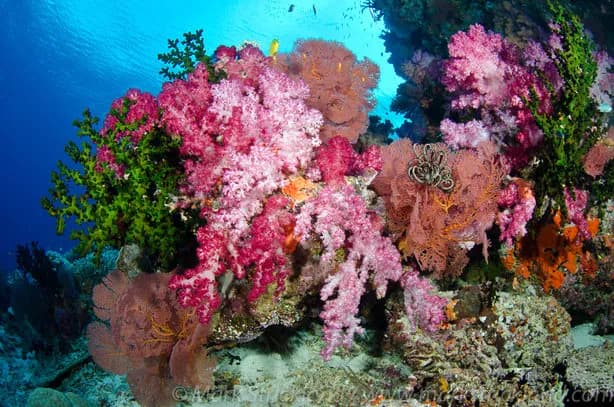
This was my second time doing the central atolls itinerary and the diving still blew my mind. The reefs were glowing with red, orange, yellow and blue soft corals, and some sites had table coral gardens stretching as far as you could see. We had sharks of every description – blacktip, whitetip, grey reef, guitarfish, nurse, even tiger – plus mantas, a whale shark, big rays, dogtooth tuna and huge schools of reef fish. The water sat between 82–85°F and nobody complained of being cold.
The Maldives covers a big area and you simply cover more ground, with more variety, from a liveaboard than you ever could from a single resort. It’s also surprisingly good value for what you get. If you’ve never done a liveaboard before, the Maldives is a brilliant place to start.
If you’d like a general primer on liveaboards first, these two guides on our site are a good starting point:
- Welcome to the World of Liveaboard Diving
- Liveaboard Diving – How to Plan, What to Expect & Insider Tips for 2026
What the Diving Actually Feels Like

On Maldivian dive maps you’ll see terms like thila, giri and kandu. Underwater they translate into a set of very distinct dive styles.
Channels (kandus)
This is where the atoll reef is cut by a pass between the lagoon and open sea. You drop in, descend quickly, and often hook in near the lip of the channel while the water streams past. Grey reef sharks, whitetips, eagle rays and tuna hang in the flow. Once your no‑decompression time starts to run low, you unhook and drift into the channel with the current.
Seamounts and pinnacles (thilas and giris)
These are submerged reefs that rise up from the surrounding seabed. Thilas sit deeper; giris can come almost to the surface. They can be draped in soft corals and gorgonians, with anthias clouds and plenty of reef fish, plus regular sharks and rays sweeping past in the blue.
Outer reef walls and plateaux
Sloping reefs and drop‑offs facing the open ocean. Expect table coral gardens, turtles, Napoleon wrasse and, in certain areas and seasons, mantas or whale sharks cruising the edge of the reef.
House reefs and lagoons
Gentler sites close to islands, perfect for check dives, training, and relaxed pottering on days when you want things a bit calmer.
Special show dives
These are the manta cleaning stations and shark hotspots where the main event happens in one small area. You settle into the sand or tuck behind a coral block and simply watch the animals loop over and around you.

Florence Hideux, one of our Junior Travel Consultants, spent almost two years guiding in South Ari Atoll, based at Villa Park (Sun Island). Her description of the house reef there will sound familiar to anyone who has fallen in love with a single site:

First‑hand experience from Florence Hideux, Junior Travel Consultant & PADI MSDT
Most days on the house reef there was very little current – a perfect spot for beginners, courses, and the first dive of a holiday. We’d start shallow, neutral, practise a few skills, then drift towards a wall that gently dropped to about 18 metres for the rest of the dive.
After a while, I knew every coral head. I knew where a particular octopus liked to hide, which overhang held a shimmering cloud of glassfish, and where the skunk cleaner shrimps would happily climb onto my hand for a quick tidy‑up.
I was with two Open Water students at the safety stop, practising SMBs, when a shadow appeared in the blue. Then another. Two whale sharks were heading straight for us. We actually had to swim out of their way to avoid contact – I could look right into the eye of one from a few centimetres away. It was only my students’ fourth dive. They surfaced completely speechless.
– Florence Hideux, Junior Travel Consultant
Our dive travel experts have been to theMaldives many times and can help you choose the right liveaboard and dates at no extra cost.
Email a Maldives specialist or use the enquiry form above.
A Quick Note on Boats: What Is a Dhoni?
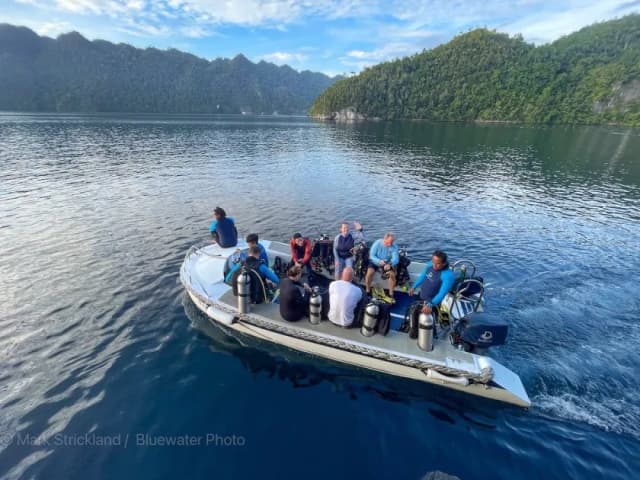
If you’ve not dived in the Maldives before, you’ll hear the word dhoni a lot. A dhoni is a traditional Maldivian boat design, adapted in this case for diving:
- It carries all the cylinders, compressors and most of the dive gear.
- You kit up on the dhoni, not the main liveaboard.
- The dhoni drops you right on top of the site and picks you up where you surface.
It sounds like an extra step, but in practice it keeps the main boat calmer and quieter, and gives the crew much more flexibility in how they manage entries and exits.
Sharks, Rays and Reefs: What You’re Likely to See

The Maldives is very much a wide‑angle destination. There is macro here – nudibranchs, shrimps, leaf scorpionfish, the odd frogfish – but the real draw is:
Sharks
Blacktip and whitetip reef sharks are common on many sites, along with grey reef sharks (Carcharhinus amblyrhynchos). Grey reefs are medium‑sized reef sharks, usually slate‑grey with a pale underside, a distinct black edge on the tail, and a solid, purposeful way of swimming. In the right channels you can see dozens at once. Certain areas and seasons also produce guitarfish, nurse sharks, tiger sharks, threshers and the occasional hammerhead.
Manta rays
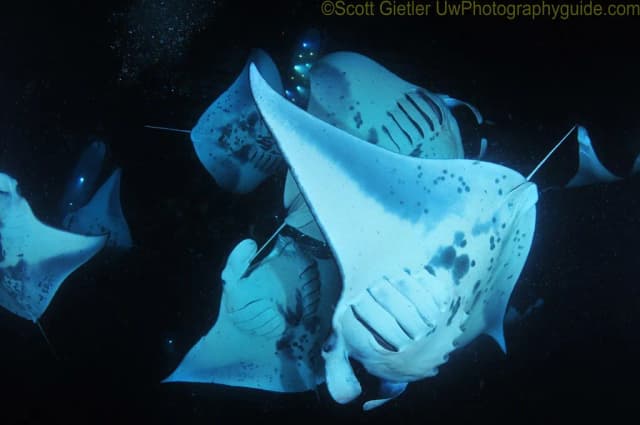
Cleaning stations and feeding aggregations, especially around Baa Atoll, North Malé and parts of Ari. At Hanifaru Bay in particular, seasonal plankton blooms can bring tens of mantas together in a single snorkel session.
Whale sharks
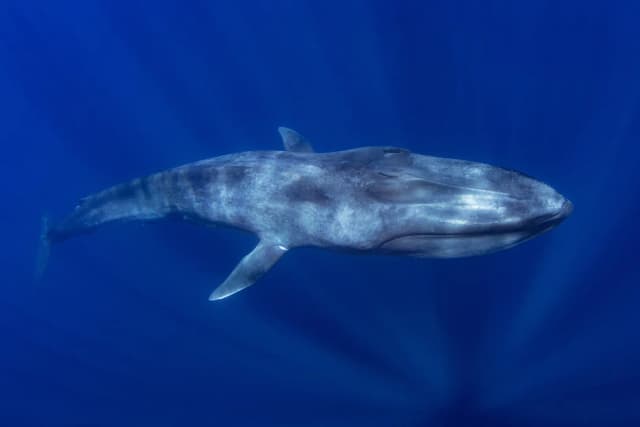
South Ari’s outer reef is the most reliable area, with year‑round sightings. Elsewhere they appear more seasonally, and occasionally under the boat at night when liveaboards run lights off the stern.
Rays and turtles
Eagle rays, stingrays and marble rays are all regulars. Green and hawksbill turtles are very common on house reefs and sloping outer walls.
Reefs and schooling fish
Healthy hard‑coral gardens, blue and yellow snapper storms, bigeye trevallies, fusiliers, batfish and clouds of anthias, often set against blue water with 20–30 m visibility.

Guest feedback from our trips and independent bookings tends to echo the same themes:
Guest feedback from a recent Maldives liveaboard trip
Absolutely breathtaking experience… each dive was a new adventure with mantas, eagle rays, sharks, turtles, nudibranchs and endless schools of tropical fish. The picture‑perfect islands and warm hospitality made this trip unforgettable.
– Bluewater Travel guest review
Lisa Garner, who spent time in the Maldives as a marine biologist before joining our team, adds another layer from the science side:
First‑hand perspective from Lisa Garner, Marine Biologist & Bluewater Travel team member
Spending time in the Maldives as a marine biologist was one of those experiences that quietly reshapes how you see the world. Based in North Malé Atoll, my days consisted of coral restoration, propagating coral through fragmentation, and monitoring their growth over time. What struck me most was the resilience of marine life, given a helping hand I witnessed entire ecosystems bounce back from barren and degraded to bustling and thriving. Watching this unfold in front of my eyes every day is something that I will never forget. With that being said, this process is something that should occur naturally and shouldn't rely on human intervention, but that is a whole other land mine!
Another part of my work that has stuck with me and will forever was witnessing coral spawn. In the Maldives this occurs around the full and new moon in March/April and October/November. If I could go back and witness this experience all over again, I would in a heartbeat. I highly recommend trying to coincide your trip here over this period of time. Just remember that coral is highly temperamental when it comes to spawning and the conditions need to be absolutely perfect, so allow a lot of overlap in the days following a full or new moon.
– Lisa Garner, Marine Biologist
Our dive travel experts have been to Maldives many times and can help you choose the right liveaboard and dates at no extra cost.
Email a Maldives specialist or use the enquiry form above.
Emperor’s Core Itineraries: Matching Routes to Divers
Through Emperor Liveaboards there are several Maldives itineraries; three in particular cover what most visitors are looking for. All operate round‑trip from Malé, and all use separate dhonis for diving.
We feature the Emperor boats on Bluewater here:
Hanifaru & North – Timed for Manta Madness
When: July to October, Malé–Malé
Where: Baa, Lhaviyani, Raa and North Malé Atolls
Experience: Suitable for all levels; comfort in some current is helpful
Experience: Suitable for all levels; comfort in some current is helpful
This route is planned around the new and full moons of the south‑west monsoon, when tides push plankton into Baa Atoll and Hanifaru Bay really comes to life.

In outline, you can expect:
- Snorkelling Hanifaru Bay: No diving is allowed in the bay itself, but you can legally snorkel. On the right days, dozens of mantas may be cyclone‑feeding in a relatively compact space.
- Manta cleaning stations: In Baa and North Malé, with patient, unhurried dives spent watching rays circle coral heads while cleaner fish go to work.
- Lhaviyani highlights: Reefs such as Kuredu Express and Kuredu Caves, with the chance of turtles, grey reefs, whitetips and nice coral.
- Northern reefs: Raa and other northern atolls have plenty of colourful hard and soft corals, schools of reef fish and the chance of the odd shark passing in the blue.
Open Water divers are welcome, though many of the best bits are deeper than 18 m, so taking Advanced Open Water onboard is well worth considering.
If you love the idea of Hanifaru but have non‑divers in the party, our Luxury Maldives Dive & Spa Experience 2028 is a good alternative: a week on Scubaspa Yang with the choice of a dive package, spa package, or mixed dive‑and‑spa option, timed for peak manta season in Hanifaru Bay.
Northern Highlights – A Longer Northern Circuit
When: July to October, 10 nights, Malé–Malé
Where: North Malé, Lhaviyani, Baa, Rasdhoo and North Ari Atolls
Experience: All levels, but you should be happy in drift dives and some channels
Northern Highlights stitches together elements of the Hanifaru route with classic central‑atoll favourites:
- North Malé: Lankan Manta Point for cleaning mantas, and high‑energy reefs such as Finger Point with sharks and schooling fish.
- Baa and Lhaviyani: Possibility of Hanifaru Bay snorkelling, depending on conditions, plus reefs and thilas with soft corals, turtles and busy fish life.
- Rasdhoo: Dawn shark dives, usually with grey reef sharks and sometimes a hammerhead or two out in the blue.
- North Ari: Pinnacles such as Fish Head, where trevallies hunt through curtains of fusiliers and blueline snappers while grey reef sharks patrol the drop‑offs.
It’s a nicely balanced route for those who want mantas and sharks, but also time on pretty reefs and pinnacles.
Best of Maldives – The Classic Central Atolls Route
When: All year, Malé–Malé
Where: North & South Malé, Rasdhoo, North & South Ari, and Vaavu Atolls
Experience: Advanced Open Water recommended
Best of Maldives is exactly what it sounds like: a week visiting the signature sites of the central atolls. The precise order varies with conditions, but the building blocks are familiar from our own trip reports:
- Channel dives in Malé and Vaavu: Grey reef and whitetip sharks, eagle rays, big schools of snapper and trevallies, often in strong but manageable current.
- Nurse shark night dive at Alimatha (Vaavu): An extraordinary experience kneeling in the sand amongst a mass of nurse sharks and rays, all using the dive lights to hunt.
- Manta cleaning stations in Ari: Moofushi Manta Point, Rangali Madivaru and similar sites, where mantas circle cleaning bommies again and again.
- Whale shark searching in South Ari: Liveaboards spend time cruising the outer reef looking for whale sharks at or just below the surface, then drop snorkellers and divers in.
- Reefs and pinnacles such as Maaya Thila, Kudarah Thila and Fish Head: With good coral, dense fish life and regular sightings of turtles, sharks and rays.
Our Maldives trip reports give a good feel for the mix of sites, the day‑to‑day rhythm onboard, and the occasional curve ball – such as tiger sharks on a check dive at the Malé jetty.
A Brief Look at the Emperor Boats
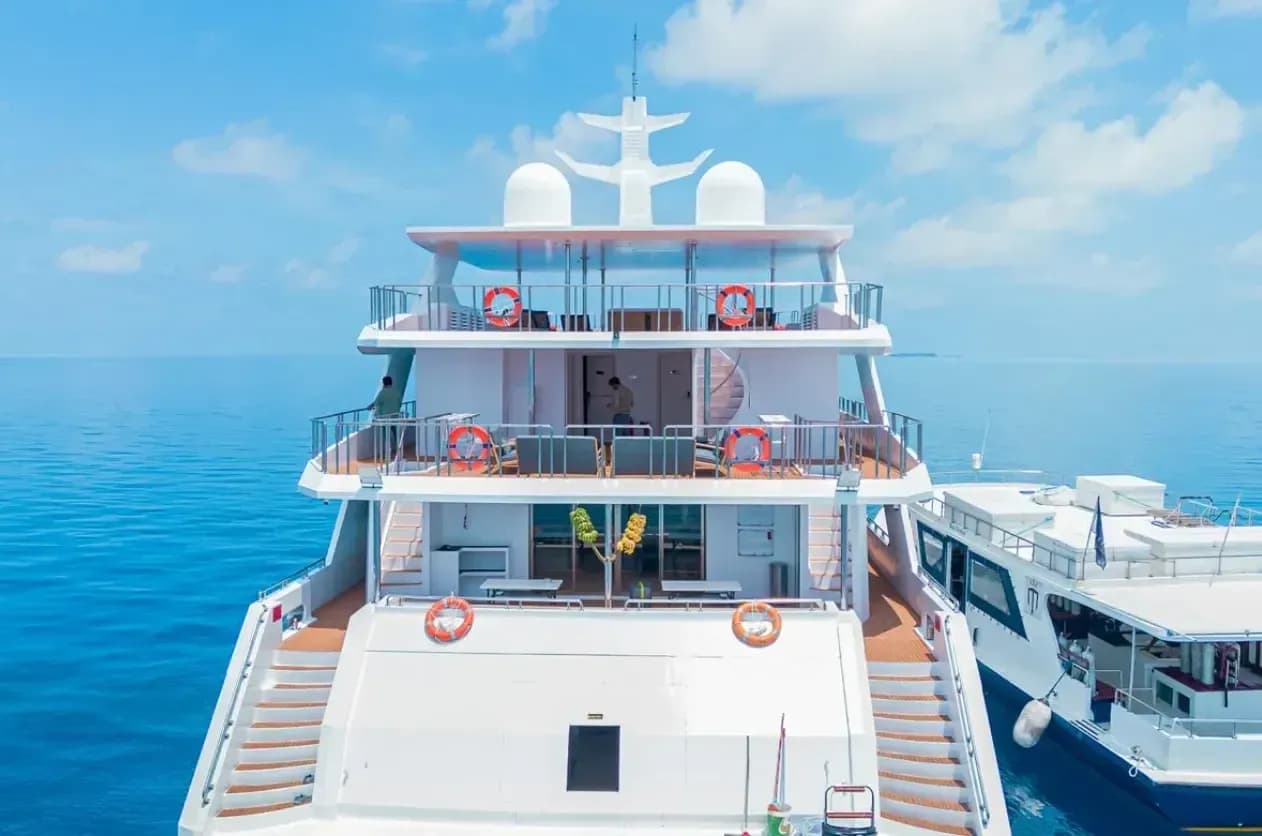
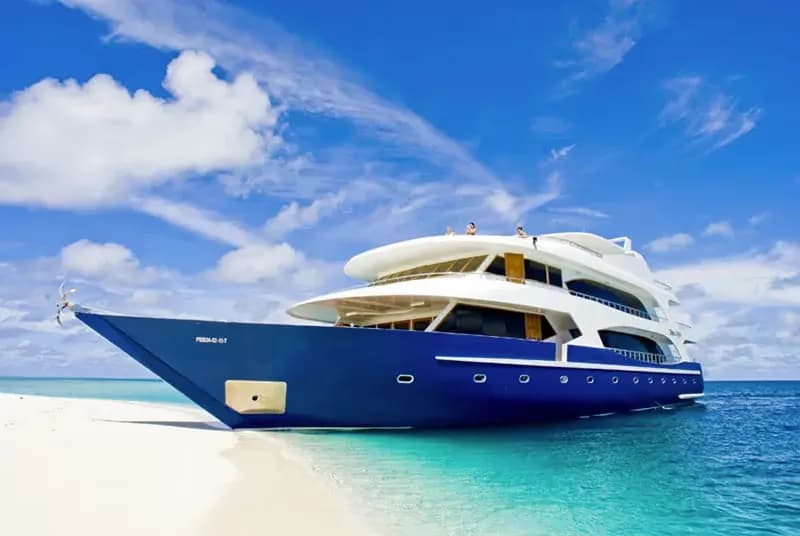
In more detail, the Emperor Maldives fleet we work with includes:
Emperor Explorer II

Emperor’s newest and largest Maldives boat, with a bright, spacious feel and large windows, plus four dive guides and a big 24 m diving dhoni.


Emperor Voyager

A very popular comfort‑plus option with al‑fresco dining and a friendly, relaxed vibe.


Emperor Serenity
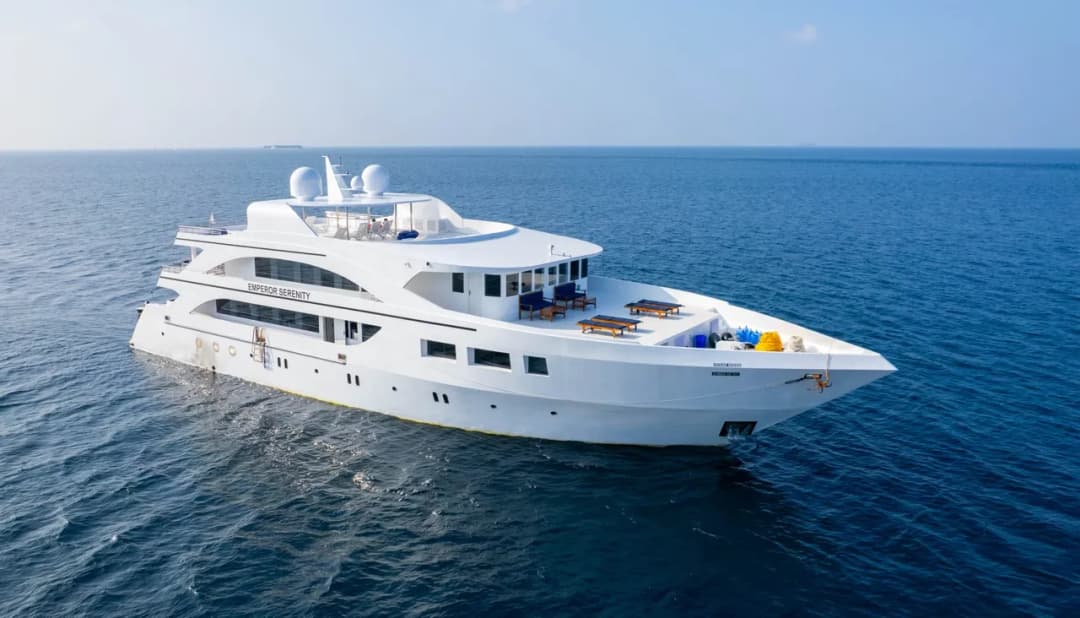
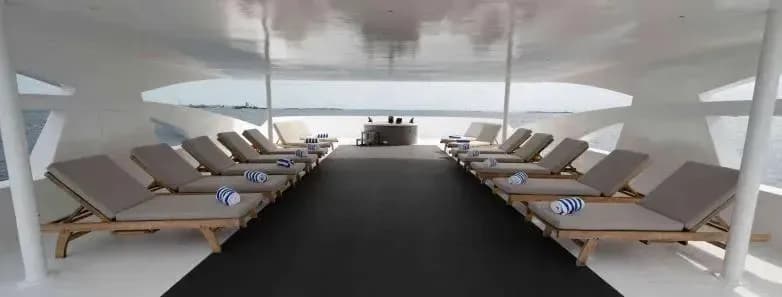
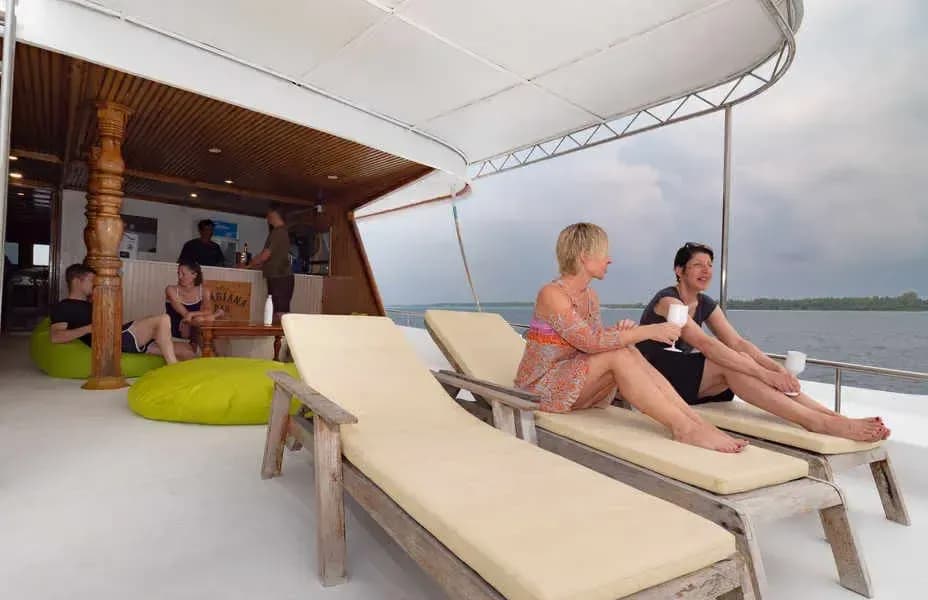
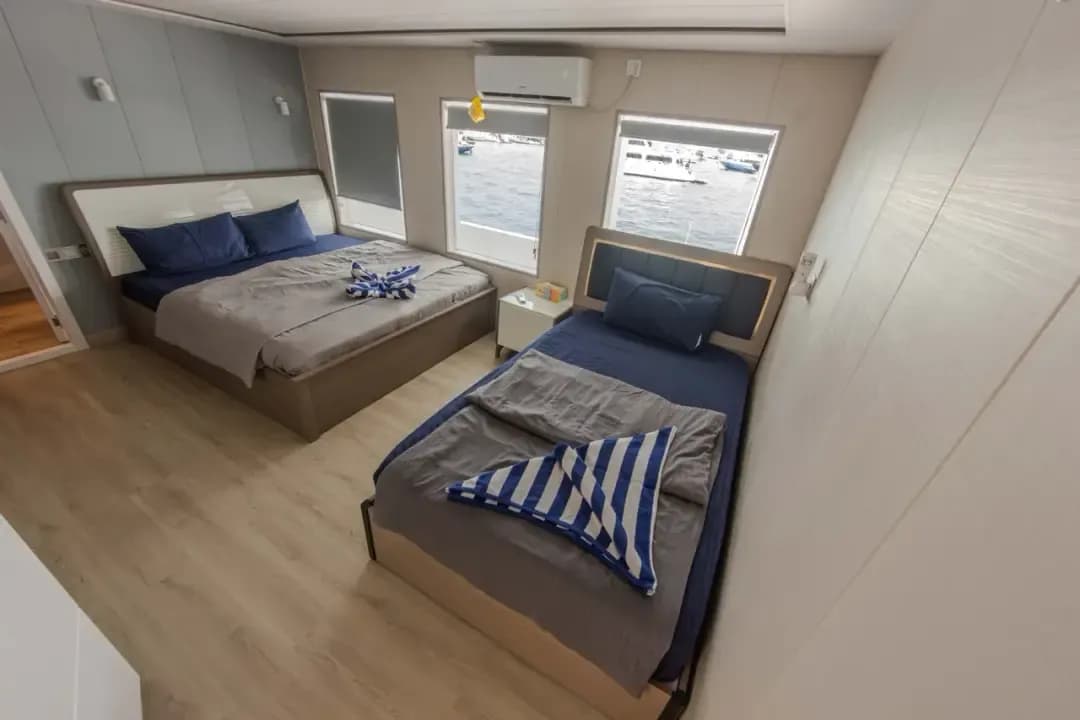
Essentially a new‑build successor to the much‑loved original Serenity, with thirteen ensuite cabins across three decks and plenty of outdoor lounging space.


Emperor Leo

Stylish, good value, and fitted with a Jacuzzi on the main deck, with twelve ensuite cabins and a warm, sociable atmosphere.


Emperor Virgo

Slightly fewer guests, contemporary interior, and a good choice for smaller groups wanting space without going fully luxury.


Seasons, Conditions and Travel Basics
Water temperature:
Roughly 27–30°C all year. Most people dive in a 3 mm full suit. Those who feel the cold often add a thin thermal layer or hood by the end of a full week.
Visibility:
Typically 10–30 m. It can be reduced when plankton is thick – but that is often exactly when mantas and whale sharks are feeding.
Currents:
This is a current‑driven destination. Many dives are gentle, but some channels can be lively, and negative entries are not unusual. A reef hook and SMB are considered standard safety kit, and most operators insist on every diver having a computer.
Monsoon patterns (very simply):
- January–April: Generally the driest and calmest, with excellent visibility – ideal for a first visit.
- May–November: South‑west monsoon. A bit more unsettled topside, but often better for big‑animal action, especially mantas and whale sharks. Coral spawning in March/April and October/November is another draw if you are happy to plan around lunar phases.
- December: A transitional month that can be windy but still offers good diving.
Getting there:
Flights land in Malé (MLE). Most liveaboards include airport pick‑up and transfer by dhoni on embarkation and disembarkation days. Many guests choose to arrive a day early, both for insurance against delays and to shake off jet lag.
Lisa also flags two very practical points that are easy to overlook on your first visit:
A practical tip from Lisa Garner, Marine Biologist
One thing worth mentioning about the Maldives, something I was blissfully unaware of before visiting, is that conditions can sometimes be challenging. Prepare for strong currents and sometimes limiting visibility. Also, remember it is a Muslim country so just be aware of what you are packing in your suitcase, because it will get confiscated at the airport!
– Lisa Garner
For more detailed information on atolls, seasons and land‑based options, our main Maldives page is our Maldives diving destination guide.
Recommended Liveaboard Kit for the Maldives
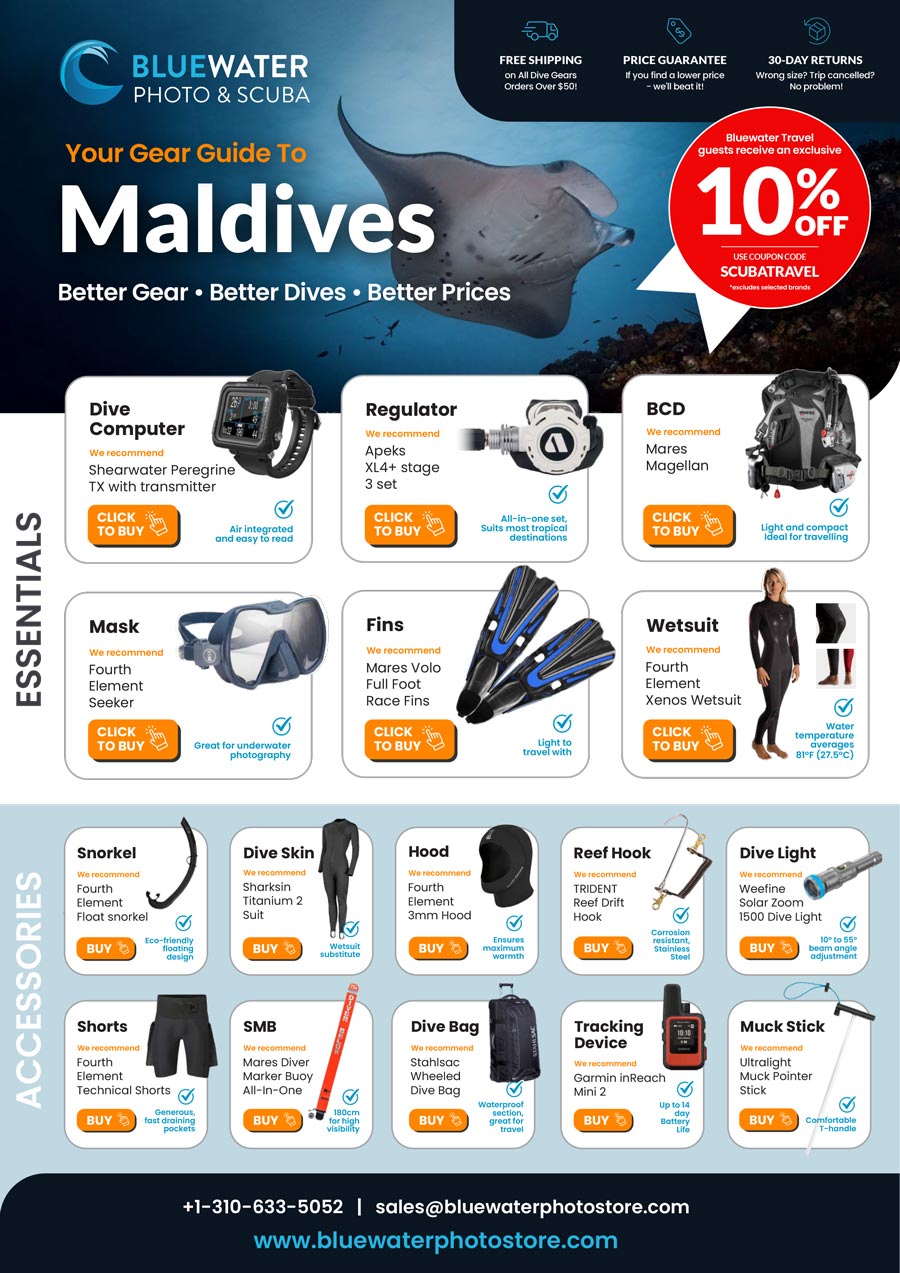
You can dive the Maldives with standard warm‑water gear, but a few specific items make liveaboard and channel diving noticeably smoother. We’ve pulled all of this together in a downloadable Maldives gear guide; here is the core of it, using concrete examples from Bluewater Photo.
Core Dive Gear
Warm‑water wetsuit (3 mm)
Most divers are comfortable in a 3 mm full suit for a week of repetitive diving.
Example: Fourth Element Xenos 3mm Women’s
Extra thermal protection
If you tend to feel the cold after a few days, a thin thermal suit or hood makes a big difference without adding much bulk.
BCD and regulator set
Lightweight, travel‑friendly gear is easier to pack and lug around airports, and most Maldivian dives are from a dhoni, so tidy kit helps.
Mask, fins and snorkel
A comfortable mask and efficient fins are essential when you’re rolling in and out several times a day, and when a whale shark suddenly appears and you need to be in the water quickly.
Dive computer
With three or four dives a day, a clear, reliable computer is non‑negotiable. Air integration is a nice bonus, but the key is readability and simple menus.
Channel and Drift Essentials
Reef hook
Essential for channel lips and some manta stations, where you want to stay in one place without kicking or grabbing the reef.
Surface marker buoy (SMB)
An SMB is standard safety kit in the Maldives, especially on drift dives. Many liveaboards insist every buddy pair carries one.
Dive light
Useful not only for night dives but also for looking under overhangs or bringing colour back on deeper reefs and wrecks.
Pointer / muck stick
Handy for steadying yourself on sand, pointing things out, or, if you are a photographer, gently bracing without waving your fins around.
Travel and “Nice to Have” Items
Technical shorts
Tough, quick‑drying shorts with pockets are ideal for wearing over a suit between dives or for travel days and shore runs.
Big, wheeled dive bag
Soft‑sided, wheeled bags are far kinder to your back and to dive crews than hard‑shell suitcases, and they swallow a full warm‑water kit easily.
Satellite communicator
Overkill for most, but some guests like the reassurance of a small satellite unit to send messages or share tracking links when travelling through multiple countries to reach Malé.
Alongside this, we always recommend:
- Reef‑safe sunscreen
- A lightweight hoodie or long‑sleeved top for sun and breeze on the sundeck
- Motion‑sickness tablets if you are at all prone
- A soft mask case and a dry bag for tenders and transfers
You can find our current Maldives destination information, including the recommended scuba gear image and links, on the Maldives diving destination page.
Bringing It All Together

Taken as a whole, a Maldives liveaboard offers a mix that is hard to beat:
- Crystal‑clear water and comfortable temperatures.
- Sharks, mantas and, with a little luck, whale sharks, plus reefs that still feel busy and alive.
- Well‑run boats, experienced dhoni crews and briefings that make sense of those channels and currents.
- Routes that can be tailored to almost any experience level, from newer divers cutting their teeth on house reefs to old hands chasing tiger sharks in the far south.
Working with Emperor Liveaboards gives us a very solid base to build from: a consistent standard of safety and service, some well‑thought‑out itineraries – Hanifaru & North, Northern Highlights and Best of Maldives in particular – and a fleet of boats that covers everything from excellent value to full flagship comfort.
Layer on Emperor’s current Buy One Get One Free offer (valid until 21 June on selected departures), plus a rolling set of percentage‑off specials on Emperor Explorer II, Emperor Voyager and Emperor Leo, and there are some very good opportunities if you’re willing to be a little flexible with dates and cabin choice.
If you’d like help matching routes to your experience, working out when to travel, or choosing between Emperor Explorer II, Serenity, Leo, Voyager and Virgo, our team – including people like Tim, Florence and Lisa, who have actually lived and worked in the Maldives – are happy to talk it through with you.
You can reach us at info@bluewaterdivetravel.com, or explore Maldives liveaboard options via our Maldives diving destination page.
Our dive travel experts have been to Socorro many times and can help you choose the right liveaboard and dates at no extra cost.
Email a Maldives specialist or use the enquiry form above.
Frequently Asked Questions about Maldives Liveaboards
1. Is the Maldives suitable for my first ever liveaboard?
In most cases, yes. Many Maldives itineraries include easier inner‑atoll reefs and gentle outer‑reef drifts, and the boats are well set up for divers who are new to liveaboard life. The key is to be honest about your experience and let us help you pick the right route and boat. If you’re freshly certified, we’ll usually suggest:
- Choosing an itinerary with plenty of reef and thila dives, not only heavy channel diving.
- Arriving with at least 20–30 logged dives if you can, or being willing to build experience on the easier sites first.
- Considering your Advanced Open Water and Nitrox, either before you go or during the trip.
If you like the idea of the Maldives but aren’t sure about currents, that’s exactly the kind of thing we can talk through with you before you book.
2. How strong are the currents, really?
They can range from barely there to “hang onto your mask” – often on the same trip. Channels and some pinnacles are where you’ll feel it most, and that’s also where the sharks and big schools of fish tend to be. Skippers and guides are very good at reading conditions and choosing sites to suit the group, but you should be comfortable:
- Descending promptly with the group.
- Using a reef hook when asked, and staying put without kicking.
- Deploying an SMB if you surface away from the main pack.
If you’re unsure, you can always sit out one of the punchier channel dives and join the next reef or thila instead. Nobody will think less of you for being conservative.
3. What’s the best time of year to dive the Maldives on a liveaboard?
It depends what you’re after:
- January to April – generally the calmest, driest months with excellent visibility. Great all‑round conditions, ideal for a first visit.
- May to November – more unsettled topside, but often better for big‑animal encounters, especially mantas and whale sharks in places like Hanifaru Bay and South Ari.
- December – a bit of a transition month, but still very diveable.
There isn’t really a “bad” time, just different trade‑offs between flat seas, visibility and big‑animal action. If you tell us what’s top of your wish‑list, we can usually narrow it down quite quickly.
4. Do I really need my own gear, or can I rent everything?
You can rent almost everything on board Emperor’s boats – BCD, regulator, wetsuit, computer and so on – as long as you book it in advance. That said, there are a few bits we strongly recommend bringing yourself:
- Your own mask that you know fits and doesn’t leak.
- Comfortable fins you’re used to finning with in current.
- A simple, familiar dive computer, even if you rent a back‑up on board.
Everything else is down to preference and airline luggage limits. Plenty of our guests travel light with a core kit and rent the rest, especially for long‑haul trips.
5. Will non‑divers or “light” divers be bored on a Maldives liveaboard?
Not necessarily, but it does depend on the boat and the person. If someone genuinely doesn’t enjoy being on the water, a resort might be a better fit. That said, many of our trips include:
- Snorkelling with mantas or whale sharks when conditions allow.
- Beach visits and island walks.
- Plenty of sun‑deck time with a book and a coffee between dives.
For mixed groups of divers and non‑divers, we’ll sometimes suggest a more flexible option such as our Luxury Maldives Dive & Spa cruise, where guests can pick a dive, spa or mixed package rather than feeling forced into four dives a day. It comes down to matching the right person to the right boat and itinerary.
Author
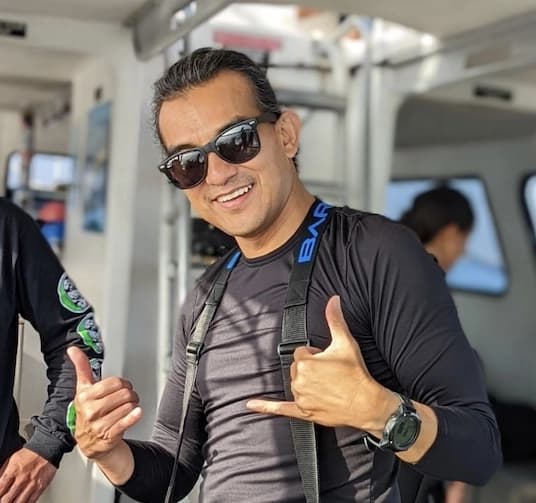
Tim Yeo
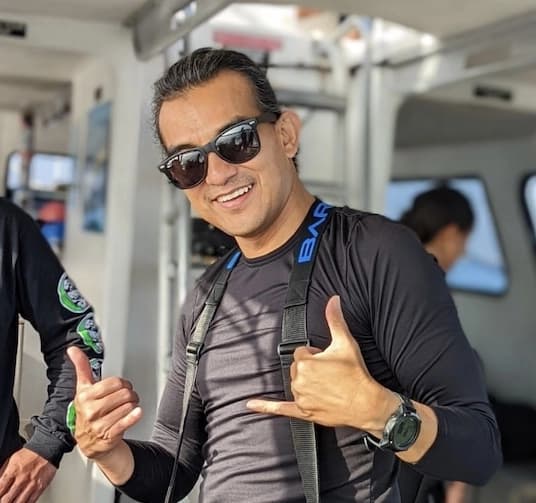
Tim grew up in tiny Singapore, where driving for more than an hour meant you would need a passport. Traveling was always his passion, but Tim became addicted to dive travel soon after he got scuba certified in Malaysia. As his diving addiction grew, Tim eventually became a Staff Instructor with PADI and an Instructor Trainer with SDI. After getting his instructor certification, Tim spent time teaching scuba in Malaysia and Vietnam.
Tim serves as General Manager and COO at Bluewater Travel and is the company's most seasoned trip leader. With a portfolio of leading over 30 group trips, his extensive expertise encompasses a variety of popular dive destinations such as the Galapagos, Raja Ampat, French Polynesia, Fiji, the Red Sea, Palau, Maldives, among others. His travels have taken him across all seven continents and allowed him to dive in all five oceans—the Atlantic, Pacific, Indian, Arctic, and Antarctic.