Special
Blackbird Caye Resort Special Packages
5|5
Expert advice on diving,
seasons, and logistics
Free planning help
when you’re ready to book
Exclusive dive packages
tailored for you
Special

Special

Special
Special

Special

Special

Special

Special

Special

Special
Special

Special
Scuba Dive Level
All Levels
Visibility
40 to 80 feet (12 to 24 meters)
Average Water Temperature
80
Stunning Reefs & Corals
Shark Encounters
In simple terms, Belize diving breaks down into three main areas: the northern cayes around Ambergris Caye and Hol Chan (easy access, fringing and patch reefs, Shark Ray Alley), the offshore atolls of Turneffe and Lighthouse (walls, sharks, Blue Hole and Half Moon Caye), and the southern coast around Placencia and Gladden Spit (whale sharks in season and quieter topside base). Choosing where to stay is really about which of these three you want to focus on.
Here are some of the best dive sites and Belize diving areas!
1. The Blue Hole: This UNESCO World Heritage Site is over 400ft deep and 1,000ft wide. There's not a whole lot to see while diving the Blue Hole in Belize, other than a large blue hole and some really cool stalactites. It requires quite a long boat ride to get to and some divers find the dive to be boring. Some people enjoy the Blue Hole simply because of the depth - 140ft, and they may be suffering from narcosis. In the hole you will hit a thermocline, dropping temperatures to around 75-77 degrees, but the change is so sudden that it will feel much colder. At 140ft depth, there are some undercuts, stalactites, and a few fish.
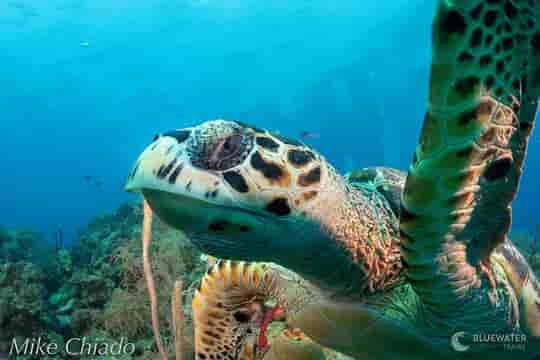
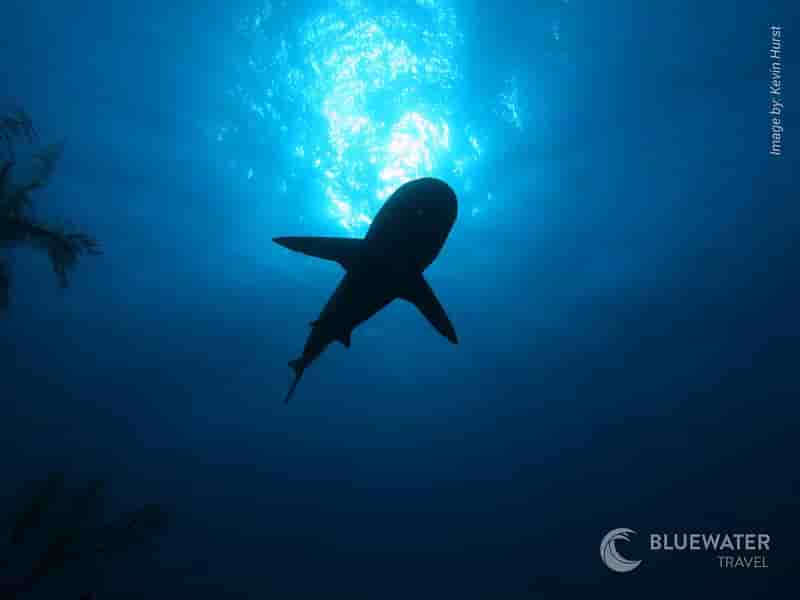
2. Half Moon Caye: You'll likely stop here for lunch after you dive the Blue Hole. Half Moon Caye is a small tropical island home to many bird species, including the red-footed booby. Even if you are not a bird watcher, you'll love the white sandy beaches and warm shallow water surrounding the caye. There's even an opportunity for some great snorkeling right near the dock where the boats park. The Half Moon Caye Wall is one of the most popular dive sites in Belize, with a huge drop-off and lots of sharks to see.
3. Ambergris Caye: This Belize diving hotspot is close to San Pedro, encompasses the northern reefs of Belize, and is home to many resorts and good nightlife. If you want to do a lot of going out in the evening or other top-side activities, this is the area to stay. Ambergis Caye hosts a lot of good diving in Belize, and you can also do some longer full-day dive trips to the Turneffe atoll area. When diving the Ambergis Caye, you can find a large variety of marine life and fish species that cannot be found elsewhere in Belize. One of the top dive sites in Ambergris Caye is the Shark Ray Alley, where you can enjoy diving with different sharks and rays.


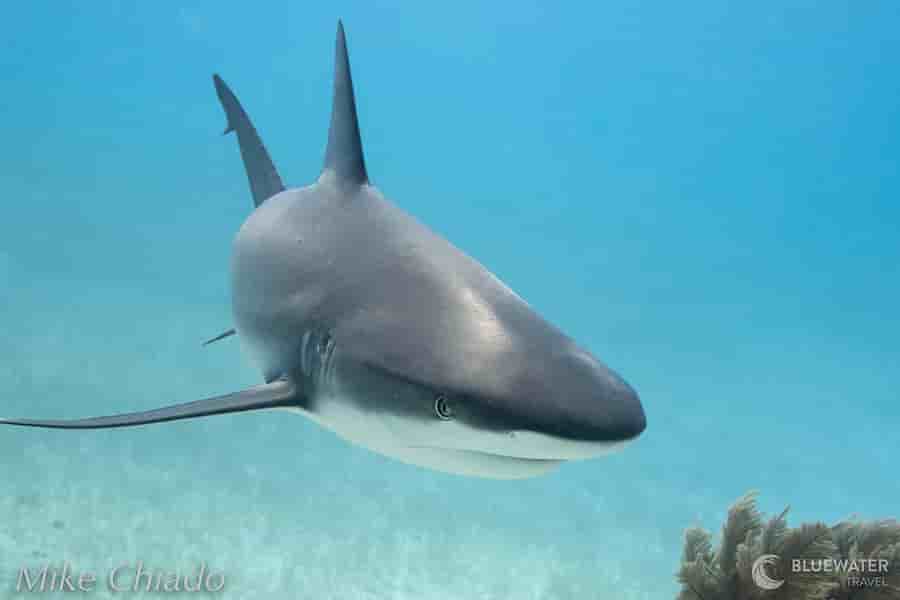
4. Turneffe Atoll: This is some of the better (if not the best) areas for Belize diving. Turneffe Atoll is a large offshore atoll reef with a wide variety of dive sites. The white-spotted toadfish, eagle rays, tarpon, green morays, groupers, nurse sharks, jacks, snappers, and reef sharks can all be seen here if you are lucky enough. The Elbow is one of the best dive sites at Turneffe Atoll, along with the Lighthouse Reef.
5. Hol Chan Marine Reserve: Hol Chan is Belize's first and oldest marine reserve. There are four zones to the reserve - The Reef, The Mangroves, Shark Ray Alley, and The Seagrass Beds. The Reef is a great site for night diving. You'll see plenty of stingrays, spotted lobster, sleeping parrotfish, hermit crabs and tons of moray eels out hunting.

6. Placencia: Placencia in southern Belize offers far less crowds than the Ambergris Caye area, along with some great topside wildlife areas. It is also close to many great Mayan ruins. This is also where Gladden Spit is located, where you have a chance to see a whale shark.
Where is Belize and how to get there? Situated in the Caribbean Sea and south of the Yucatan Peninsula, with Mexico and Guatemala as the neighboring countries, Belize is relatively easy to access.
From the U.S.: Luckily, there are direct flights to Belize City – Philip S.W. Goldson International Airport (BZE) from major U.S. cities including Los Angeles (LAX), New York (JFK), Miami (MIA), Houston (IAH), Dallas (DFW), Atlanta (ATL), and Charlotte (CLT).
If you're coming from outside the United States, you'd likely have to make a stop in a city in the U.S.
How to get to Ambergris Caye: Once at Belize city, there are two ways to get to Ambergris Caye. One involves taking a small propeller plane and the second way is to go via a water taxi.
We recommend taking the 15-minute flight for both the time savings and the unique opportunity to see the reef from above. Maya Island Air and Tropic Air both run flights every hour from Belize City International Airport (BZE) to San Pedro, Ambergris Caye (SPR).
The water taxi/boat ride takes anywhere from 45 minutes to 2+ hours depending on whether the boat makes any stops along the way. Tickets can be purchased on the north side of the river at the Maritime Museum located at the foot of the Belize Swing Bridge in Belize City.
Experience Belize diving while staying at a land-based dive resort or dive Belize from a liveaboard. The reef covers a large area so liveaboards will cover a wider range of dive sites, and potentially see more marine life than people not staying on Turneffe Island. The advantage of staying at a resort is that you can enjoy diving Belize while experiencing many additional activities, and potentially still get to some of Belize's best dive sites (depending on the resort).
View all liveaboards in Belize or dive resorts in Belize or contact Bluewater Travel for the best options!
New to liveaboard diving? Check out this article.

Image By: Kevin Hurs
Belize diving conditions are generally good year‑round with warm water and decent visibility. If you want a simple answer, April–June often gives the best overall mix of clear water, fewer crowds and the chance of whale sharks around Gladden Spit.
If you have fixed dates, we can help you choose the region (Ambergris vs Turneffe/Lighthouse vs Placencia) that fits conditions best for that time of year.
An endless list of things to do await to fill up your time when you're not diving in Belize:
1. Visit ancient Mayan Ruins - include Lamanai, Xunantunich, Altun Ha, and Cahal Pech.
2. Caving -Whether by foot or inner tube, a tour within the Caves Branch System and is a good starting point for your Belize cave explorations.
3. Enjoy the scenic drive through the countryside - Belize City aside, this little country is blessed with a beautiful rainforest pretty.
4. Explore Ambergris Caye - This area hosts a lively nightlife scene. You can also find a good number of shops and restaurants.
5. Wildlife and birdwatching -Belize has amazing wildlife. Bird watching is very popular, especially for species like the macaw, toucan, motmot, boobies, and storks. Animals include howler monkeys, sloths, lizards, armadillos, peccaries and the rarely seen but omnipresent jaguar & tapir.


Covering approximately 8,800 square miles with a population of less than 350,000, Belize is the most sparsely populated country in Central America. It's relatively cheap and easy to get to from the US, their currency is pegged to the US dollar (2:1), and English is the native language - all factors that make Belize diving a popular choice for American travelers.
Most Belize diving is suitable for all levels: easy boat dives on reefs and walls with mild current. Newer divers do well from Ambergris Caye and Hol Chan, while confident intermediates and above get the most from Turneffe and Lighthouse atolls. Advanced dives like the Blue Hole and Gladden Spit whale shark trips are best for divers comfortable with depth, boat rides and occasional current.
The Blue Hole is a famous bucket‑list dive for its depth, cavern feel and stalactites—not for fish life. It’s a long boat ride and a single deep dive with limited marine life at the bottom. Many guests on our 2022 trip actually preferred spending more time on the surrounding walls at Lighthouse Reef and Half Moon Caye, which offer far more sharks, turtles and reef life.
Whale sharks are most reliably seen at Gladden Spit off Placencia around the full moons of April and May (sometimes into June), when they come to feed on spawning fish. Even in peak season sightings are not guaranteed, so it’s important to time your trip carefully and choose operators who focus on these dives.
If your priority is hitting Turneffe and Lighthouse atolls and maximising time on the outer reefs, a liveaboard is the most efficient way to dive Belize. If you want to mix diving with topside activities like Mayan ruins, caves and rainforest, a resort base near Ambergris Caye or Placencia can work very well and still give you access to excellent diving.
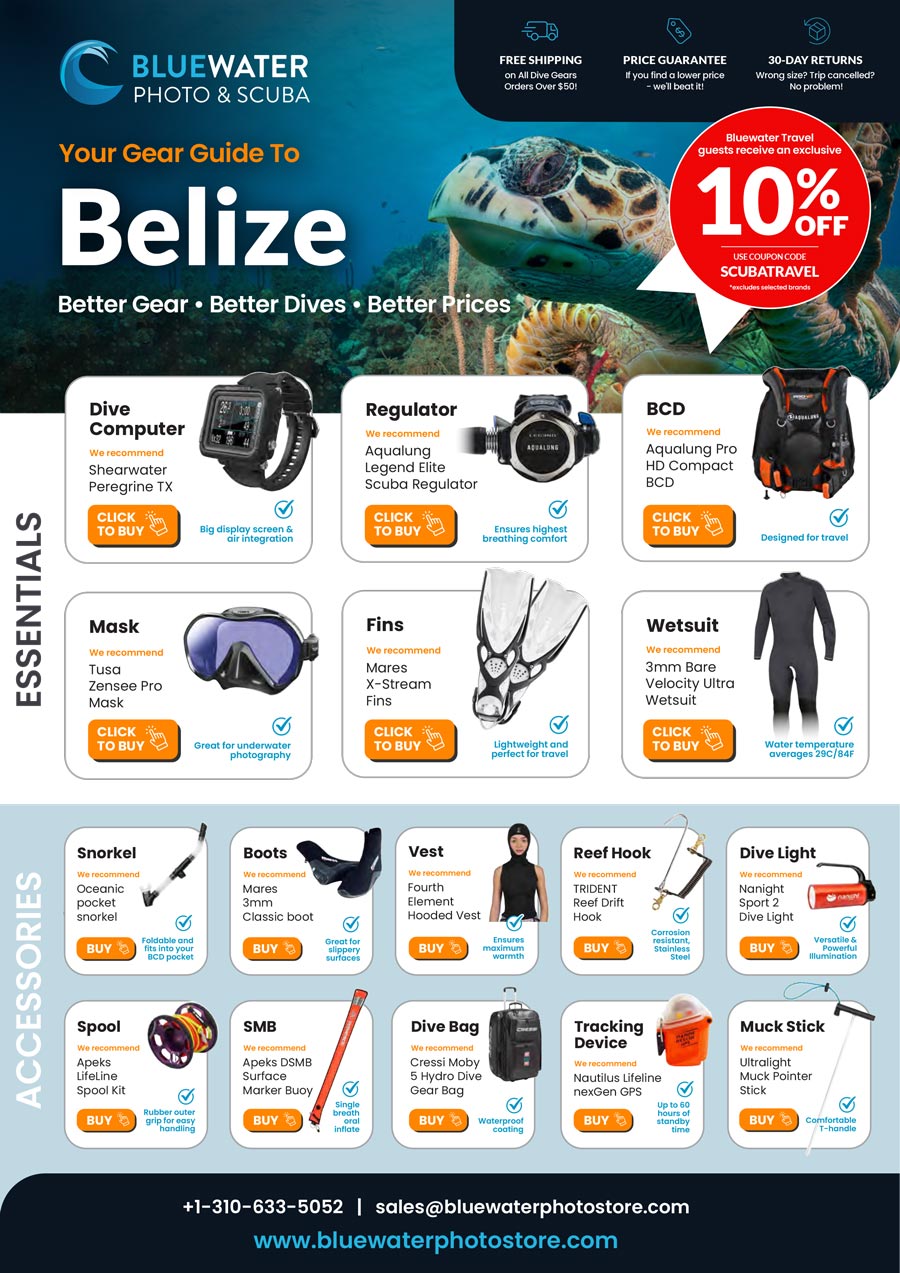
Download our full scuba gear guide to Belize, Bluewater Travel guests receive 10% OFF!

T'Lane Spanos, CFO of Bluewater Travel and Bluewater Photo & Scuba, brings a dynamic blend of finance expertise and adventurous spirit to her role. Raised on a cotton farm in land-locked Kansas, T'Lane always had big dreams that led her to explore the world. As an avid adventurer, she thrives on exploration both above and below the water. She finds immense joy in diving adventures and has a particular passion for African safaris. Equipped with her trusty Sony A7CR camera, she loves capturing the beauty of her journeys.
In her spare time, T'Lane dabbles in acting and enjoys creating abstract paintings. She also enjoys exercising to stay fit for her next adventure. T'Lane is truly grateful to integrate her love for scuba diving, travel, and safaris with her work. It allows her to meet different people from all over the world. Forming new connections is something she cherishes.
Her top three adventures thus far include:
Belize was my last dive trip before the Pandemic. 4 of us traveled to Belize for 5 days of diving. We stayed in a small hotel about .5 mile from the water. We chose that for $$ reasons of course but the hotel was clean, had a pool, and there was a food "cart" right next to us so Breakfast was easy.Diving was good. We got hit with some issues. One of us got a stomach bug so he missed a day of diving and then he gave that to me so I missed the next day of diving. The following day we got skunked by the weather. The waves on the other side of the breaker were huge so no dive operators went out.Wildlife was good, it wasn't EXCITING, but any day diving in a humdrum tropical paradise beats working any day. We got skunked on our Manatee search but overall the diving was good. Topside there are dozens upon dozens of places to eat, drink and be merry. There are some interesting things to do such as the World Famous Chicken Drop. Some say it shouldn't be missed. I am not part of those someones but to each their own.If you like Caribbean sharks, turtles and warm water this is a good place to hang your hat for a week or 2.
In January 2020 I traveled to Hopkins, Belize to provide formal Free Dive training to a pod of local spearfisherman/freedivers.It takes a boat ride to get out to the reef, but it is one of the most spectacular underwater environments in the world. She sheer scale of the barrier reef, right there on the edge of very very deep blue water, is as awe-inspiring as it is rich with underwater life.The weather was unusually rough while I was there yet, even with sometimes extremely large waves, the visibility was over 100 feet.Another highlight for me was a small blue hole the local guys had discovered. None of them wanted to go in it so, naturally, I had to :) It was extremely creepy because it went from being a hole about 30 feet across at 35 feet to a relatively narrow crevice at about 70 feet, then another one at 90. The lighting was such that you couldn't see what was beyond each crevice until you were in it. Really fun, and a nearly perfect place for training.
I have traveled to Belize twice. The first time was to Ambergris Caye. The trip required a short flight from the international gateway of Belize City to San Pedro, the main town, where you can find many great restaurants, shops, bars, and dive operators. We stayed in a private villa, toward the south end of the island, that was oceanfront and had a 100 foot dock. The dive operator I used picked me up here every morning. Accommodations include rental houses, hotels, and resort. We traveled here with several non-divers and they enjoyed themselves very much. Travel around the island is basically by golf cart. See if you can watch the feeding of the saltwater crocodile toward the south end and join in at the “Chicken Drop" in town. I did local diving in Belize around Ambergris Caye and also long range boat diving to the Great Blue Hole and Lighthouse Reef. The Great Blue Hole is a fascinating bucket list dive. See stalactites and sharks, and prepare for a dive to about 130 feet. The dives at Lighthouse Reef were on spectacular, pristine reefs. This was my favorite area to scuba dive.My second trip was to St. George’s Caye, a small private island accessed by a short boat ride from Belize City. The island has one resort that is all inclusive. This is truely an island getaway destination. We did local diving and trips to Turneffe Atoll. Other guests were non divers and some honeymooners and they said they were very pleased with their stay.Overall, I found the scuba diving in Belize to be excellent, the food delicious, the people very friendly, and the culture to be diverse and interesting. When you visit, be sure to taste and take home some of my favorite hot sauce, Belize's famous Marie Sharp's Hot Sauce.
I stayed in San Pedro on Ambergis Caye. Easy short flight on single engine prop plane from Belize City. The reef is close by and the marine park has an abundance of marine life. Further out on the atolls is where the real action is with amazing diving. People are friendly, dive operators on every corner, cool bars and restaurants, picturesque, and and overall great dive experience.
Photographing in Belize- Part 1Underwater Photography and the Belize Coral ReefFor my wife’s birthday, 15 of us planned a surprise trip to Belize for a week of snorkeling along the Belize barrier reef, the second longest barrier reef in the world, next to Australia’s Great Barrier reef. As we live in Vermont, most of our vacations involve skiing or going to colder northern climates. As Gerry had never been to the Caribbean, I felt that a snorkeling trip with some of our dearest friends would truly be memorable. To this end, I planned a trip to the Cayes of Belize. I had been to Belize thirty years ago, but had headed inland and across the border into Guatemala. At that time, many of my young traveling companions were heading out to the Barrier reef to snorkel. It was said to be “world class.” This adventure had remained in my head, so I was anxious to experience what I had missed all those many years ago as well.When planning a trip for a group, all with similar interest, but varying taste, I researched an option that I thought would fit most of our needs and budgets. I settled on the Caye (pron: key) of Ambergris. This is the largest of the cayes and the most visited and, therefore, catering to tourist somewhat more. If the trip had been for just Gerry and me, I might have considered the more low-key, backpacker oriented Caye Caulker, but with a group of this size Ambergris Caye proved a perfect choice. And, really, a perfect choice overall. I found a resort online called Banana Beach Resort, which bills itself as a 5 star hotel with 3 star prices. I started working with the resort some nine or ten months ahead of our trip and they were always upbeat and courteous no matter how many revisions and additions to the itinerary I made. I chose a one- bedroom ocean side suite for Gerry and me. It was equipped with a very sparsely furnished kitchenette, but it did provide a great meeting space for all to gather in the evenings and for happy hour. Others in the group chose the one bedroom court side suites, which came with two beds, refrigerator and outside tables for drying clothes. Most in this group chose to hang out by the ocean where there were ample lounge chairs provided. At the time of our booking (December 2013). The ocean side bedroom suite was $1125.00 for the week and the one-bedroom courtyard suites were $535.00, which I thought was very reasonable for an ocean resort. When you fly into Belize you fly into the Belize International Airport and then take a puddle jumper flight with Tropic Air to get to Ambergris Caye. As an aside, Ambergris and Caye Caulker are the only two Cayes that have an airstrip (2014). To get to the other Cayes and atolls you must take a boat or water taxi. We met some folks on our inland trip the second week and they described a challenging and scary boat ride off of Glover’s Atoll back to the mainland. Very high seas, that as the gentlemen telling the story said , “made our very large boat feel like a toy bobbing in the water”. Perhaps something else to factor into your decision. At any rate, when we arrived in San Pedro, Banana Beach arranged for a taxi to pick us up and drive us the mile or so to the resort. The resort picked up the taxi fare.We planned our trip during the Thanksgiving holidays, as many of those going were teachers or in the public school system. Taking the trip at this time would minimize the time off they would need to take from work as most already had Wednesday, Thursday and Friday off for the holidays. The trip for the group was from Saturday to Saturday. Traveling at this time of year was a little bit of a gamble as this is just beginning the dry season and ending the wet season. For us as Vermonters the weather was very good to excellent that week. We had weather in the high 80′s the first part of the week and the high 70′s the latter part of the week. We had a few early morning showers that cleared off and did not alter our days’ activities. Also, at this time of year, we pretty much had the resort to ourselves which was really very nice. It seems that folks were starting to come in towards the end of our stay.On Ambergris Caye there is only one major paved road, with a few paved side roads in town. The road might be 10k tip to tail and includes the town and a little bit of the outskirts, mostly to the south of town. Banana Beach is located at the end of the paved road south of town. Beyond the paved roads, the road continues but is sandy and rutted, and during our stay the pot holes were water-filled making for a lot of zigzagging when biking or traveling by golf cart. Oddly enough, the more posh resorts are located in these more remote locations, which might make sense, but to me felt removed and isolating. We all felt Banana Beach was the perfect location. Close enough to town to walk or golf cart in to visit and get a taste of the culture and restaurants, but removed enough to be very quiet. I personally would not want to visit a third world country and be isolated from the local culture. As noted earlier, we rented a golf cart, which, besides, walking, is the preferred travel method around the island. There were very few cars and trucks, as the locals seems to travel by golf carts as well. We all loved visiting town and sampling the local foods. We really like Warumga’s, which served fresh grilled papupas, an El Salvadorian dish. If you like seafood, the ceviche at Banana Beach, itself, is not to be missed.When you go to Ambergris Caye, besides the island touring, the Barrier reef should be your focus for activities. Because of the barrier reef, there is not a tide or waves hitting the shore. Therefore, the calm water allows sea grasses to grow close in to shore and, thus, is not really the best for wading or swimming. You can venture out to one of the long piers and snorkel or swim from there, but even then the locals advise not putting your feet down in the sea grasses because of the stingrays that bed down there. But if you go to snorkel or snuba dive, you will not be disappointed. Some folks claim that the Belize barrier reef is in better shape and more healthy than Australia’s Great Barrier Reef.Hol Chan and Shark Ray Alley-The first snorkeling trip we went on was the much acclaimed Hol Chan and Shark Ray Alley. All of our trips were easily arranged and organized by Monkey Business Tours. Monkey Business is located to the right of the main entrance driveway to Banana Beach. It was very easy to have breakfast, walk across the driveway and make any arrangements that we would need for that day or the next. They were always gracious in altering or making accommodations, which for 15 people in one group I am sure can be challenging. That being said, all 15 of us decided to go on this tour, which is a half day. We chose the morning trip, figuring the seas would be calmer. Everyone decided to snorkel but me, I chose to snuba dive. Snuba is a hybrid form of snorkeling and scuba diving, which requires no advanced training. You are given a regulator just like scuba diving, but the regulator tank is on a floating raft and you are attached to the tank by a 40 foot air tube. I chose this option as I wanted to do underwater photography and wanted to be down among the coral, instead of floating on top and looking down. This proved a perfect option for Hol Chan and as I was the only snuba diver, I had one whole raft to myself. Later in the week, others joined me on a snuba dive and were assigned four people per raft. This was definitely more restrictive and if I were to dive again, I would ask for a private raft, even if it cost a little more, and especially if you are photographing. The beauty of the Belize barrier reef, other than it being almost directly off shore, is that it is only six to fifteen feet deep in clear, azure Caribbean water. Even snorkelers will have a great time. Hol Chan was one of the deeper sections of the reef we did and, thus, perfect for snuba diving. Stingrays were common as were nurse sharks and all assortment of colorful fish and varied coral. As Gerry said, “Snorkeling in our lake will never be as interesting and may be downright boring.” We all felt the outfitters we went with throughout the week gave us a generous amount of time in the water and we never felt rushed, hurried or cheated in our experience. Each trip was $100.00 per person, per adventure, but on the full day trips a lunch, snacks and refreshments were provided. So though the trips will add to your budget expenses, they are well worth the expenses as the trips are what are the essential part of your journey. At home, I get jumpy at the site of a mouse running across the floor, so I was a little nervous as to how I was going to respond to swimming among all these fish and stingrays and nurse sharks. For whatever reason, I did not feel skittish at all of all the wild life. They seemed to keep a respectful, but close distance and the colors made up for all else. The only time I took a hard swallow was at Shark Ray Alley when one our guides grabbed a nurse shark and turned toward me with the shark’s face maybe a foot from my face. Perhaps it was the surprise of it all, but I did flinch in that one instance.Mexico Rocks and Three Coconuts-The next trip that most of us took was as all day trip to Mexico Rocks with a second snorkel at “Three Coconuts”. Because I had raved so much about snubaing at Hol Chan several more of our party decided to try this experience. For them, it was great getting down and among the reef. But for me, tethered to three others when I had been solo before was definitely more limiting. For the future, if photographing, I would see if I could go solo, or at least, with only one other person for the freedom of movement. Even with these restrictions, this part of the reef had enough different coral formations and varied fish that all encumbrances were forgiven. After the morning snorkel, we pulled on to a beach in front of an unoccupied house and the cooks set about cooking up a meal of fish they had caught while we were snorkeling. Sodas and rum punches filled the waiting time, while we scoured the beaches for abandon conch shells. Being in front of someone’s house was a little odd, but the crew seems to have made an arrangement with the owners. After lunch, we headed out and on the way home stopped by for an extensive snorkel at a place the guides called “Three Coconuts”. Three coconut trees on the beach help to act as a guides as to where to set anchor for the snorkel. I have to say that Three Coconuts was one of my favorite snorkels of the trip. The reef here is very shallow, perhaps only six to eight feet, and, thus, you are right in and among the reef and the fish. The reef here is so shallow that there is no need to snuba. If fact, on several occasions while photographing, the wave action from the reef caused me to run into the coral despite my trying to back paddle. And though the shapes of the reef coral are varied and many, I am here to tell you that they are not soft. I had quite a few coral scrapes after this dive. Because of my run-ins with the reef, I did ask the guides what the impact of tourism was having on the reef. They said that the sections where tours were run were alternated at different years and intervals so that the reef did not sustain abuse or over use. Their livelihood depends on the reef and its health and I was relieved to know that they took its protection seriously.Night Snorkeling-Another adventure many of us wanted to try was the night snorkeling. This is a two hour evening trip that heads back out to Hol Chan to see creatures that seem to only come out at night. At the thought of snorkeling in the inky blackness of the ocean, I have to admit that I had to give myself a talking to. But it all proved unnecessary, as the night life caught my imagination. After being given large spot lights we jumped in to the water with our guide. The guides skillfully pointed out eels, octopus, lobsters and crabs. And sleeping fish listing sideways. Who knew fish slept so. Gerry and I still talk about the octopus we saw. At perhaps twelve inches, it was a translucent, gelatinous blob, more like an amoeba under a microscope that the eight-legged creatures we had seen in books. Eels came out of their day hiding and slithered through the water. Lobsters scuttled sideways. Some fish were swimming and other sleeping. Magical. On a practical note, the temperature during the day had dropped to the mid 70′s, so the night time temperature was a little cooler as well. So in the water I, and others, were a little chilled. For our trip the next day, many of us rented little shorty wetsuits, which were wonderful. Just perfect for being in and out of the water and riding along in the boat.Bacalar Chico-For our last snorkeling trip of the week. we did another all day trip around the northern tip of the island. We headed out and had to thread a channel to get to the backside of the Caye. Several Iguanas were resting on tree limbs hanging out over the water. On the backside of the island we headed into open water to get to the head of the Caye. This was a little rough and gave me a taste for the roughness of the open water. Many of us had taken Bonine to prevent seasickness. Once at the top of the island, we stopped at a small, quaint museum where we were served coconut tarts that could be generously topped with rum if you so chose. Leaving the island, we went through a channel that divided Mexico from Belize and had been carved by the Mayas some thousand years ago. The channel significantly shortened a trade route. In the calm waters of the channel we were on the lookout for manatees, which we did not see here, but many did swim with one on our first snorkel trip of that day. After leaving the channel, you have to cross the barrier reef out into open ocean as the reef and the shore almost collide at this part of the island. So the guides gunned the motors and through the waves and reef we went, eventually cutting back inside the reef to snorkel. We had two wonderful snorkels and then headed for lunch on a deserted part of the island that reminded many of Gilligan’s Island or Robinson Crusoe. The hundred acres or so of deserted beach, dotted with palm trees and white sand is owned by a Canadian that eventually hopes to retire here. He has three caretakers that live in an 8′ x 10′ shack with an outdoor cooking grill and well blackened pots and pans. The beach itself was immaculately raked and cleaned and our guides, once again, seemed to have made some special arrangement with the caretakers. Sadly to say, though, the beach itself was strewn with all kinds of garbage, plastic, ropes and bottles. All this detritus was tangled in among the sea grass. Such was the state of paradise. The food, however, was excellent. Once again freshly caught fish with beans, rice, salads and drinks. After lunch we had one more great snorkel among the shallow reef before heading back to the resort. You might think that one snorkel was like the rest, but each tour and each part of the reef shows you a different and varied version of itself. So, if you head down to Belize, don’t miss the snorkeling as I did thirty years ago, because, who knows, it might be thirty years before you return. And with climate change……The underwater camera equipment I used-Realizing that we were heading to the Belize barrier reef, I wanted to figure out an underwater camera set-up. I could not afford and didn’t want to go top tier as I knew that I would not be a regular scuba diver being a Vermonter and all. That being said, I wanted something that would provide a level of professional quality.I decided on the Sony DSC- Rx 100 camera with a Rescea housing, a Sola 800 focus light and one YS-D1 strobe. I also bought a UWL-04 Fisheye Lens and a Bluewater +7 Macro lens. I ended up using the Wide angle lens exclusively in Belize. To help me make my decision, I relied on information and videos from Blue water photo and I also found an interesting article online from an Italian diver who switched from a DSLR underwater set-up to this Sony/Recsea combination. He claims that over time he liked the weight of the Sony/Recsea combination over the DSLR weight. I emailed him and he gave me a site to get the quick release connections for each section of the camera set-up to make sure that it is secure in the water so you don’t fear dropping a lens or strobe in the depths of the ocean or lake. I also liked that this Sony shot RAW, had good high ISO ratings, a generous megapixel count (20.2), and the option to shoot video. I also liked the fact that this little camera could become my point and shoot camera when not in an underwater housing. There are many positive and detailed reviews of this camera online.I practiced with this set-up in our local lake the summer before the trip and also in a local pool just before the trip. I wanted to be prepared as possible as I knew this would be a trip not likely to be repeated anytime soon. Before the trip, I had several learning experiences that bear mentioning. The first thing I discovered when practicing in the lake during the summer was that I couldn’t read the LCD screen on the back of the camera, and, therefore, could not read my camera settings. To that end, after looking online, I sent my swim mask in to Prescription Dive Mask, where I had a reading diopter put in to my mask. They have three size options. I choose the option that came up about half way in my mask. This option worked great as it gave me plenty of room to read the LCD screen, without impeding my long distance vision. On one of my pool practice sessions, a friend of mine threw some flippers into the deep end of the pool. She said they might float like fish and give me practice shooting something moving. After this practice, I dove down to the bottom of the pool, about eleven feet deep, to retrieve the flippers. On the dive down, I felt a lot of pressure in my ears and commented on it. Gerry tried the dive and felt the same pressure. I didn’t think much about it and commented that I didn’t remember feeling that pressure when I was a kid. I felt fine the rest of that day and into the evening. The next morning, however, as soon as I swung my legs over the side of the bed I knew something was wrong. Long story short, I had a pretty significant case of Vertigo, a misalignment of crystals in my inner ears. The world was spinning and I had to crawl on all fours to the bathroom because the nausea was pretty intense. I laid in bed most of the morning and looked online for Vertigo exercises you can do to help realign the inner ear crystals. By noon I was up and walking around, but still felt off for the rest of the day.The moral of this story is that you need to clear your ears, which I did frequently and often in Belize, as you start to descend. This equalizes the pressure in your ears from the water pressure outside. It is a simple matter of holding your nose and gently blowing out your nose, much the same as you do on an airline when you feel the air pressure in your ears. If you are aware of this, you should not have any problems. On the trip, I noticed the guides, who are in the water almost every day, clearing their ears frequently.Another tip I would recommend is taking a small glasses repair kit with you. On the Rescea housing, the little rubber gaskets that accept the fiber optic cable from the strobe, near the flash, can sometimes turn. When this happens you cannot insert the fiber optic cable securely and the cable releases. It is a simple and easy fix if you have the small screwdrivers that come with the glasses kit. Also make sure to have your flash set to “fill-flash” when shooting RAW so that the camera fires automatically, which sends a signal to the fiber optic cable. If you shoot JPEG, then turn this setting to “Auto flash.” And yet another thing to be aware of is the corrosive nature of salt water. Be sure to bring a bag to serve as a fresh water rinse tank or ask the tour guides ahead of time to bring a fresh water tank for you to rinse your camera gear in after each snorkeling activity. Most guides are happy to comply with this request. I would highly recommend visiting the Blue Water Photography Store as they have a lot of really valuable information about traveling with and caring for you camera, as well as recommended underwater settings for you camera.Conclusion-Many in our group said it was one of their best vacations ever and I do think traveling with a group of compatible friends did enhance the joy of the trip. There is nothing like shared memories to bond a group together. All in the group liked the choice of Banana Beach, visiting the town of San Pedro and the relaxed and friendly atmosphere. That fact that this was an English speaking country that readily accepted American dollars (US $1.00= $2.00 BZE) also lowered any stress level about communicating and enhanced our interactions with the locals. The time of year we traveled, though perhaps a risk, proved a good choice as the hotel and the island did not feel overrun with tourist. As climate change increases, it was on my bucket list to visit the coral reef before the warming oceans damage their beauty. Sadly to say, they had had a very warm year several years ago that had bleached out the reef, but on our visit the guides said the reef was in very good shape. For that I am grateful.To see this blog with pictures included, please visit:http://cindysmithphotography.com/wordpress/blog/
I went to Belize this past Holiday season. I went to Ambergris Caye and San Ignacio. The people of Belize are extremely nice. It is one of the friendliest countries I have ever been too. It is really easy to visit because everyone speaks English and Spanish. It was really easy to get around Ambergris Caye. The little downtown area is very walkable. There is a lot to see considering it is such a small town. I went diving with Amigos Del Mar. They were excellent. I thought the diving was phenomenal. The food and lodging is pretty reasonable as long as you don't eat at the resorts. The activities are a bit expensive. Diving in Belize is a little pricey, especially for the long day trips so be prepared for that in your budget. The interior of the country, "the jungle", is just beautiful. I saw lots of beautiful birds and monkeys. I really recommend the Belize Zoo also.
I visited Belize for work in January 2014, and was able to tack on a weekend of diving at the beginning just for fun. I was staying on Caye Caulker, a fun little island just a short plane flight or boat ride away from Belize City. This spot was a great getaway from the city, and is the epitome of "no shirt, no shoes, no problem." The island has a nice mixture of backpackers, expats, and locals - I think just about anyone would fit in here. As far as topside activities, I would highly recommend Caribbean Colors Arts Cafe for great breakfast and also great local art.I was able to do one day of diving in Belize, where we went to Esmeraldas and the Tackle Box, two sites located in front of Ambergris Caye and part of the Mesoamerican Barrier Reef (about a 45 minute boat ride from Caye Caulker). Visibility was decent (70+ feet), although the water temp was colder than expected - I was very cold at the end of both dives while wearing a 3mm shorty. The dives were quite nice though, with several sitings of nurse sharks, sea turtles, morray eels, goliath groupers, trumpetfish, etc. I did not see a whole lot of small guys for the macro underwater photographer, but that may have been a function of my dive guide who was moving much too quickly. Coral cover and diversity was decent, and these sites in particular highlighted some beautiful coral canyons.Overall, I really enjoyed my scuba diving experience in Belize. However, if I'm able to go back to Belize, I would really like to focus instead on the offshore atolls (Lighthouse, Glovers, Turneffe) and of course the Blue Hole. I have not yet been to these locations, but hear rave reviews.