$400 OFF

Special
Expert advice on diving,
seasons, and logistics
Free planning help
when you’re ready to book
Exclusive dive packages
tailored for you
Special

Special
Special
Special

Special
Special

Special

Special
Special
-optimized.webp&w=3840&q=75 "Ilike Liveaboard Special Packages")
Special
_-optimized-optimized.webp&w=3840&q=75 "Samambaia Liveaboard Special Packages")
Special
Special
Scuba Dive Level
All Levels
Visibility
30 to 70 feet (9 to 21 meters)
Average Water Temperature
84
Stunning Reefs & Corals
Tropical Fish
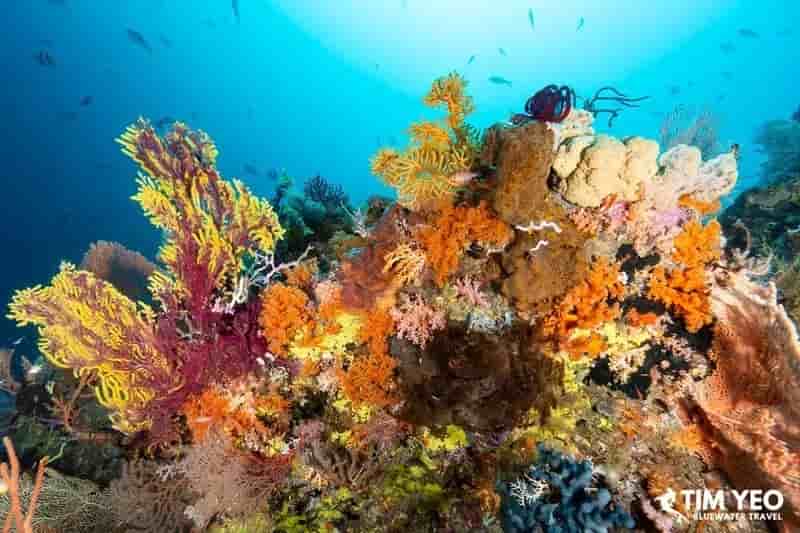
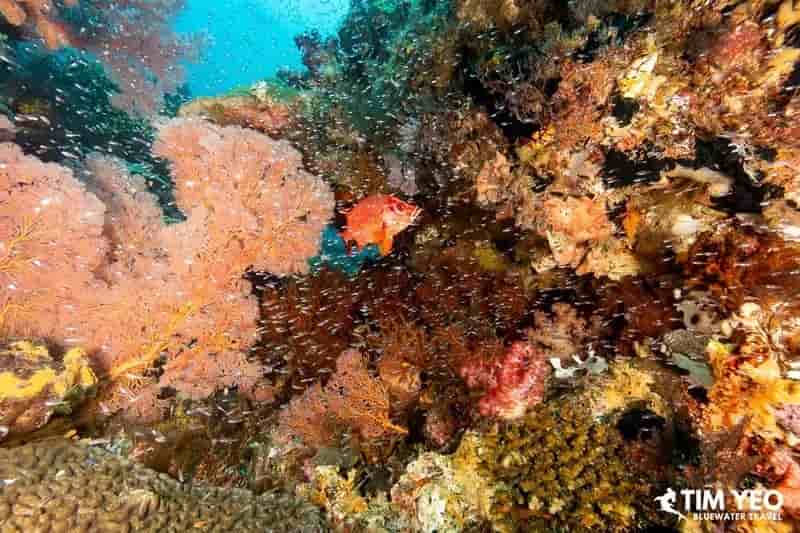
Diving in Raja Ampat is characterized by its mindblowing diversity, featuring a plethora of medium- to large-size fish, good macro, and great hard and soft coral reefs, along with some muck and mangrove sites. The water temperatures hover at around 89F (31C) year-round-so warm that a wetsuit is hardly needed. The archipelago's topside scenery is also stunning.
Being so remote, getting to Raja Ampat diving is no easy task, as it requires three or more flights from most parts of the world. But you should do it!In fact, Raja Ampat is one of the few dive travel destinations that many people say they would definitely go back to - the Bluewater Travel staff included!
-optimized.webp&w=640&q=75)
Expert insight from Scott Gietler, Founder & CEO of Bluewater Travel
My experiences scuba diving in Raja Ampat, Indonesia have been nothing short of spectacular. Corals, fish, exotic sharks, manta rays, huge schools of fish - Raja has it all. In my opinion, it deserves its reputation as the top coral reef dive location in the world. That said, there are a few things I’ve learned on my visits there that everyone should know.
First, visibility can be variable. Some trips will have great vis, but sometimes the vis can drop because of plankton. It’s hard to predict, and if you have a low visibility trip, I’ll say try to go back again.
Second, the operator, itinerary and dive site selection can make a huge difference in what you see. If you have specific goals, it’s best to go over them with one of our agents, so we can help you find the best options. We have hundreds of customers going to Raja every year and we are constantly getting personal feedback from them on their trips - I do not know of any other company with this knowledge base, at this scale.
Last, but not least, Raja can be enjoyed by either liveaboard or resort. Food, amenities, accommodations are always being changed or upgraded, so again check with us for the latest opinion on quality. There are some nice resorts, but Raja is remote so keep in mind that “luxury” has a slightly different meaning in such a remote location.
That’s all, I hope you have an amazing trip!
– Scott Gietler, Founder and CEO
Raja Ampat is located in the province of West Papua (formerly known as Irian Jaya) in Indonesia. It is situated in the heart of Indo-Pacific's Coral Triangle, which is home to the richest marine diversity in the world and some of the best scuba diving in the world.
The word Raja Ampat means "four kings" in the Indonesian language, and this refers to its four main islands: Misool, Salawati, Batanta, and Waigeo. Another smaller island, Kofiau, and over 1,500 small islands and cays form the entire Raja Ampat archipelago.
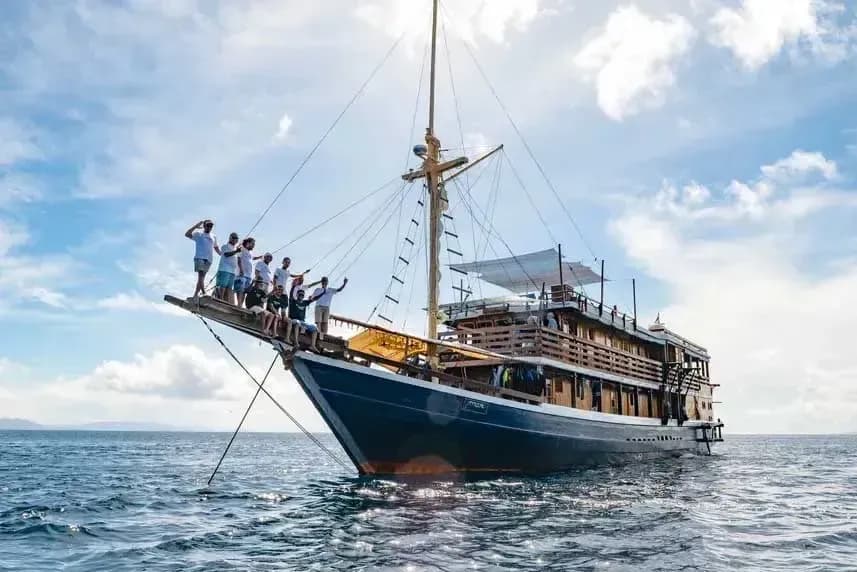
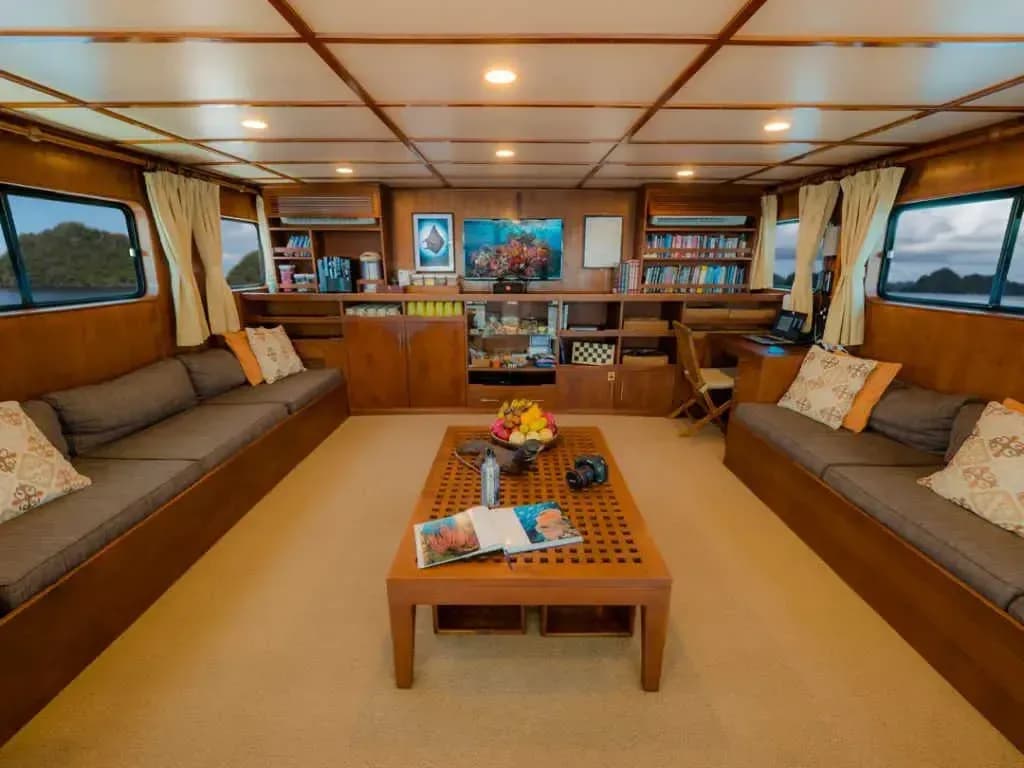
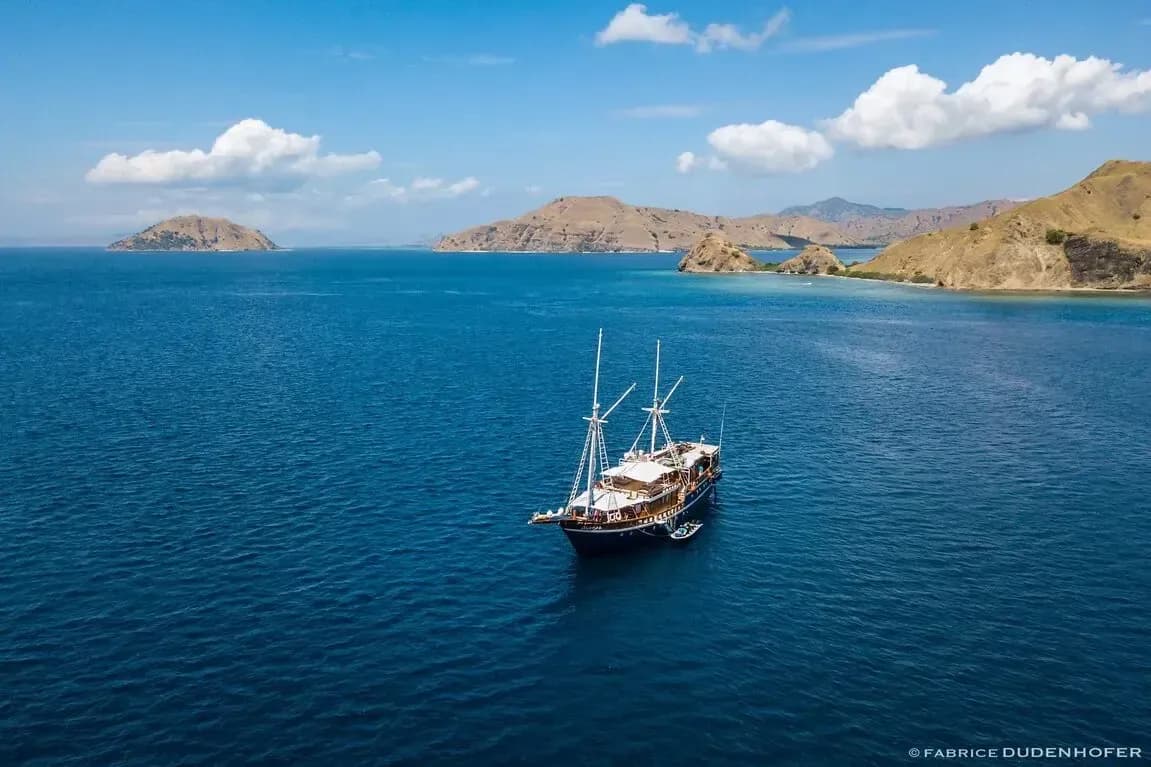
The Dewi Nusantara is an elegant three-masted liveaboard that explores some of the richest marine environments on the planet, from Raja Ampat and Komodo to the Banda Sea, with spacious cabins, attentive service, and exceptional diving operations throughout. Known for its experienced crew, excellent food, and access to remote sites few divers ever reach, Dewi Nusantara has earned its reputation as one of the world’s premier liveaboard experiences.


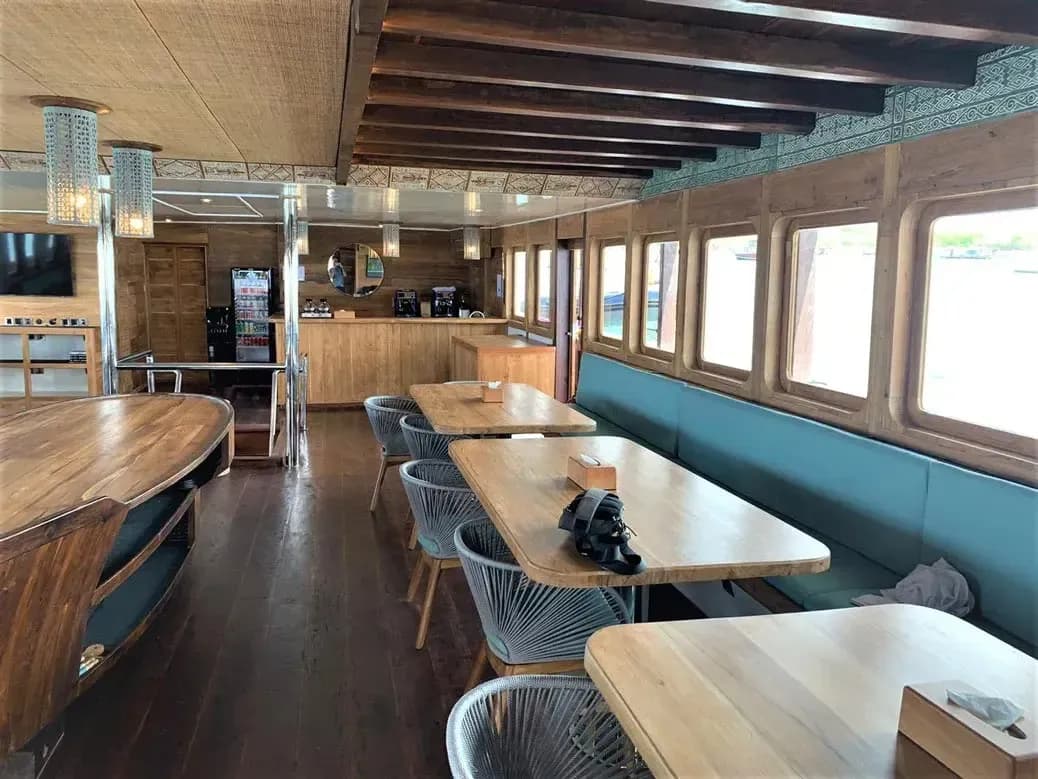
The Pearl of Papua is a great option for divers looking to experience Raja Ampat without stepping into the ultra-luxury price range. This traditional Indonesian schooner combines comfortable en-suite cabins, experienced dive guides, and access to Raja Ampat’s world-class reefs at a more affordable price point than many higher-end liveaboards. With a maximum of just 14–15 guests onboard, divers also benefit from a more personal atmosphere and smaller dive groups throughout the trip.


View All Liveaboards & Availability
Scuba diving in Raja Ampat is usually done via liveaboard, which allows you to visit all the best Raja Ampat scuba diving spots in one visit. Such liveaboard trips are offered from October to May, during the prime season for Raja Ampat diving.
A good number of land-based options are available for all kinds of budgets, scattered across Raja Ampat's many islands. Some of our staff's favorite resorts are found in Raja Ampat.
For those seeking a luxurious diving experience in Raja Ampat, the Raja Ampat Aggressor liveaboard offers exceptional comfort and access to world-class dive sites. The Majik Liveaboard, a luxurious phinisi, offers an intimate, private-charter diving experience. Another option, the Nataraja liveaboard explores Raja Ampat, Komodo, and remote Indonesian reefs, offering expert-guided dives with manta rays, reef sharks, and abundant pelagic life.
Over multiple trips shooting Raja Ampat, I’ve found that no two visits are alike. Some days are all about swarms of fusiliers and reef sharks at sites like Blue Magic or Cape Kri; on others I’ve spent whole dives stalking wobbegongs or pygmy seahorses on the reef. As a photographer, what keeps bringing me back is that you can shoot everything from big‑animal scenes to tight macro portraits on the same itinerary—and often on the same day.
– Mark Hatter, Author & Underwater Photojournalist
You'll find one of the highest numbers of fish species of any place on the planet when diving in Raja Ampat, making it one of our top 5 underwater photography destinations. This area also hosts some of the world's most beautiful coral reefs.
To see what recent expeditions have been like in different parts of Raja Ampat, explore our detailed trip reports with day‑by‑day notes and photos:
You can browse all of our Raja Ampat trip reports here.
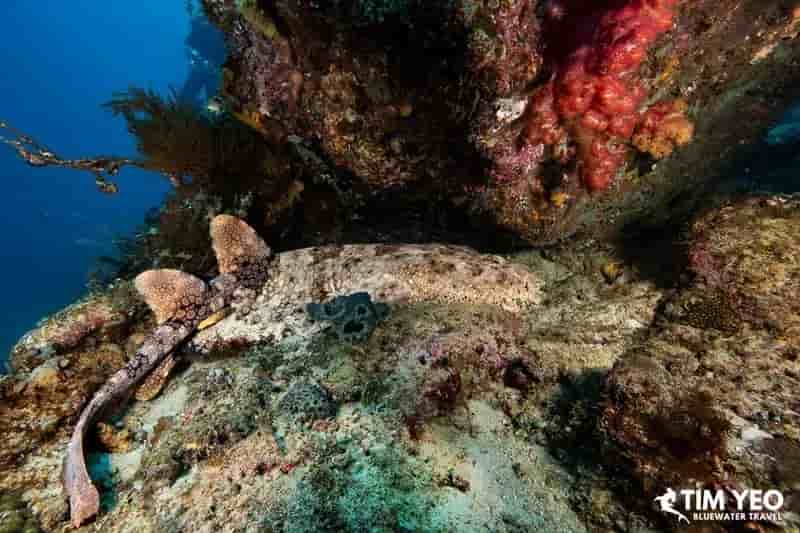
Wobbegong sharks and reef sharks are commonly seen, especially once you learn where to look for the Wobbegongs. The rare endemic Raja Ampat Epaulette shark (walking shark) is also found on certain night dives. This small, harmless carpet shark only comes out at night. While appearing to walk on the ocean floor with its fins, it can actually move surprisingly fast!
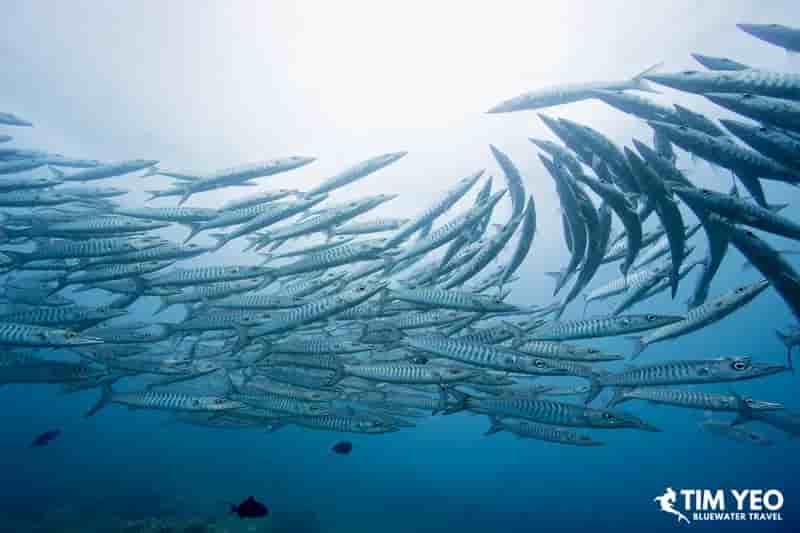
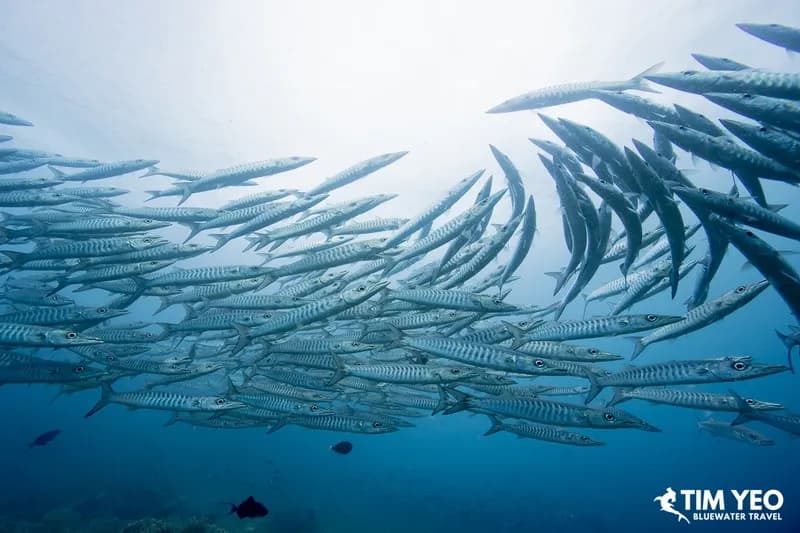
Jacks, barracuda, Napoleon wrasse, trevally, and bumphead parrotfish are seen on many dives. Pygmy seahorses are found at most dive sites, along with a good variety of nudibranchs. Macro diving at the piers is excellent. You will also see lots of juvenile fish, such as batfish, angelfish, butterflyfish, barramundi cod, parrotfish, etc.
If you look a little deeper when the current picks up, you can see reef sharks at most sites, especially at places like Blue Magic and Sardines. These are also prime locations for schooling fish, which tend to gather when the current is running. At such times, it's not unusual to be surrounded by clouds of fusiliers and surgeonfish in mid-water while legions of sweetlips completely obscure large coral heads below.
Muck diving might not be the major draw in Raja Ampat, but divers can find a large range of macro subjects such as shrimps, eels, squid, jawfish, blennies, gobies, and more. There are some muck diving sites in Raja, but we think it is better to plan a dedicated macro photography trip somewhere else.
The fortunate diver may encounter the remarkable golf-ball-sized blue-ringed octopus. These highly venomous cephalopods rank as one of the most deadly animals on earth. A single bite from this diminutive octopus means quick and almost certain death. However, these creatures are rarely aggressive and present no danger to divers as long as a respectful distance is observed.
Although Raja Ampat diving is not comparable to Socorro or Galapagos for big animal encounters, there are a couple of dive sites like Manta Sandy that are very reliable for manta rays.
Schools of large bumphead parrotfish are frequently encountered, especially at sites like Cape Kri and Boo Windows. Great barracuda and Napoleon wrasse can also be seen at several sites.
If you're lucky, you might even catch a glimpse of a dolphin or a whale while visiting Raja Ampat.
In general, diving in Raja Ampat will involve a large number of fish circling you and a mild or possibly strong current. Healthy reefs often extend much deeper than 100ft and are also healthy in 10ft of water.
Most of the time when scuba diving Raja Ampat a tender boat will drop you at the dive site, and do a live pickup wherever you surface. Although there are around 40 liveaboards currently in Raja Ampat, they cover an enormous area and generally, you will have dive sites to yourselves.
Depending on tide movements, some dives can involve strong currents, and some divers will use reef hooks to tether in place. Otherwise, an open water ascent may be required. In such cases, the tender crew needs to be vigilant to ensure safe retrieval of every diver. A surface marker buoy (SMB) is highly recommended for Raja Ampat scuba diving, so the crew can easily identify distant, drifting divers.
Most dive sites in Raja Ampat range between 30 and 130ft (10 and 40m), with much of the most colorful life found close to the surface. Some deeper dives afford the opportunity to spot large schools of jack, fusilier, and surgeonfish, as well as reef sharks and visiting manta rays. However, at some of the shallower sites, there is a fantastic range of macro critters waiting to be discovered.
Raja Ampat is home to several different shark species, and most divers will encounter whitetip, blacktip, and gray reef sharks during their dives. You can also encounter some more unusual species while scuba diving Raja Ampat, such as wobbegongs and several different types of sharks.
For those passionate about marine life and discovering weird and wonderful new species, Raja Ampat diving is the best in the world. The region holds the record for the highest number of species recorded in a single dive and boasts the richest marine diversity on the planet. The challenge of getting to Raja may be a bit much for some, but it is well worth the journey for divers keen to experience this uniquely breathtaking array of life and color.
Raja Ampat scuba diving can be done by liveaboard or from a shore-based resort. We can help you put together the perfect dive package, including accommodation, diving, and land-based tours, as well as provide advice on the best flight routes and how to get to Raja Ampat.
Many Raja Ampat liveaboards and resorts offer open water and beginner diver training, and what a place to learn! We would recommend a shore-based resort for beginners as this provides the best facilities to learn at your own pace. Once qualified, there is no better way to improve your diving than to embark on a liveaboard and practice all the new skills you've learned.
While the diving in Raja Ampat isn't overly challenging, some sites experience mild to medium currents, and so some experience is required. The region's remoteness also means it is better suited to advanced divers. Practicing good diving techniques and etiquette is crucial when scuba diving Raja Ampat, as misplaced fins or a dragging SPG can cause significant damage to this unique habitat.
While Raja Ampat isn’t as extreme as some big‑animal destinations, its remoteness and currents mean it’s best suited to divers with at least a few trips under their belt. I recommend that visiting divers are comfortable in mild to medium current, able to do live boat pick‑ups with an SMB, and happy spending a week or more in a very remote setting with limited connectivity.
Liveaboard itineraries typically run 7–12 nights, with multiple dives per day and tender drops on most sites. To cover North, Central and South Raja Ampat in one trip, you’re generally looking at 10–12 nights. Resort‑based trips can work very well for beginners or anyone who prefers to ease into the conditions with house‑reef dives and structured training before heading out on full‑day boat trips.
Because the season is limited and the area is so popular, it’s wise to plan Raja Ampat at least 9–12 months in advance if you want the widest choice of boats, resorts and cabin types. Our team books hundreds of Raja trips every year, so if you have specific goals—manta rays, walking sharks, macro, photography workshops—we can match you with the operators and itineraries that fit those best.
Raja Ampat is a massive area, and we've broken down the best dive areas in Raja Ampat. Pick a dive spot or scroll through the entire list:
This is "classic" Raja Ampat scuba diving - Cape Kri, Manta Sandy, Mios Kon, Mike's Point and Arborek Jetty. Sites like Sardine's Reef, Mike's Point and Blue Magic are considered "epic". These world-class sites should be dived early and often. Currents can be strong, but the currents bring the fish out. Wobbegongs are more common in this area. There are also good mangroves with archerfish near Citrus Ridge that are worth a visit.
Cape Kri is often referred to as the most diverse dive site in the world, with respect to fish life. Dr. Gerald Allen documented 374 species of fishhere in a single dive, a world record! We think it's one of the best dive sites in Indonesia, if not the world.
Best Dive Sites at Batanta IslandBatanta has several muck diving sites that may produce weird critters, macro subjects, and various cephalopods. These sites are fairly close to Sorong and are often done on the first or last day of a Raja Ampat scuba diving trip.
Best Dive Sites at Misool IslandMisool is known for its exceptionallycolorful soft corals and forests of healthy mangroves. In some places, soft corals are actually growing on mangrove roots in very shallow water, which makes for some excellent wide-angle photography.
There are also archerfish in the shallows. These fish hunt insects on low-hanging branches and knock them into the water by spitting water at them! If you want great soft corals, make sure Misool is on your itinerary.
There was a saltwater crocodile attack in the mangrove area of Misool in 2009, so please note that some boats are avoiding the mangrove area. This is a rare incident, and most dive operators would work closely together and notify each other if they ever catch a crocodile sighting. Raja Ampat scuba diving sites around Misool, such as Boo Windows, are full of fish, color and are simply outstanding.
On the south side of Waigeo Island is a famous dive area called "The Passage", also known as Kabui passage, where mangroves and soft coral exist in very shallow water. Overhanging trees meet sea fans here, and it is considered heaven for shallow water video and wide-angle underwater photography. Not all Raja Ampat scuba diving trips stop here - check with your particular trip.
Triton Bay is actually several hundred miles southeast of Raja Ampat, and boats usually sail out of Kaimana, not Sorong. This area is quite remote, and not many boats go here. Visibility is usually only 15-30 feet due to nutrients in the water, but the life here is fantastic, with a profusion of soft corals and fans along with incredible fish diversity. Diving with whale sharks is also possible in Triton Bay.
Fak Fak and Kaimana are also located in this area. In some years, dive boats have not been allowed into this area because of permission disputes.
The Raja Ampat scuba diving season is governed by the monsoon, which hits the islands with rough seas and strong winds between June and September. The majority of resorts are closed during this time, and liveaboards move to other parts of the Coral Triangle. From October through to May, the entire region experiences calm seas and clear, dry skies.
October to May is considered the best seasonfor diving in Raja Ampat when you'll find less rain, calmer seas, and better visibility. You will be able to visit all the main diving hot spots from northern Wayag to southern Misool Island.
The monsoon season in Raja Ampat runs from mid-June to mid-September. During these months, most liveaboards move to Komodo, as the southern Raja Ampat area becomes inaccessible due to rough seas and higher winds.
However, the northern and central Raja Ampat scuba diving areas remain accessible throughout the year via some liveaboards and dive resorts.
Raja Ampat has traditionally been tricky to get to, and routes haven't become any easier since COVID. Many airlines have limited their domestic flights and so expect to plan at least one, if not two layovers during your journey. The most popular route is to fly internationally to Jakarta – Soekarno-Hatta International Airport (CGK), then take a domestic flight to Sorong – Domine Eduard Osok Airport (SOQ). Another option is to route through Singapore – Changi Airport (SIN) for international connections. Read our guide to domestic flights in Indonesia. We are happy to assist with finding the best flights and hotels for your journey.
Please note that baggage allowances on the flights to Sorong can be small, and excess baggage charges are strictly enforced. Staying overnight near Staying overnight near Jakarta Airport (CGK)before and after your trip is highly recommended. Contact Bluewater Travel staff for assistance to plan the best route for your trip.
There are plenty of great dive resorts and liveaboards in Raja Ampat.
Most Raja Ampat dive resorts offer all-inclusive meal plans, since the locations are remote and eating out at a restaurant, in most cases, isn't an option.
Raja Ampat has many liveaboard options, from basic and mid-range liveaboard boats to some of the luxurious boats in the world, such as the Velocean. The boats in the area are often praised for their service and hospitality. It's a truly hospitable country after all!
During the main Raja Ampat diving season, many liveaboards offer 7 to 12-night trips, typically leaving starting and ending in Sorong. To visit the entire Raja Ampat--North, Central & South Raja Ampat--you're looking at a 10 to 12-night trip.
Check out some of the itineraries on offer from the Aggressor fleet.
Some Indonesia liveaboards will do one-way trips between Ambon, the Banda Sea, or another region, to or from Raja Ampat, which is a great way to see a larger more diverse area, as the boat transitions from one region to another. For combination trips, search our great range of Indonesia liveaboards.
Hiking: Hikes on some of the islands can offer outstanding vistas. The trek to the top of a small island can be sweaty and steep, but once you reach the top, the stunning panorama of the expansive ocean, dotted with picturesque islets, will make you forget your burning legs and lungs! Bring sturdy hiking shoes, not flip-flops, for these hikes.
Cultural Tours: Cultural tours to visit local tribes are available. Contact us for recommendations of reliable tour operators.
Nightlife & Other Activities: There is not much to do in Sorong, and most areas will have a rather spotty internet connection. Be prepared to get disconnected from the digital world and reconnect with Mother Nature!
If you're looking to dive somewhere else in Indonesia after a Raja Ampat trip, there are a few great scuba diving destinations that you can consider.
Manado, Bunaken, and Lembeh Strait in North Sulawesi aresome of the easiest options, with direct flights available from Sorong (SOQ) to Manado (MDN). A flight to Manado would take you less than 2 hours, and within a 2-hour car ride or less, you can be in Lembeh Strait, the muck diving capital of the world!
If you're looking for an off-the-beaten-path diving destination, Sulawesi has a lot to offer. Great scuba diving destinations keep popping up in Indonesia. Contact Bluewater Travel Advisors for the latest information!
Bali is a possible option, although getting there may not be as convenient as going to Sulawesi. Direct flights from Sorong to Bali (DPS) are uncommon, and most require at least one stop in a city in Sulawesi, likely an overnight layover in Makassar (UPG).
Raja Ampat isn’t only for experts, but some experience really helps. Many sites have mild to medium current, and most diving involves tender drops and live boat pick‑ups. Confident intermediates do very well here, and beginners are usually better off starting at a resort that can offer training and easy house‑reef dives before tackling the more exposed sites.
Both work, and I’ve done and enjoyed each. Liveaboards are the most efficient way to see North, Central and South Raja Ampat on one trip and maximise your time at signature sites. Resorts are ideal if you prefer more space, a fixed base and the ability to add land‑based excursions or training days between dives.
For peak season (roughly October–May), many of the most popular liveaboards and resorts fill 9–12 months in advance, especially for Christmas/New Year and prime manta months. Last‑minute spots do appear, but if you have specific dates or boats in mind, planning early gives you far more options.
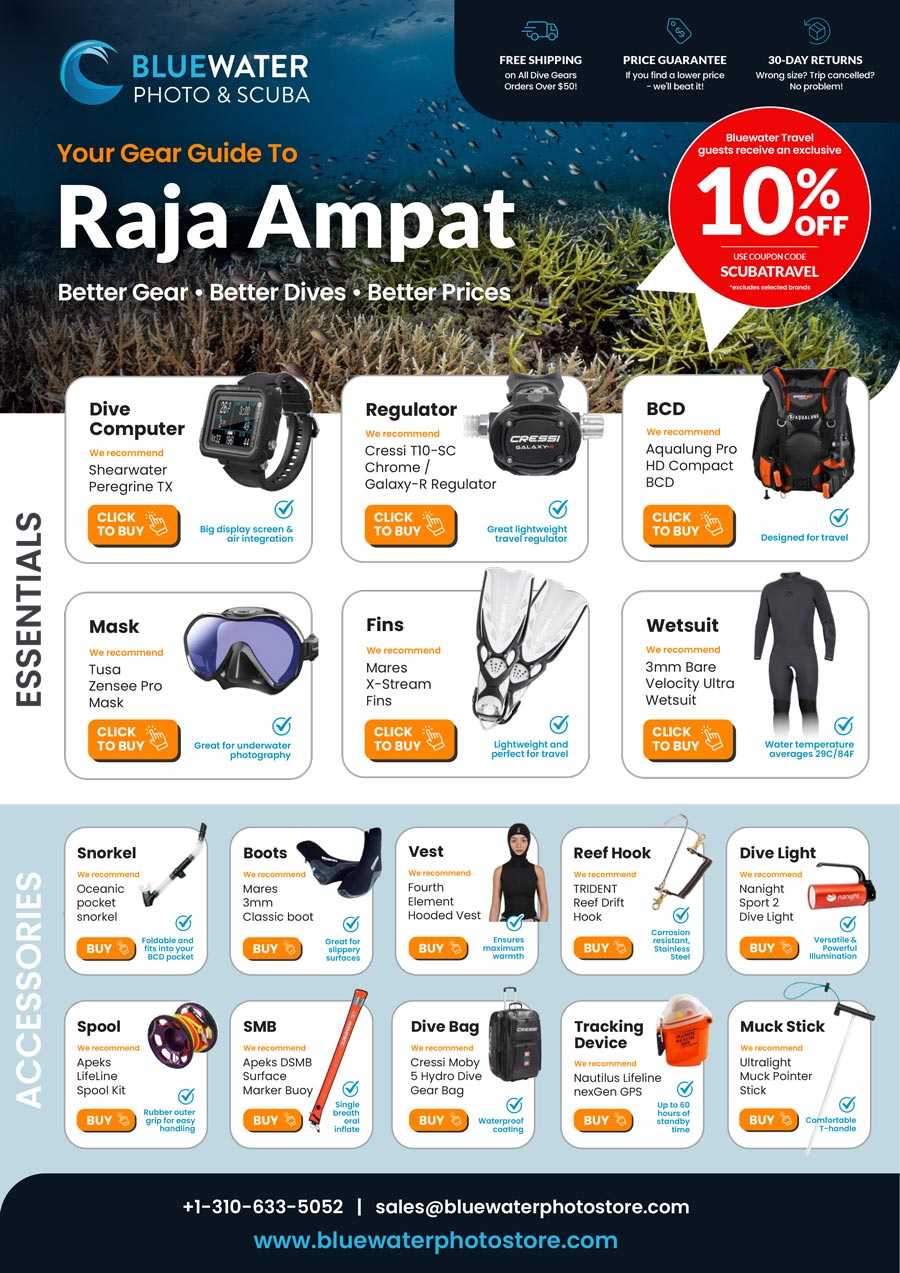
Download our full scuba gear guide to Raja Ampat, Bluewater Travel guests receive 10% OFF!


Mark Hatter is an international award-winning photojournalist who has had over one hundred feature articles with many hundreds of images published in more than three dozen diving publications and fly fishing publications over the last three decades. His most recent destination features have appeared in Ocean Geographic and Asian Diver (UK) magazines.
Mark has traveled the world in pursuit of new underwater photography challenges, including cold-water destinations such as British Columbia and even Antarctica.
“Of course, I love shooting in tropical locations but I think cold water diving is a great forcing function to hone one’s photography skills as the environment and equipment are much more demanding of a diver. Good image capture in cold water is particularly rewarding.” Mark tells us.
Mark has been shooting underwater since the early 1980s and has worked in both film and digital mediums in his photojournalism pursuits. In 35 years of diving, Mark has logged over 2,500 hours, much of it doing underwater photography. Currently, he teaches underwater photography classes locally at Seminole Scuba in Lake Mary, Florida and works for Aggressor Adventures as a commercial photographer and writer.
Learn more about Mark with this amazing video!
I joined a liveaboard trip which passed through Raja Ampat for a few days worth of dives. Raja is everything and more than the hype people share about it.When people say "There was not a place to put your finger"; thats Raja Ampat on nearly every dive. Football fields of continuous coral. Coral growing on top of old coral for meters deep. Fish tucked into every hole, anemones the size of a diver, barrel sponges, soft corals and fans larger than a diver. The colors are extraordinary, the schools of fish are large and active, there is more macro than you can photograph on a single dive in a 5 sq. meter area.By my California standards the visibility was amazing on nearly every dive we had around 50-100ft visibility. Many dives had a slight current to them to help push you along, some had stronger currents that required pre-dive planning. One one or two dives a reef hook came in handy (if you could manage to find a non-living spot to place it). SMBs and reels are mandatory safety tools.The islands are beautiful and the dense jungles reminded me of Jurassic Park. The water was warm, 86 degrees F. The seas were relatively calm for our journey. The locals are incredibly helpful and friendly, one lent me a cell phone to make a call.All in all, I suspect that my trip to Raja Ampat may rank as the best coral diving I will do in my life, and I have a lot of diving left to do. I will certainly look for an opportunity to return to Raja.
The marine life in Raja Ampat absolutely blew my mind - It was an underwater photographer's dream!This was the first trip I had taken to the tropical Pacific, and it more then exceeded my expectations. Picture the perfect coral reef ecosystem, and this is exactly what you will find here. The healthiest coral coverage I have ever had the pleasure to experience, with an ideal mix of wide angle and macro photography options.Wide Angle: Napoleon wrasse, hawksbill and green sea turtles, batfish, schools of sweetlips, clutchs of staghorn coral, manta rays blacktip and whitetip reef sharks, giant clams and wobbegong sharksMacro: Peacock mantis shrimp, nudibranchs, pygmy seahorses, blue-ringed octopus and anemonefishPlus SO much more!
The so-called epicentre of the coral triangle does not disappoint even the most jaded of divers. The water was unseasonably warm and perhaps slightly lower visibility than previous visits due to the earlier rains, but the fish life is still varied and prolific being a protected marine park.We had 10 days of diving the Dampier Strait iconic sites. While there were no mantas spotted this trip, most impressive were the schools of Barracuda on most dives, jacks and sweet lips on others especially the Arborek Jetty dive.Coming from Australia, I was excited to see so many barramundi cod but less enthusiastic than the guides to see wobbegong sharks which are common on our east coast. I particularly enjoyed a bi-plane dive which was richly encrusted with corals and home to tiny anthias decorating the wreck in bright colors.Our last dive this trip was a gin clear dive on Sardine’s reef, where just hanging in one spot you could see entire layers of the marine food chain in action. It is only in such clear conditions you can truly see the magnificence and scope of the corals and fishes Raja Ampat has to offer.
Raja Ampat is every diver's dream. The vast amount of fishes + corals in the underwater world is captivating. It is worth every penny to go there. Yes a little of beaten track but if u want the best of nature unspoilt healthy marinelife, it is worth travelling there. At least a once in a lifetime experience.Flights into Jakarta international airport. Then off to Sorong. Most indo flights do that. Most operators/hotel ppl will pick u up from Sorong. Then a ferry to Waisai where most liveaboard boats will sail.A must do dive sites would be Blue Magic, Cape Kri, Airborek Jetty, Manta Sandy, My Reef, Melissa's garden, Mike Point.Big fishes like barracudas, sharks, mantas? Bumpheads are surely there. Not to mention the usual sweetlips, batfishes, morays, nudi + pgymy seahorse for the macro lovers. Raja Ampat is famous for its wobbegong, epaullette walking shark + blue ring octopus.An evening walk to Piaynemo is a must. Walk up to get the great view.Much said, I am back for another trip again in Dec 2019
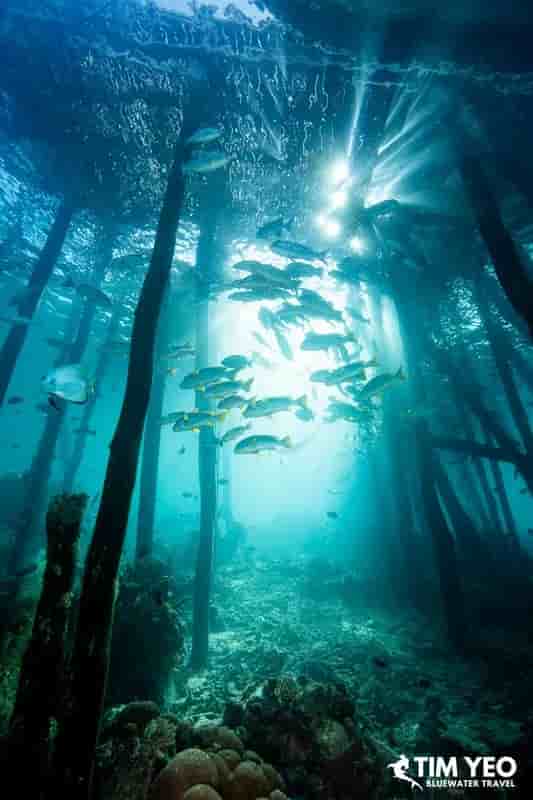
I dived Raja Ampat on a liveboard, which the marine biodiversity was absolutely amazing! Very healthy corals, both hard and soft coral - very colourful and fishy! Offers stunning wide angle opportunities as well as great muck diving. Clearly with muck diving, if you are not diving the sites daily it may take a little bit of time to find the critters. Dived Aborek Jetty which has lovely soft coral growth on the jetty pylons and schooling fish next to the jetty - made for some great photo opportunities. There are many great dive sites that the liveaboards can get you to with ease.Travel tips - fortunately from Australia it is not difficult or long to get to Indonesia. Generally flying into Sorong may require a stop at Manado (Lembeh) which I would recommend before flying over to Sorong, particularly if you are getting on a liveaboard. If your luggage goes missing, staying at Lembeh will give you time for your luggage to catchup!
For any serious diver, Raja Ampat should be the destination on the top of their list. No other spot in the world offers the variety of pristine coral reefs and reef fish that Raja offers. While liveaboards are the preferred way to see the region, several very nice and elegant dive resorts have popped up.While not a part of the region per se, Triton Bay to the Southeast ranks as one of the most exotic dive areas of the world. Unfortunately, my attempt to make it there was foiled by sea pirates who try to extract money and gasoline from divers. While I understand the situation is better, it is still a risky spot to go (not for your life, but for your diving). Several people on my boat had been there and confirmed that it was very good, but visibility is limited and currents can be tricky. I still want to go there someday. One other note, Triton Bays boats leave from Kaimana instead of Sorong. A year before we were there a plane crashed on landing, so it is not without some risks.The first area of south Raja Ampat of diving note is Daram Islands. Like the entire area, the seas are warm and the area is filled with schools of fish and clouds of antheas. It is very remote and rarely dived except by liveaboard, so it is outstanding.Onward to the dive sites around Misool. This is the pinnacle of this area and therefore the pinnacle of the world's coral diving. The currents can be very strong here however. My teenage daughter got caught in a washing machine whirlpool current and had to be rescued by a divemaster. She is a good diver and was not in danger, but it scared me. One could easily spend a week here which is why the MIsool Eco Resort has been so successful. We stopped by there and had lunch and the place is heaven on earth. Even my non-diving wife would be blown away by the place I am sure. My favorite island was Boo and the Windows site is pictured on most picture books of the area. You get the idea.We dove the Blue Mangroves which was great. A diver was bitten there once by a crocodile a few years earlier so our Indonesian guides refused to go into the water. We had one diver hang out as a lookout and we had a great time. My aforementioned daughter did stay in the boat here however.The diving in the north part of Raja Ampat is not quite as good (by a small amount) as the diving in the Misool area. The center of this area is Cape Kri which is a point out into the Dampier Straight with very very good diving. You can easily spend a day here. About a 30 minute boat ride away is Manta Sandy which is supposed to be the most reliable place in the world to see mantas. I have been there 4 times and the only mantas showed up on the dive I skipped. Oh well. I did see the largest octopus that I have ever seen though and it kept us entertained for 30 minutes.The Aboratek peer is also a very good site and I took an award winning photo there of a large school of fish that frequents the peer. The peer poles are covered with multi-colored soft corals which go all the way to the surface.All in all you will see just about everything imaginable here. We saw 4 kinds of pygmy seahorses. We saw mandarin fish in several locations. We saw an enormous clam that was big enough to hold a small human. You see everything here except for sharks which hopefully will return some day. We did see a couple of black tips and there is hope, but not a lot to be seen right now.We were there once in March and the weather was beautiful. We were there a second time in early July and the weather was perfect then as well although that is classified as off-season. I do know that the Misool area is not so good in our summer months.
April 2025 - My experience at Waiwo Dive Resort paired with diving through Dive Into Raja Ampat was absolutely incredible. The resort itself was clean, peaceful, and surrounded by natural beauty. The staff worked tirelessly to keep the grounds immaculate, the rooms spotless, and the meals fresh and full of delicious variety. What stood out the most was their kindness and professionalism—they welcomed everyone with warmth and grace, even when some guests weren’t the easiest. The diving with Dive Into Raja Ampat was beyond anything I could have imagined. The team was professional, friendly, and incredibly knowledgeable about the dive sites. They worked from sunrise to sunset helping us gear up, guiding us safely through each dive, and meticulously handling all equipment and sanitization after. The underwater world was breathtaking—I was lucky enough to see manta rays, sea turtles, reef sharks, seahorses, and endless colorful fish swimming through vibrant, healthy coral reefs. Each dive felt like entering a living, surreal dream. This was a top-tier experience from start to finish, and I’m so grateful to Anne Rucquoi at Bluewater Travel for helping me organize such a seamless and magical trip.
I visited Misool in April by liveaboard, and it was some of the most fish-filled diving I’ve ever done. Every dive felt busy—in the best way. Huge schools of fusiliers, snapper, batfish, and barracuda swirled around us, with reef sharks passing by and the occasional manta showing up. Turtles were common, and the macro was solid too—pygmy seahorses, nudis, and lots of different types of crabs tucked into the reef. You get everything here—big stuff, little stuff, and tons of variety. The reefs were packed with color: soft corals, sea fans, and all kinds of life on nearly every dive. Some areas showed early signs of bleaching, but it wasn’t widespread or severe. April is the tail end of the season, so visibility wasn’t perfect, and currents could be strong at times (reef hooks came in handy). It’s a better destination for experienced divers who are comfortable in changing conditions. No plastic slicks or miles of floating rubbish like I’ve seen in other parts of Indonesia. Misool felt remote, healthy, and alive. I definitely want to return to explore more of Raja Ampat—it’s a region that really deserves multiple trips.
I traveled to Indonesia for an eleven-day liveaboard trip to northern Raja Ampat. After several flights and layovers, totaling about 30 hours, I arrived in Sorong, the embarkation point for the trip. Sorong is a bustling city, far larger than I expected. I was met at the airport by boat staff and was taken to the harbor for a short tender ride to the liveaboard, which was anchored nearby. After getting settled in my stateroom and preparing my gear for diving the next morning, we had dinner and turned in for the night, with high expectations for the next day.The boat sailed at night and we woke up at our first stop. As is customary, all of the diving was done from tenders. Each day three dives were offered along with a night dive. On this boat, a complimentary neck and shoulder massage were offered after every dive. No one ever passed on this wonderful perk. The boat was moved every night to a new dive location.As the trip progressed, we made our way west and north, until we crossed the equator and dove the Equator Islands. We dove a large variety of sites, including reefs, walls, and jetties. At several sites, the current was very strong, requiring a reef hook to stay in place and watch the show. The current attracts large schools of fish, and we were never disappointed. We saw large congregations of schooling Barracuda, Jack’s, Sweetlips, and many others. The biodiversity in this area is second to none. We also saw mantas, seahorses, cuttlefish, squid, many different species of nudibranchs, Leaf Scorpionfish, Mantis Shrimp, turtles, Napoleon Wrasse, and Bumphead Parrotfish. Shark sightings included Blacktip, Whitetip, Grey Reef, Zebra, Nurse, Wobbegong, and Epaulets. Night dives were always in shallow water at muck sites. The dive guides had an uncanny ability to locate pygmy (pontohi) seahorses and we saw quite a few. During these dives, Coconut Octopuses and Dragonettes were common. We were also able to find Blue Ringed Octopuses and Flamboyant Cuttlefish. Needless to say, I checked a large number of fish and other critters off my bucket list.The topside views in Raja Ampat are spectacular, including lush islands populated by birds and bats, and awesome sunsets. We did an off-boat excursion at Pianemo Island, where you make an easy climb of about 250 wooden steps to reach viewing platforms, which give you a breathtaking view for miles around.Bottom line: Raja Ampat is a wild, remote area which is largely unexplored. The biodiversity is incredible, with a large concentration of fish and corals of every variety. This is truly the Holy Grail of diving!