-(2)-optimized-optimized.webp&w=3840&q=75 "Sunshine Azure Beach Hotel Specials & Packages")
Special
Expert advice on diving,
seasons, and logistics
Free planning help
when you’re ready to book
Exclusive dive packages
tailored for you

Special
-optimized.webp&w=3840&q=75 "Sunshine Bay Zanzibar Specials & Packages")
Special
Group trip
Group trip
Scuba Dive Level
Open Water
Visibility
30 to 100 feet (9 to 30 meters)
Average Water Temperature
65
Shark Encounters
Wreck Diving
South Africa is blessed with a very rich and varied marine environment. Big animals include whales, dolphins, seals and many shark species, while the reefs and kelp forests are home to colorful nudibranchs, seahorses, octopus and crustaceans. Seasonal highlights range from Sardine Run bait balls and schooling hammerheads to humpback migrations and playful Cape fur seals. You’ll encounter a mix of Indo‑Pacific tropical reef fish on the east coast and temperate‑water critters around Cape Town and the west.
Read about the most popular dive spots around South Africa, including where you can dive with the most sharks, where to dive South Africa's famed 'Sardine Run', and where to find the best coral reefs and wrecks.
In practice, most itineraries focus on one or two regions: Aliwal Shoal / Protea Banks for shark action, Port St Johns or the Wild Coast for the Sardine Run, Sodwana Bay for warmer reefs, and Cape Town & the Garden Route for kelp forests, wrecks and topside scenery. We can help you combine areas based on your experience level, time of year and whether you prefer big‑animal or reef‑focused diving.
Recognised as one of the top ten dive sites in the world, Aliwal Shoal is famed for its shark sightings, including ragged-tooth sharks, tiger sharks and hammerheads. Located about 50km south of Durban near the town of Umkomaas on KwaZulu Natals southern coastline, this ancient sandstone reef within a Marine Protected Area has dive sites to suit all levels. In addition to the thrill of diving with sharks within their natural environment, there are also a couple of fascinating wreck dives to explore.
For divers planning to dive Aliwal Shoal and experience baited shark dives, Agulhas House and Diving offers a convenient base in Umkomaas.
If you are visiting South Africa in June or July then diving during the Sardine Run is a must. The annual Sardine Run is a natural phenomenon when billions of sardines spawn in the cool waters of the Agulhas Bank and move northward along the east coast of South Africa, with them making an appearance from the Eastern Cape right up to central Kwazulu Natal.
Their sheer numbers create a feeding frenzy for hungry and opportunistic predators from the depths, and even from the air above! Apart from the sardine bait balls that one can see, there is also the annual migration of the Humpback whales that are heading north to give birth. There are super pods of Common dolphin, thousands of Cape gannets, Bottle nose dolphin and thousands of sharks.
For those looking for a dive operator in South Africa, Ocean Warriors Dive
is a great option for Sardine Run and other local reefs.
Protea Banks is situated 7.5km straight out to sea from Shelly Beach, off the KZN Coast in South Africa. The reef lies at a depth of between 27 and 40 meters and is about 6km long and 800m wide. It consists of a fossilised sandbank which comes up from around 60m, and features caves, overhangs, and pinnacle features which attract game fish and sharks year-round. This is a deep dive with strong currents.
Protea Banks is one of the richest Tuna grounds in the world which explains why it is so strongly frequented by Bull Sharks. Almost all year round they patrol the reef in search of food.
Scalloped Hammerheads swim up and down the reef in schools that most times are often hundreds strong, sometimes thousands of animals just keep coming. The Great Hammerheads also make frequent appearances on Protea Banks. Oceanic Blacktip sharks are very common, often seen on entering the water or on your safety stop. The massive sand patch of Sand Shark Gulley is home to the endangered Giant Guitar Shark. Ragged Tooth Sharks can be seen in huge numbers during their breeding season, mostly in and around the caves of the northern pinnacle. Topping the shark list on Protea Banks is the magnificent Tiger Shark often shy but always a dominant presence in the water. Dive In Adventure Tours operates daily launches to Protea Banks from Shelly Beach, offering trips suited to experienced divers looking to explore this world-class shark diving destination.
If you can handle the cold (or own a dry suit), then the reefs around Port Elizabeth wont disappoint. In addition to Avalanche Reef, which is rich in colorful marine life and home to a vast array of corals, there is also a fantastic wreck dive at Haerlem Wreck. In 1987, this navy frigate sunk to 21 meters and is now home to beautiful soft corals, fish and sharks that hide in the countless nooks.
100km from the southern border of Mozambique lies Sodwana Bay, affectionately known as Sordies. This heavily protected marine and coastal reserve is a nature lovers paradise, both above and below the water. In addition to the impressive Zambezi and tiger sharks, expect to see tiger angelfish, butterfly fish and longnose hawkfish amidst a vibrant coral reef. Whether youre a beginner looking to venture out into the open seas for the first time or an expert looking for a technical diving challenge, Sodwana Bay has dive sites to suit. In the summer months, the water is an enticing 25C and you might be lucky enough to even see turtles laying their eggs on the parks beaches. Siso Dwana Lodge is a great base for exploring the area, with its own onsite dive center right on the reef's doorstep.
South Africas Garden Route is undoubtedly one of the country's favorite getaway destinations with beautiful scenery and coastal towns to explore. But the aquatic landscape is just as fascinating, most notably at Mossel Bay. From colorful drop-offs, swathed in corals and home to impressive fish, to great white shark cage-diving, the dives here will appeal to all adventure levels. A night dive is also highly recommended with plenty of weird and wonderful creatures emerging once the sun goes down.
Interested in diving with sharks? Check out diving with the experienced team of Scuba Addicts or Shark Diving Mozambique.
There are three major international airports in South Africa: O.R. Tambo International Airport (JNB) – Johannesburg, Cape Town International Airport (CPT) – Cape Town, and King Shaka International Airport (DUR) – Durban. There are also many regional airports, including Kruger Mpumalanga International Airport (MQP) – Mbombela (Nelspruit).
There are plenty of dive resorts and dive centers in South Africa that can meet all of your diving needs. In many areas – especially along the KwaZulu‑Natal coast and during the Sardine Run – diving is done from zodiacs launched through the surf, which can be physically intense when the swell is up. Cape Town and some eastern regions also offer shore and boat dives in more sheltered bays.
If you have back, shoulder or mobility issues, or are unsure about surf launches, let us know. We can match you with operators and regions that best fit your comfort level and explain what to expect step by step.
You can dive somewhere in South Africa year‑round, but conditions and water temperature vary a lot by region and season. In general, April–May and September–October offer pleasant air temperatures and good weather in many areas. June–August can be colder, especially in the mornings and evenings, but also overlaps with the Sardine Run and some shark aggregations.
Cape Town’s kelp forests often have their best visibility in the cooler months, while Sodwana Bay and the KZN coast are popular for warm‑water reef diving in the summer. We’ll help you pick the right area for the time of year you plan to travel.
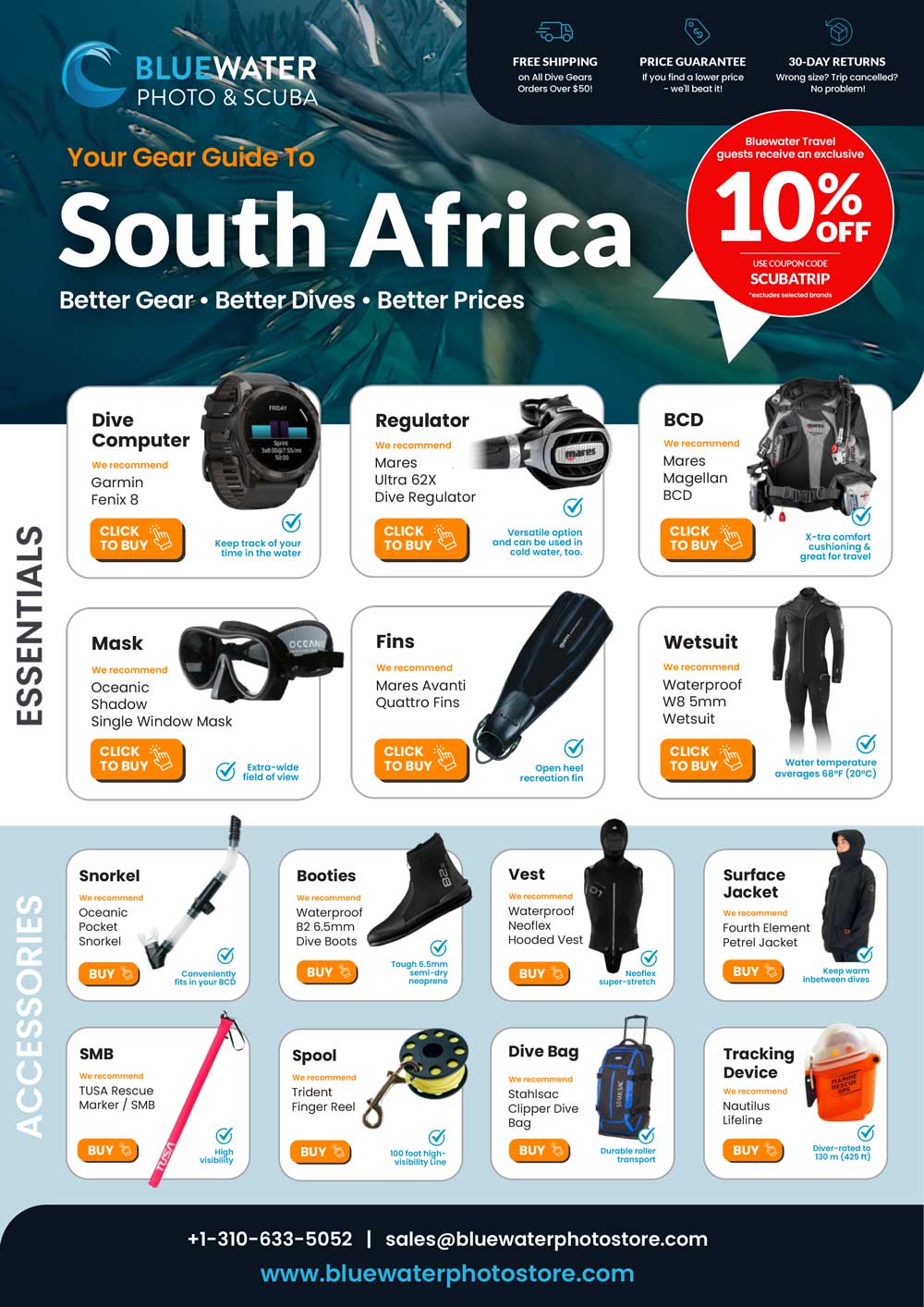
Download our full scuba gear guide to South Africa, Bluewater Travel guests receive 10% OFF! Click the image below to download (PDF).
Many of the shark and Sardine Run sites are best for experienced, comfortable divers who are used to current, swell and blue‑water conditions. However, there are also sheltered reefs and kelp forests suitable for confident Open Water / less experienced divers, especially around Cape Town and Sodwana Bay. Tell us your experience level and we can suggest appropriate regions and operators.
Most divers are comfortable in a 5–7 mm wetsuit or semi‑dry (often with a hooded vest) for Cape Town and winter diving, and a 3–5 mm suit for Sodwana Bay and the KZN coast in summer. If you’re used to warmer tropical water, err on the warmer side – you’ll enjoy longer dives and surface intervals more.
For a single region, we recommend at least 5–7 diving days to allow for weather and rest days. If you want to combine shark diving, Sardine Run or Sodwana with Cape Town kelp forests and a safari, 10–14 days makes for a more relaxed itinerary.
Yes – and it’s one of the big reasons to dive South Africa. Many guests pair a week of diving with 3–5 days on safari in reserves near Durban, Johannesburg or the Eastern Cape. We can help coordinate transfers, internal flights and timing so that your dive and safari days fit together smoothly.


We loved our trip to South Africa. We went primarily for the Sardine Run and were one of the lucky groups that saw sardines multiple times. Timing is everything as it had been rainy the previous week and the group that were there that week didn't see any. On our final day, we saw what looked like the water bubbling. It was sardines at the surface and we witnessed a shark feeding frenzy. There were probably over 100 sharks all in one area at the same time. The Cape Gannet birds seem to be great indicators of where the sardines were moving. They would dive bomb the water and almost always come up with fish in their mouths. Once when we were snorkeling close to a bait ball, a bird dove down, didn't get a fish, and had the funniest look on his face like" Wait! Wait! No fish in my mouth! What is wrong with this picture!"The weather was chilly in the morning since it was winter there in July. Not much fun putting on a cold wet 7mm wetsuit but well worth the experience. Got to see dolphins surrounding us in all directions and pairs of whales swimming next to the boat. Getting on & off the boat was an experience in itself... Push the boat out, throw yourself on, and the landing...Hold onto the straps and yell with fear or joy!We tried to make the most of our trip since it is a long way to travel from Michigan's Upper Peninsula so we also went to a game preserve to see all of the big 5 and a variety of other animals. We were glad we had brought a variety of clothes because we bundled up in the mornings and stripped off layers as the days warmed to hot.Then we spent time at a land dive resort to do some diving with more typical sightings. I think that was the first time, I actually recognized an octopus on my own. Our guide pointed one out first but I couldn't see it so I remained behind until it moved and I saw the motion. Then I realized that there wasn't just one octopus but two fairly close together on the coral.The drive to the resort was also very interesting. Our driver told us about life in South Africa. We saw people rolling barrels full of water from the spring back to their homes. Fences kept people safely in and animals out as many roamed free along the roads. People were washing their clothes in streams. Buffalos were used to plow fields. We were dropped off at a cashew farm to await our transfer to where we were staying next. There we sat with our big dive suitcases in an empty parking lot wondering if tourists got left out in the middle of nowhere often. Our ride came and everything was fine. In fact, when we got dropped off there again, my husband decided to buy some fresh cashews. After he tried them, he wished he had bought more; they were so delicious.Overall, it was a fantastic trip that I would recommend to everyone.