Group trip
Expert advice on diving,
seasons, and logistics
Free planning help
when you’re ready to book
Exclusive dive packages
tailored for you

Group trip

Special

Special

Special
Special

Special
Special
Group trip

Special
Special

Group trip
Visibility
30 to 100 feet (9 to 30 meters)
Average Water Temperature
80
Tropical Fish
Stunning Reefs & Corals
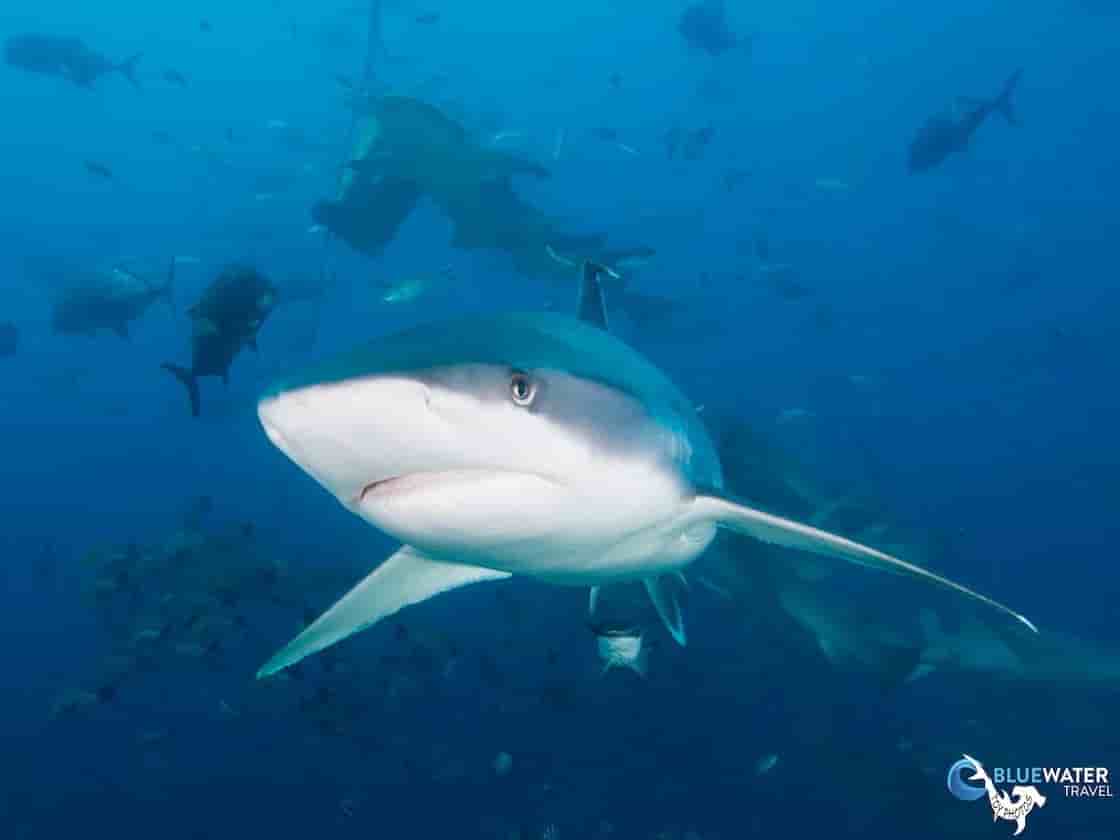
Shark Encounters
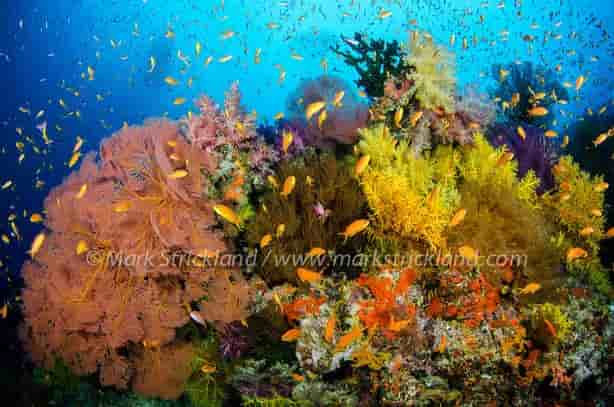
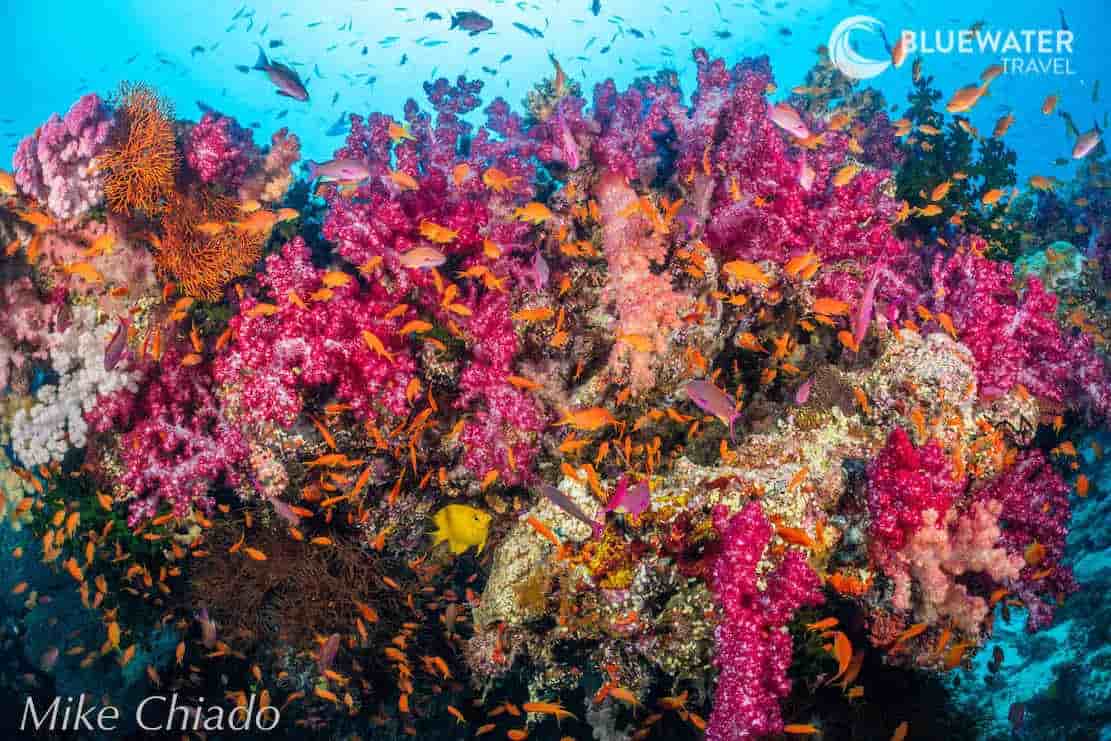
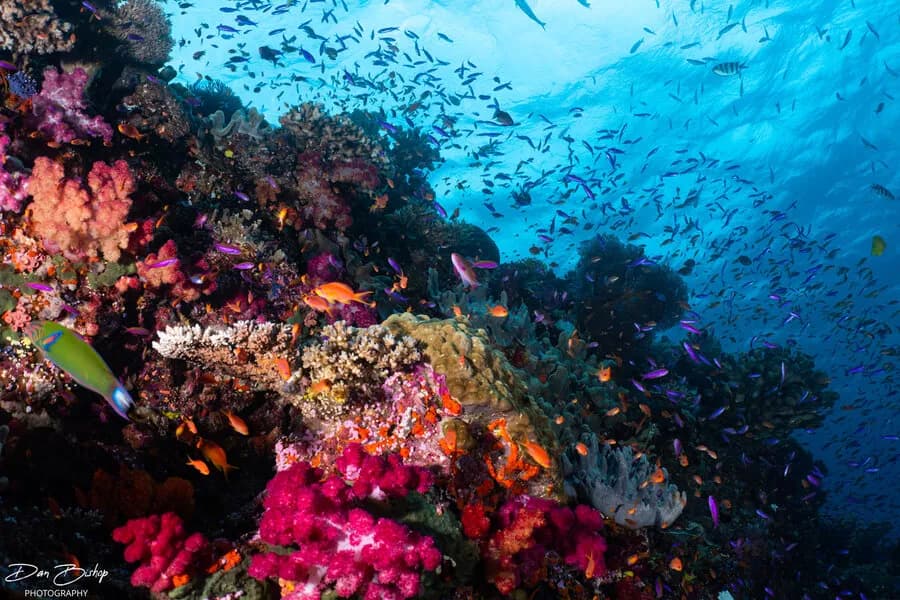
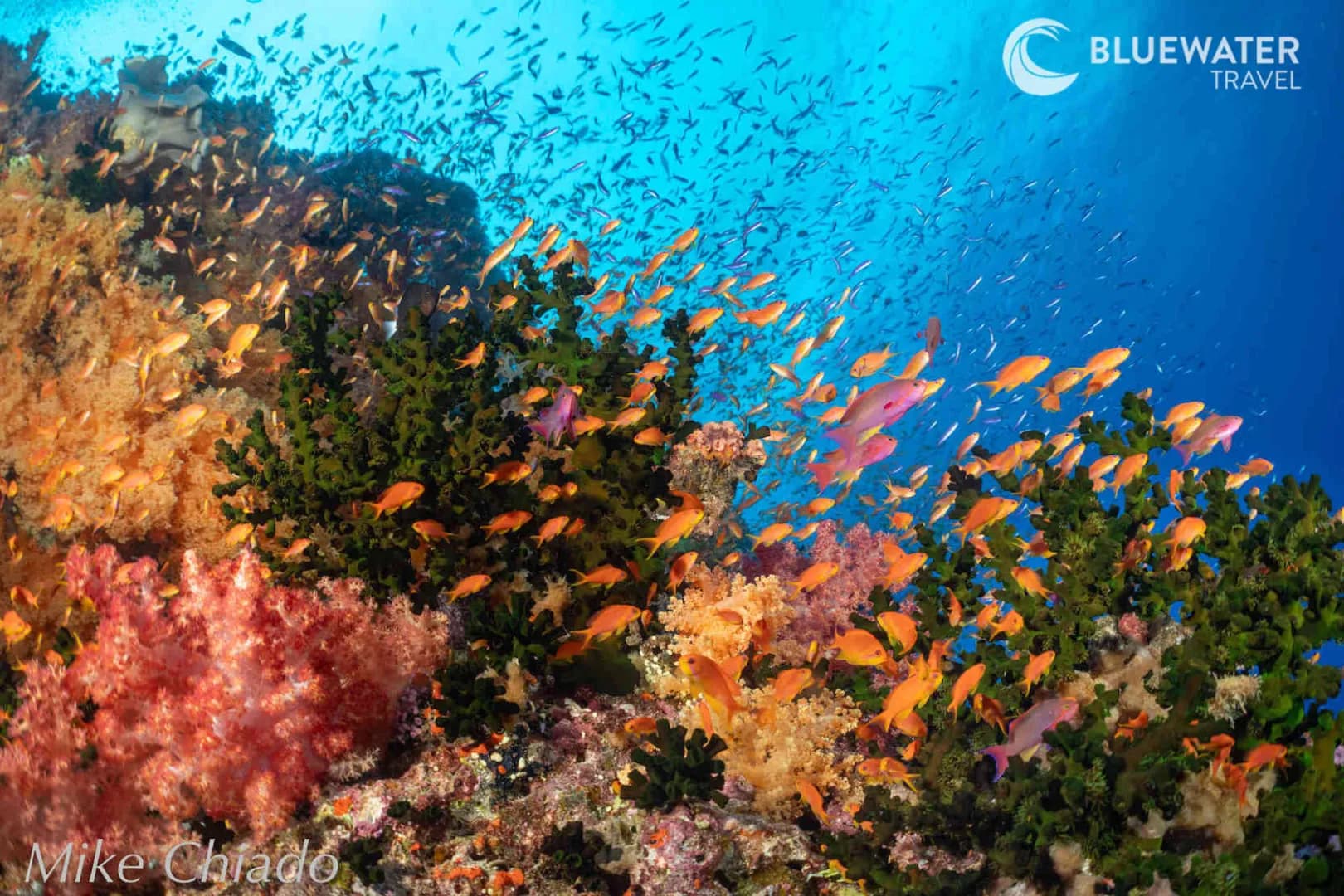
In Fiji, it’s all about the corals. The colors are so incredibly vibrant and the anthias so plentiful that it’s hard to ever look away. Around every corner is the next world-class image. Remember to get in the current. One of the main draws of diving Fiji are the reef scenes - they are quite spectacular!
The gorgeous, lush, color-splashed images of Fiji that you see in dive publications are courtesy of a soft coral called dendronephthya. Few other places in the world offer such an abundance of this coral, nor the wide spectrum of colors, ranging from pink, purple, orange, yellow and fiery red. Dendronephthya soft coral needs current. With little current present, the soft corals are muted, but as the current increases, they inflate with water and their color really begins to glow.
Watch our webinar where we tell you everything you need to know about the Bligh Water
Discover why Volivoli is one of our most recommended resorts in our in-depth article Fiji’s Friendly Gateway to Bligh Water’s Best Reefs
As the current picks up, planktivores such as beautifully colored scalefin anthias spring up off the reef in polarized schools. Together, this forms a rich pageantry of color. Underwater photographers will want to shoot when some current is present, making a dramatic difference in the color of underwater imagery.
The best places for soft coral in Fiji are the Bligh Waters between Viti Levu and Vanua Levu where there are numerous reefs and pinnacles, the Somosomo Strait between Taveuni and Vanua Levu, and Namena Island and its marine protected area.
Interested in corals? Check out our list of the Best Coral Reefs in the World.
The majority of diving is done as drift dives, allowing you to cover large distances and see walls of soft corals. Current is your friend in Fiji, as it brings out the soft corals while wildlife piles up on the current side of boomies.
As a photographer, you may wish to bring a reef hook - find a spot with beautiful colors, hook in, and shoot to your hearts delight! The tops of pinnacles and bommies usually host a plethora of life. Just hook in and shoot as the current blows you around.
Always have a safety sausage so the tender boat can see you when you surface. Despite what you may have been told, soft corals are not everywhere in Fiji — you need to go to specific areas. Likewise, there are some stunning hard coral reefs in Fiji that nobody talks about, great macro, some good pelagic life, and the best shark dive in the world. Many people take an underwater photography class before coming to Fiji.
For awesome drift diving along spectacular walls, check out diving Komodo or our Tubbataha diving guide.
Water Temperature: Dry season (June–Sep) temps are in the mid‑70s °F, with August being the coolest month. Wet season (Dec–Apr) temps are in the low 80s °F, with Feb/Mar being the warmest months underwater.
Visibility: During the dry season, visibility is often 100+ ft outside the lagoons. The Bligh Waters can have high visibility even in the wet season, ranging from 80–100 ft.
Weather: Fiji is warm and tropical most of the time with air temperatures ranging between 26–31 °C all year round.
Wet season (Nov–Apr): Expect heavier rain in some regions and reduced visibility close to shore due to run‑off, but outer reef sites are often still clear. Seas can be wonderfully flat after rain, and water temps around 28–30 °C / 82–86 °F make shorties and rash vests very comfortable.
Dry season (May–Oct): Less humid with cooler water—down to about 23 °C / 73 °F at the coldest. Most divers are fine in a 3 mm, but if you’re “thermally challenged” a 5 mm is ideal. Trade winds, especially June–Oct, can make longer rides to remote sites choppier—but this is also peak bull shark season in Beqa.
Currents: Often strongest near spring tides and around the equinoxes (March & September). Strong current sites have the best soft coral; on true slack tide the corals can look limp. Good operators plan around this, but for the very best soft‑coral dives, being comfortable in current is important.
Best for: Shark dives, colorful reefs, adventurous travelers who like a “family” feel.
Stay at: Waidroka Bay Resort
Waidroka is a small 3‑star boutique resort tucked into rainforest on the Coral Coast, with rustic but comfortable rooms and very friendly, authentic Fijian hospitality. It’s ideal for divers who want the Beqa Lagoon shark dive plus soft coral reefs, and also enjoy surfing, yoga, or rafting on their non‑dive days. The on‑site dive center (recently voted Dive Center of the Year 2025) offers full valet service and caters well to different experience levels. Waidroka is about 3–4 hours by road from Nadi International Airport and can organize all transfers.
Best for: Soft coral “greatest hits” and easy logistics.
Stay at: Volivoli Beach Resort
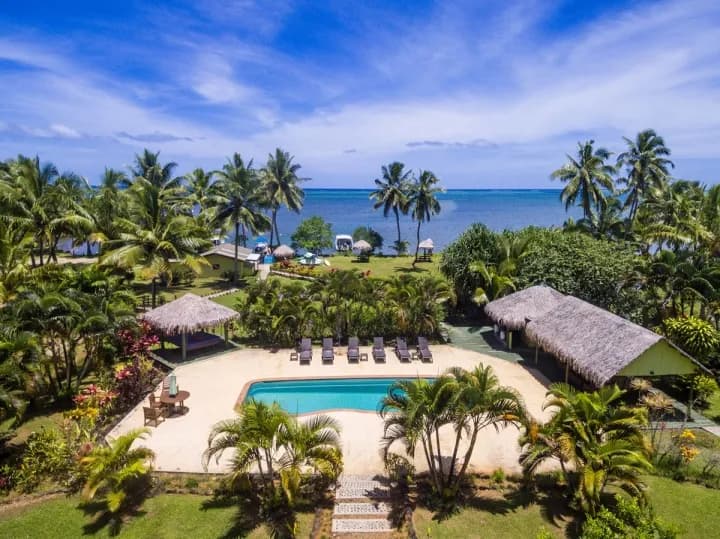
Volivoli is a popular 4‑star dive resort with ocean‑view villas, a professional dive operation (Ra Divers), and access to 90+ sites in the Bligh Water area. It’s easy to reach—no additional flights or ferries—and the resort organizes transfers. There’s unlimited shore diving on the house reef (great for macro shooters) and a well‑equipped camera room, plus big, comfortable boats with small guide‑to‑diver ratios.
Best for: Iconic soft‑coral walls (Great White Wall), more remote feel.
Stay at: Paradise Taveuni and similar Taveuni dive resorts
Reaching Taveuni involves a domestic flight from Viti Levu or a ferry from Vanua Levu—often on small planes that may split groups across flights. It’s more effort but rewarded with some of Fiji’s most untouched reef. Paradise Taveuni is an intimate, eco‑style resort largely powered by solar, very dive‑focused, with flexible scheduling, a camera room, and a good house reef for shore entries.
Best for: Remote hard corals, mantas, off‑the‑grid eco stays.
Stay at: Matava and other Kadavu eco resorts
Kadavu is for divers happy to go off the beaten path. It requires a domestic flight from Nadi or Suva and often an additional boat ride. Resorts like Matava are “true eco” – very limited electricity, central charging, no air‑conditioning, and some steep paths and stairs. In exchange you get raw, wild reef, mantas on the Great Astrolabe Reef, and a strong sustainability focus.
Best for: Seeing multiple regions without transit hassle; serious divers and photographers.
Boat: Nai’a
If you can’t choose just one area—or want access to more remote sites like Namena Marine Reserve and the Koro Sea—a liveaboard like Nai’a is ideal. Trips run 7–10 days and cover areas day boats can’t reliably reach. Nai’a has an excellent reputation for staff, food, and dive operation, and is a favorite with photographers.
Here are the top scuba diving spots that you shouldn't miss while diving Fiji:
Learn more about diving in Fiji, read all about our 2024 Photo & GoPro Video Workshop.
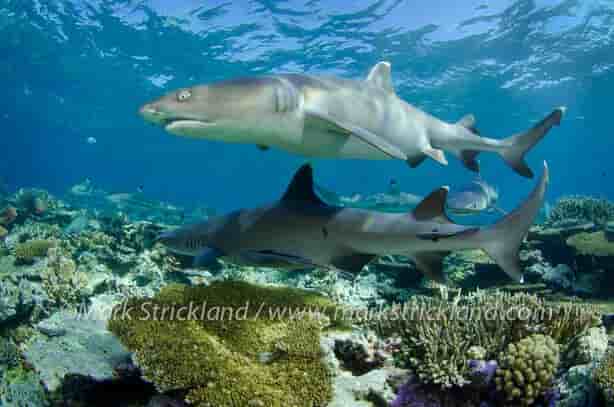
Taveuni offers great diving on the famous Rainbow Reef, which lies in the Somosomo Strait and has great soft corals and lots of reef sharks like whitetips, gray reef sharks and nurse sharks. There can be currents, so it's not necessarily for beginners. However, the soft corals look their best in the currents!
There are around 20 different dive sites on the Rainbow Reef. The "inner reef", the north side of the rainbow reef, has the best soft corals, and streams of anthias and fusiliers. Best dive sites include "Rainbow Passage" and "Rainbow's End".
The "outer reef" is on the south side of the rainbow reef, and has a better chance of shark sightings. Top dive sites include the "Great White Wall" with endless streams of white soft coral from 80ft to 120ft on a wall, and "The Zoo" which is known for more frequent big animal sightings.
Beqa Lagoon has beautiful reefs, a great variety of marine life and is also home to one of the best shark dives in the world, with several species of sharks appearing. From Nadi, it's a 2.5-hour car ride, followed by a 45-minute boat ride.
From the main island, it's a 2–3 hour drive to your resort. Staying in the central north coast in the Rakiraki area means that you can dive the Bligh Water directly from your resort, with just a 50-minute boat ride. In the Bligh Water you can see beautiful soft corals, sharks (including hammerheads on occasion) and turtles. The Bligh Water are home to famous dive sites such as Mellow Yellow, which has gorgeous yellow soft corals, and Black Magic Mountain, which has prolific amounts of fish, anemones, and hard & soft corals. Taking a boat like the Naia liveaboard is the best way to dive the Bligh Waters, but it can also be dived from Volivoli Beach Resort - weather depending.
The Rakiraki / Volivoli area also has more protected "local" dive sites that are a 20–35 minute boat ride from the resort. These sites have incredible structure, sea fans, swim-throughs, and copious amounts of fish, along with occasional whitetip sharks.
Along Fiji’s Coral Coast, divers based at resorts such as Waidroka Bay Resort can also explore the offshore pinnacle Cakau Leka Leka. This unusual site is a stand-alone coral formation rising from deep water roughly 39 km (24 miles) southwest of Viti Levu. Because of its exposed offshore location, it is rarely visited and typically accessed only on special trips when sea conditions allow.
In the Bligh Waters lies the Vatu-I-Ra passage, home to some of Fiji's best dive sites and the most amazing soft coral reefscapes. The passage lies on the northeast coast of Viti Levu, and the reefs display the most spectacular rainbow of colors. E6 is one of the most famous dive sites of the passage.
Kadavu is an island south of the main island and is less visited than most of the other islands on Fiji. The resorts on the island offer an "Eco" experience. The area is remote and pristine, and the diving has great coral and marine life, including manta ray cleaning stations. It is also known for having less current than other places like the Bligh Water or the Rainbow Reef near Taveuni. There are a lot of fish and a good number of reef sharks. Many of the dive sites are short boat rides from the resorts. Topside activities include kayaking, visiting waterfalls, and great birdwatching.
The Namena Island reserve is a one hour boat ride from Savusavu on a fast boat, if the weather cooperates. It is also frequently dived via liveaboard. Here, you can experience some of Fiji's best diving, including prolific fish, amazing soft corals, huge schools of jacks & barracudas, pelagics, sharks, and even schooling hammerheads. Top dive sites include "Grand Central Station".
Learn more about diving in Fiji from Bluewater travel advisor/trip leader Katie Yonker's Fiji & Her Islands: A Photo Essay
The Red Sea is similar to Fiji in terms of having a large diversity of fish, corals, and both big and small animals. One difference, is the Red Sea is more of a liveaboard based location, while Fiji is generally resort based. Fiji also offers more opportunities for snorkeling.
The Sea of Cortez has a great diversity of life, but not the colorful corals that Fiji has. Fiji is a nice colorful change if most of your diving has been in Mexico, or in the Caribbean in a place like the Cayman Islands.
Fiji’s department of tourism has done its homework and made Fiji one of the easiest places to get to for diving in the Pacific. Flight schedules are good and fares on the national airline, Fiji Airways, are very reasonable. Fiji is quite easy to get to from the USA.
There are daily direct redeye flights from Los Angeles (LAX) to Nadi (NAN). You cross over the international dateline along the way; a Thursday night flight gets you into Nadi (NAN) on Saturday morning. If staying there, you simply transfer to your hotel or meet your liveaboard.
When departing, you fly out of Nadi (NAN) in the late evening and return to LAX in the afternoon of the same day—you get back the day that you lost going over the dateline. If flying to one of the outer islands, the domestic terminal is next door to the international arrival hall, and island flights are usually less than one hour. You are relaxing in your beachfront bure by noon!
There is a range of choices of dive resort based on comfort level. Liveaboards are also available and they rate as some of the best in the world. For an immersive photography experience aboard a premier liveaboard, consider joining our Fiji Photo Workshop on the Nai'a – October 2027, where expert guidance meets world-class dive sites.
Check out our list of Fiji dive resorts.
Fiji is a great family destination, with plenty of snorkeling and top-side activities for non-divers. You can read more about our Preferred Partner resort in Fiji, Volivoli Beach Resort.
Before jumping into a conclusion on the best time to visit and dive Fiji, let's go through the two distinct seasons of this beautiful chain of islands: dry and wet seasons.
June through October is the dry season. During that time, the water is clearest (100+ ft) but it can be windy and water temps can drop into the mid-70s °F.
Fiji’s wet season runs from December to April, when winds ease off and visibility decreases slightly, though it still often exceeds 60 feet. Water temperatures remain warm in the low 80s °F. This period also coincides with cyclone season (similar to hurricanes and typhoons in other regions). The last major storm to affect Fiji was Tropical Cyclone Winston in 2016.
The transitional months of November and May might be the best times to go. However, keep in mind that the weather can be different on different islands. The jungle mountains of Viti Levu top out at over 4,000 ft and create their own weather.
Quite often, clouds form by the afternoon and dissipate as early morning rain showers arrive. The northern part of Viti Levu usually has clearer weather than the south.
Unlike many other remote dive destinations, Fiji provides a host of non-diving activities to enjoy on your days off. You could easily spend a day or two (or more!) enjoying the island of Viti Levu.
Here you'll find waterfalls, caves, zip lines, the Garden of the Sleeping Giant, authentic villages, temples, and even a championship golf course. If you choose to venture to some of the outer islands there are a number of day cruises, charters, and boat hires.
Capturing Fiji’s underwater beauty—from bustling coral gardens to close-up critter encounters—requires a camera setup that’s compact, reliable, and capable of high-quality results across a range of conditions. Whether you're snorkeling in a lagoon or diving deep with manta rays, here's a well-balanced kit for enthusiasts and professionals alike.
This rugged compact camera is a top pick for underwater shooters thanks to its durability, exceptional macro capabilities, and travel-friendly size.
Why it’s ideal for Fiji: Compact yet powerful, it excels in vibrant reef scenes and super-detailed macro work—perfect for Fiji’s diverse marine life.
Alternative: For those already shooting mirrorless, the Sony A7C II or Canon R5 Mark II offer exceptional image quality, though they require a larger, more complex setup.
A dependable and affordable housing option that unlocks the full underwater potential of the TG‑7.
Why bring it to Fiji: Simple, solid, and easy to use. Built for repeated dives and perfect for divers who want a no-fuss setup.
Upgrade Option: The Nauticam NA‑TG7 housing offers a more robust aluminum build with room for future expansion and accessories.
A powerful and flexible strobe for still photography.
Why it's great for Fiji: Adds rich, natural color back into your reef photos, especially in clear tropical waters.
An advanced continuous light perfect for wide-angle video.
Why it shines in Fiji: Brings reef scenes and manta encounters to life with vibrant illumination and wide coverage.
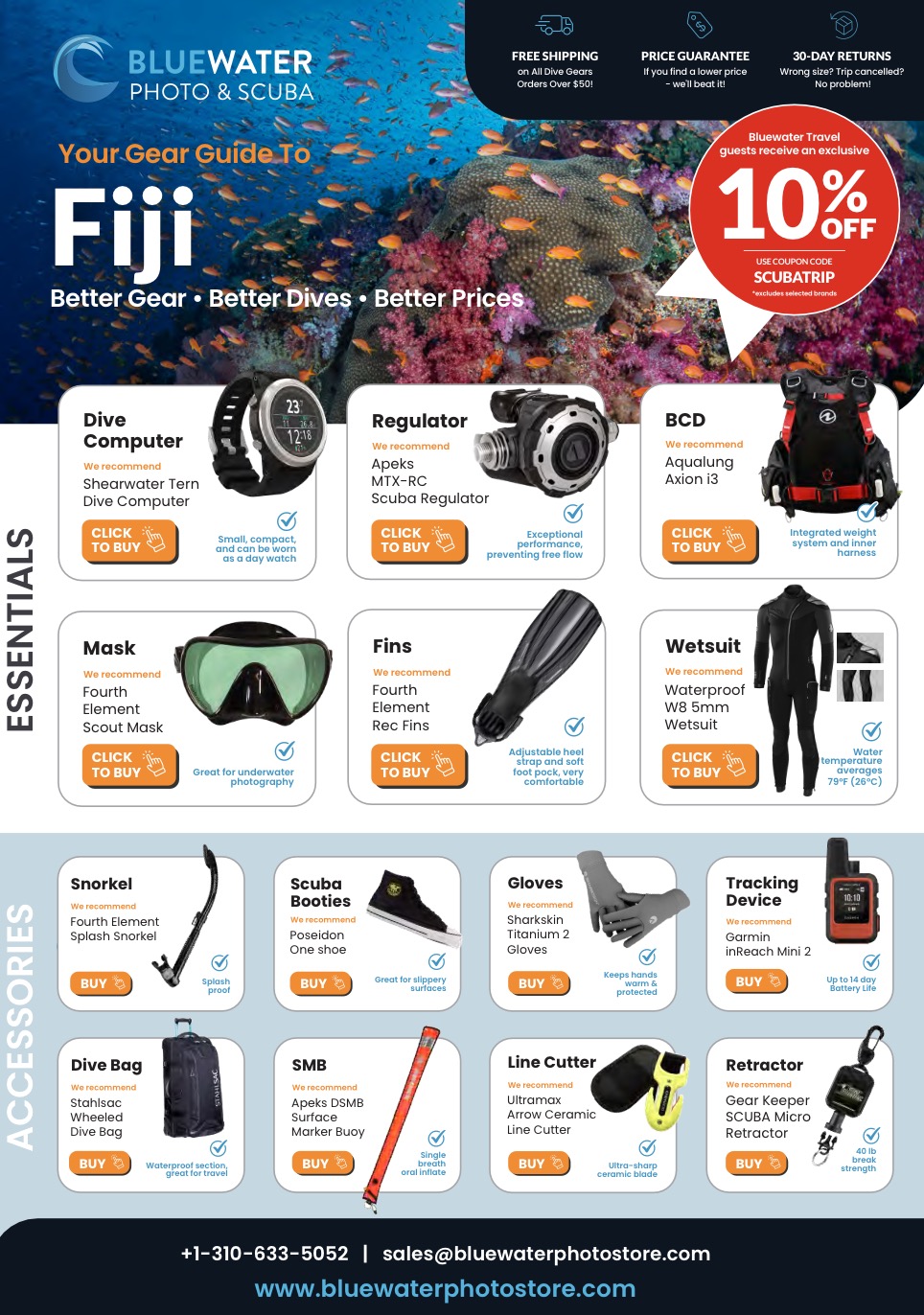
Download our full scuba gear guide to Fiji, Bluewater Travel guests receive 10% OFF! Click the image below to download (PDF).
Looking for a romantic getaway in Fiji, check out the Tokoriki Island Resort.
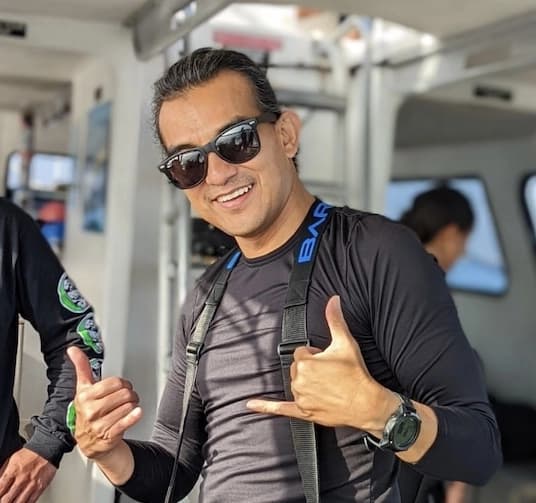
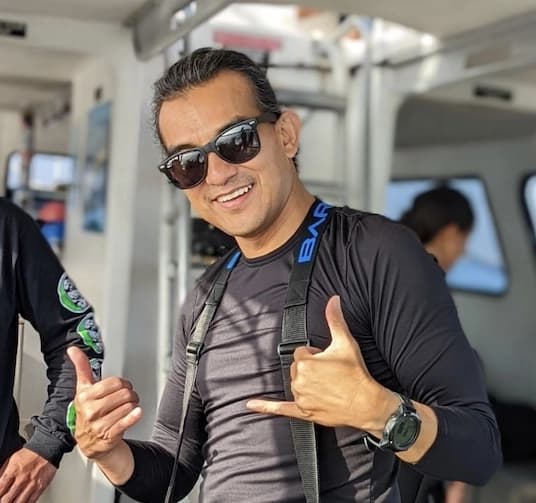
Tim grew up in tiny Singapore, where driving for more than an hour meant you would need a passport. Traveling was always his passion, but Tim became addicted to dive travel soon after he got scuba certified in Malaysia. As his diving addiction grew, Tim eventually became a Staff Instructor with PADI and an Instructor Trainer with SDI. After getting his instructor certification, Tim spent time teaching scuba in Malaysia and Vietnam.
Tim serves as General Manager and COO at Bluewater Travel and is the company's most seasoned trip leader. With a portfolio of leading over 30 group trips, his extensive expertise encompasses a variety of popular dive destinations such as the Galapagos, Raja Ampat, French Polynesia, Fiji, the Red Sea, Palau, Maldives, among others. His travels have taken him across all seven continents and allowed him to dive in all five oceans—the Atlantic, Pacific, Indian, Arctic, and Antarctic.
I've never had or seen such an amazing time diving off this island. The staff and diving instructors were very helpful, kind and knowledgeable about all areas of diving. The reefs we had dived were spectacular. I had never seen sharks up close until then and now I continue to dive all over the world photographing all sea life as a result. I always hold fond memories of the real day I stared diving and am eager to experience all diving all over the world.
Diving in Fiji is beautiful both above and below the waterline. The water temp only varies a few degrees throughout the year. A 3 mil suit should keep most divers happy. There are the most beautiful hard and soft corals that can only be matched by Raja Ampat. Abundant fish life from the tops of the reefs to the depths of the clear waters ae a photographers dream. Fiji is my chosen dive destinationfor a few reasons-easy to get to;the Fijian people are the most friendly people on the earth, and lastly the types of sea creatures are varied and unique. No matter what your dive leval is there are dive sites for all. You can find 7 star resorts if that is your thing or backpackers specials or anything in between.Fijian food is wonderful but almost any type of food is available-the fruits out of this world. Accomodations vary depending on the thickness of your wallet !! No matter what your accomodatins are like the diving in Fiji is second to none.
I was able to travel to Fiji for the first time in May, 2013. We wanted to experience the different types of diving available in Fiji and were easily able to plan a trip accommodating 3 different areas. The people of Fiji were so welcoming all around, in airports, transportation, hotels and resorts and especially the dive masters. Although far from home in California, I never felt uneasy. We were able to coordinate a trip to include the Bequa shark adventure from Pacific Harbor, a week at Matava eco resort on Kadavu to dive the Astrolabe reef, and a week at Wananavu to dive the Bligh waters. ! This would be a wonderful destination for divers of any level as well as non divers to be welcomed by the Fijian people. The shark dive by BAD at Bequa was incredibly well run and lived up to the expectation to be close to big sharks and lots of sharks. The reef diving there at Cumbe reef was very pretty, but not especially colorful. For me, the time at Bequa should be for the shark dive and move on for other diving. We stayed at Matava on Kadavu which was a wonderful experience to begin to absorb the islands of Fiji rather than the city atmosphere around Pacific Harbor. This eco resort truly takes you away from day to day and offers a unique diving area. Diving the Astrolabe reef off Kadavu was large in scale with big, plentiful hard corals and the myriad life surrounding them. I really enjoyed exploring this area from the coral bommies literally covered in small life to the larger fish and clams among the more neutral hard corals. My favorite though, which would draw me back to Fiji is the Bligh waters. We stayed at Wananavu where it was a short boat trip out to the dive sites. The soft corals were truly amazing and the fish among them so bright. Purple and yellow corals were surrounded by orange and yellow, and purple fish! Each dive was a bit different but trulythe most colorful I have ever encountered. I felt like I was diving inside a kaleidoscope and am eager to return.
I spent two weeks in Fiji and found it to be a true paradise. We flew into the international airport in Nadi, on the main island of Viti Levu. This is a large, modern airport with many amenities. We had an easy walk over to the domestic terminal to connect to the island of Taveuni. The friendly and welcoming attitude of the Fijian people is evident as soon as you arrive. Everyone we encountered was very happy and cordial. The airport staff was efficient and assisted with checking us in and tagging our bags. Our flight was on a 12 seat, twin-engine prop aircraft. It's about a 1½ hour flight, which goes by very quickly while looking out the window at the beautiful islands below. The terminal at Taveuni is very small and only accommodates small aircraft. We were met at the airport by a driver who took us to our resort on the south end of the island. During the 1 hour drive, the driver gave us a brief history of Taveuni and told us about Fijian culture. Taveuni is called the Garden Island, and it is evident why. Everything is very lush and covered with jungle.I spent a week diving primarily on the Rainbow Reef and some local reef diving. Rainbow Reef deserves the reputation it has built over the years. Wonderfully colored corals abound. We found a lot of marine life, including blue ribbon eels, electric disco clams, many different nudibranchs, large schools of fish, etc. Favorite dive sites are the Great White Wall and Fish Factory.We also did day excursions on non-diving days. We visited a local village, where we learned about local customs, crafts, and culture. We were given many demonstrations and sampled food cooked in a lovo and fresh prawns right out of the river. The village chief also invited us to a kava ceremony where everyone joined in. This was a really enjoyable visit. We also went to a site with three different waterfalls. Each one requires an uphill hike, but the beauty of these falls is worth it. Each has a pool to swim in after the hike. A different site has a natural water slide which also requires a bit of a hike. The slide’s a lot of fun and can be done several times before moving on. A stop at the International Timeline is mandatory. Everyone needs a picture with one foot in today, and the other foot in yesterday. Another must-stop on the island is the historic Catholic church. There are shops in town to do some shopping for food, drinks, and local handicrafts.The second week, we returned to Viti Levu. We were met at the airport for the 2-hour drive to our resort on the south side of the island, near Pacific Harbor. Once again, our driver acted as a local tour guide, pointing out the sites of interest along the way. Fruit stands lined the roadside and food and beverages are available on the drive. Staying at a resort in the Pacific Harbor area allows you to dive Beqa Lagoon, but also the local dive sites along the Sun Coast. You also have the advantage of still being on the main island.We found Fijian, Asian, and Western food readily available on both islands. Overall, Fiji has happy, friendly people, beautiful tropical scenery, a wonderful culture, and world-class diving. Soft coral capital of the world. Fiji is a real bucket list destination.
So just got back from a wonderful week of diving in Fiji. Figured it was about time to write a review of the resort and the diving over there.We stayed at Volivoli Beach, Volivoli Beach is a relatively small boutique family run resort on the northern tip of Vitu Levu. A 4 hour long direct flight from Brisbane, followed by a 2.5 hour drive will generally get you to the resort just before dinner. The resort is situated on the beach at the end of a narrow mountain road, best not navigated by yourself in the dark unless you know what you are doing. It is quite a big drop on one side of the road.Surrounded by mangroves, beach and lots of greenery along all the paths, each room/villa is built in such a way there is no direct line of sight into another one. The room we stayed in was a Premium Ocean View Villa, situated at the top of a hill, this room features separate sleeping area, sitting area, ensuite, kitchen, washing machine and large patio. The kitchen benchtop was the ideal workplace to prepare the camera gear each day and charging all batteries overnight.Three bars and two restaurants make for plenty of options for drinks and meals. Once a week there is a BBQ night and a traditional Fijian style evening, both served at the Ra Bar on the beach. During the Fijian night there is traditional Fijian dancing and of course kava with the crew. Though I am not a great fan of kava, I do like the social aspect of drinking kava and getting to know the crew.Diving around the resort is simply amazing. Volivoli Beach does not have a spectacular house reef, but it is great for muck diving. We found three sea horses, quite a few nudibranchs (even undescribed ones) and a lot of reef fish. If you don't want to dive the house reef, Ra Divers can take you out to a myriad of dive sites. Travel time to the site ranges from 15 minutes to 1.5 hours.All dive sites feature an abundance of soft coral. This area is known for the amount of soft corals. Some sites have a single colour of soft coral (Golden Dreams is mainly yellow) while others feature all colours of the rainbow (rainbow wall at Mount Mutiny). Visibility ranges from 15 metres on the sites close to the resort to 30+ at the dive sites further away in the VatuiRa Conservation Park- FIJI.As this is a family-run business, it is not uncommon to see the owners or their children running about in the resort. Both Steve and Nick are very approachable and always up for a chat or a drink at the bar. This makes you feel more part of the family than just being a guest at the resort.We are most definitely looking at going back next year.
I had the chance to visit Fiji in early December of 2013, and had a wonderful time diving as well as exploring on land. We stayed on Beqa Island, so the island itself is very rustic, and you can walk into the villages or do some day hikes near by. Diving was primarily done in the morning, and with 6 dives days, we scheduled two of those to be the famous bull shark feeding dive. No regrets!The reef dives were beautiful, with many soft corals for beautiful reefscapes, and very rich in color and life. For me, the highlight really was the ability to dive with bull sharks. Our trips were organized through Beqa Lagoon Resort, and we were very happy with how professionally they were run. It was a wonderful opportunity to get to see these huge animals up close. Bring a camera ...any kind! You'll definitely want pictures or video!The weather was warm, in the 80s and water temps were 78-81 during our trip. You can also do some snorkeling and other activities like kayaking or jet skis around the island. We primarily dove in the mornings, came back for lunch and showers and then spent afternoons doing more topside or surface water activities, so Fiji is a destination that is friendly for non-divers as well.And last but not least, try the Kava, at least once.
Diving in Fiji has been one of the best diving experiencies I have ever had. The main reason was the diving in Beqa lagoon Shark Dive.The diving guides were totally outstanding as I have never seen before that familiarity with the sharks. First you go down to aproximately 25 m and have to lay down while the shark expert guide do the feeding to many bull sharks. If you are lucky you can get to see the tiger shark. Unfortunately it did not come on the days I was diving over there. But still having around 15 bull sharks is very intimidating. And they get really close!!!On the way up you stop at 15 m to stay with grey sharks and white tip sharks and finally in the security stop the diving guide do the feeding to the playfull black tips. and the feeding is literally giving the chunks of fish in the mouth of the shark.The briefing was very detailed and actually the way in which the feeding is done seems quite correct. I have always been against the feeding but this people is doing it very conciously and it seems in the right way.After these dives I visit other parts of Fiji and the feeding was done without any precaution and in a totally different way. Meaning without control while in Beqa everything seems to be under controlI would recommend this dive to any one who likes sharks, because it is just awesome!!
Bula! My first dive destination after I became certified was to Fiji. We stayed in Nadi, which is close enough to the Mamanutha islands that you can easily plan a 3 dive day trip to many of the islands and surrounding reefs. These islands offer all kinds of diving for all levels of divers, however, we found that the reefs there were a bit disappointing and covered with silt. The water conditions were ideal, with 80 degrees F and visibility from 100+ feet. These islands offer shark diving, drift diving, walls, and a large variety of fish, crustaceans, and critters. In addition, there are lots of tours offered to visit these islands from the main island. You can visit several of them by sailboat in a day, or stay in a resort on one of the tiny islands.We also dived up near Raki Raki (northeast part of the island, about a two hour drive from Nadi Airport) on the beautiful "Golden Dream" and "Dreammaker" dive sites in the Bligh waters. Although we did this in a day, I would recommend staying in one of the lovely resorts along the Northeast coast of the island. These boasted incredible 60 foot tall coral columns, soft corals, and all kinds of marine life from sharks to nudibranchs. I would highly recommend the northern waters of Vitu Levu, the largest island, for diving. The reefs are beautiful, healthy and full of colorful life. The water temperatures are warm year round (78 to 82 degrees F), and the visibility is great.The people of Fiji were warm and welcoming. We found plenty to do on the islands with activities that included hiking in the lush rain forests, sailing, fishing, and special village tours where we obtained permission from the clan chief to explore their land. Fiji will forever be one of my favorite dive and travel destinations.
Fiji has been called the "Coral Capital of the World" which led us to believe that the reefs would rival those of the Red Sea and the Maldives, which in my opinion it did not. We dove the famous white wall on three different occasions. Dive guides will watch tide charts to determine the best time to dive it. If there is no current, the corals will not be feeding and will be diminished in apparent size. If there is too much current, the corals will be fuller but the divers will fly by too fast and not really see it. When we saw it the first time, it did not equal our expectations, but was better than either of the subsequent times. It was like individual small clumps of coral spaced at about 18 inches on center. I was never aware of much current which might explain why the wall failed to impress. The wall can be accessed through a tunnel starting at about 40 feet and dropping to about 70 feet.The purple wall is not as big, but its color makes it lovely. The current was quite strong on our visit so it was pretty much a purple blur.Hard corals are varied and abundant. Unfortunately, not all were healthy. One particular table coral I remember had a section that appeared bleached, another section that was covered in moss, and yet another portion that appeared healthy.We were also disappointed by the fish life. Yes there were the normal schools of snappers, fusiliers, butterfies and angelfish, but they didn't seem as numerous or as varied. The sharks we saw in 33 dives can be counted on one hand, but we did see 8 eagle rays which is a personal high.Nudibranches: one variety of chromodoris, one variety of nembrotha, one variety of glosidoris, and maybe 5 or 6 phyllidias.Fish factory and Coral Garden were exceptions where quantity of fish was more abundant.The water temperature in September was 75 degrees.Visability is never as good as I hope for. During our 2 weeks there it ranged from 30-50 feet at which you could detect the presence of another diver.There are two very nice National Parks on Taveuni. The Lavena Coastal walk is a pleasant walk along the beach for about an hour and then about a half hour incline that leads to a waterfall. Plan to swim in the pool below and maybe even climb up the rocks and slide down the smaller falls on the left, but be careful as the rocks are slippery. Buoma Park has 3 waterfalls; the first and most famous is a easy 10 minute walk. The highest fall is at least an hour climb and though a bit stenuous, is well worth the effort.The Fijian people are quite friendly.