Scuba Diving in Palau
Expert advice on diving,
seasons, and logistics
Free planning help
when you’re ready to book
Exclusive dive packages
tailored for you

Destination Highlights
Scuba Dive Level
All Levels
Visibility
50 to 100 feet (15 to 30 meters)
Average Water Temperature
82
Pelagic Encounters
Stunning Reefs & Corals
Palau Liveaboards And Dive Resorts
Palau scuba diving can be done via liveaboard or resorts and dive operators. There are a good number of liveaboards to accommodate a range of budgets, and many resorts and dive operators to create your perfct custom package. Liveaboards often include up to 5 dives per day, while most land-based operators would offer 3 boat dives per day plus additional dives from their jetty. Land-based dive shops have access to all the dive sites liveaboards visit in Palau, so the choice comes down to your preferences.
Palau is often visited in conjunction with Yap and Truk Lagoon. Learn about getting to Yap from Palau with direct flights from Pacific Missionary Aviation.
Diving Information
Marine Life, Diving Conditions, And Best Dive Sites.
Intro To Palau Diving
Palau scuba diving involves a lot of drift dives and reef hooks. After your descent, typically 50 to 60 feet, your dive will continue as either a gliding drift over the reefs and along walls as the current carries you, or you will stop and anchor yourself to a sturdy outcropping of rock and let the current bring the reef life to you. A reef hook is essentially a big fishing hook with the barb removed attached to a 3-5 meter rope.
The hook goes into a dead part of the coral reef and the other end attaches to your BCD. Reef hooks are fairly well accepted in Palau, but only at specified sites that have consistent current and an abundance of dead coral to hook into.
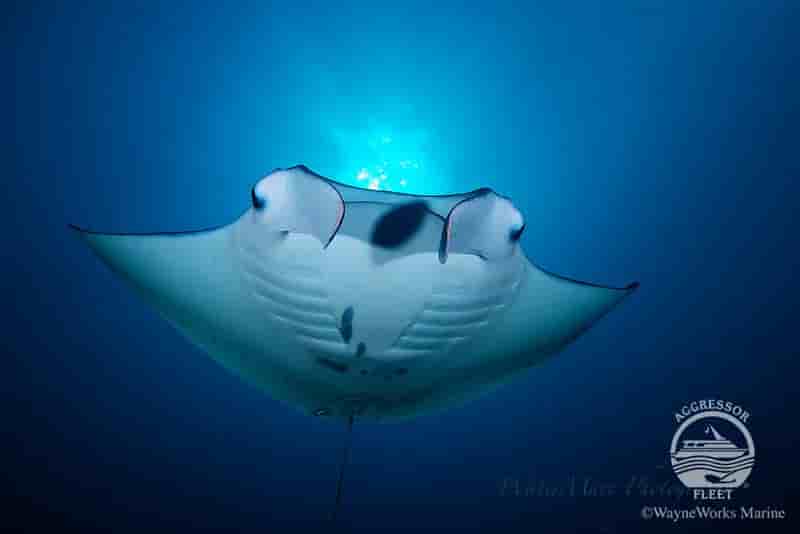
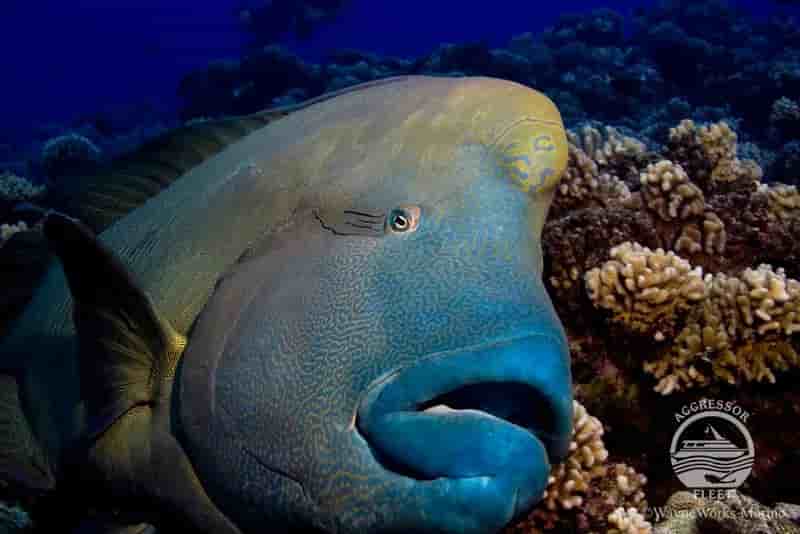
Perhaps the most popular of all reef hook dives are at Blue Corner, where a lot of current around the point brings in the big fish. Sharks, jacks, tuna, and resident Napoleon wrasse are often sighted. If mantas are what you seek, head out to the German Channel, where divers rest on the ocean floor while teams of mantas circle above. Palau has a lot of healthy hard coral and a good amount of wall diving.
A typical day of diving in Palau usually involves up to 5 dives a day including a night dive, whether you are staying at a resort or on a liveaboard. For an in-depth look at liveaboard experiences, check out our Palau liveaboard diving guide.
Marine Life & Photography Subjects
Palau's prolific marine life includes big animals and macro life. The strong currents and variable conditions at many dive sites make underwater photography very challenging. It can be difficult to get reef sharks to come close to you while you are hooked in at Blue Corner. Unhooking and swimming down into or over the lip of the reef can get you closer to sharks, but you also risk the ire of other dive groups who fear your bubbles will scare away the wildlife. It's best not to chase sharks - instead, find a good spot where they can swim by you in the current. Photographing mantas in reduced visibility will test your post-editing skills.
Night dives are often the best time to put on your macro lens, as a wide range of reclusive creatures emerges from the reef after dark. This can also be a great opportunity to get close to otherwise skittish fish while they sleep.
Diving Conditions
- Water Temperature: 81-84F(27-29C).
- Visibility: Ranges from 50-150+ feet (15-45 meters). During the dry season, the visibility often exceeds 100 feet (30 meters).
- Depth Range:16-131 feet (5-40 meters).
Palau's Best Dive Sites
We've rounded up some of the best dive sites in Palau. These sites are typically usually included in most liveaboard itieneraries.
1. Chandelier Cave - This site is a large cave with several "rooms". You can enter the cave at 25ft, and surface in several different "rooms". Underwater tunnels allow you to swim from room to room. This is a very cool place, and a good place to take a wide-angle photo with a diver.
It's a very adventurous dive that must be done at the right time of day with an experienced guide with whom you feel comfortable. Bear in mind that this is an overhead environment and there are places where you can't see any light, visibility can drop to zero, and you can have trouble finding your way out. For all of these reasons, this dive should be taken seriously, and participants should be experienced divers, equipped and trained accordingly, preferably at least cavern certified. It is also wise to come equipped with lines & reels as well as backup lights unless you are sure that the dive operator will provide them.
2. German Channel - German channel is famous for its manta rays, but it has much more. This narrow pass separates Ngemelis and Ngercheu Islands, forming a connection between the inner lagoon and open sea. Shallow water, strong currents, and boating traffic make the narrowest portions unsuitable for scuba, but the large area at the channel's mouth offers amazing diving opportunities.
Virtually every sort of tropical marine life can be seen here, but the site is most famous for mantas, eagle rays, reef sharks and many species of schooling fish. Often the best strategy involves settling in a lively area and waiting for the action to come to you. If the current is running, this can also be a great drift dive. Just go with the flow and soak up the sights as you fly effortlessly over the reef. Be extremely cautious when surfacing, however, as boating traffic can be very heavy here. Make sure that at least one member of your team sends up a safety sausage (SMB) on a line before your final ascent!
3. Blue Hole / Blue Corner - These two sites are among the most celebrated in Palau, for good reason. Known throughout the world for its abundance of fish life, Blue Corner is the kind of place where it's possible to see just about anything.
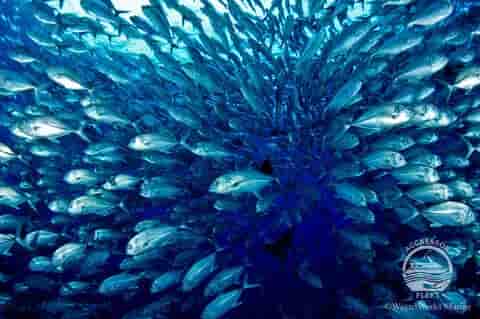
Situated on a current-swept corner of a steep drop-off, it is a natural gathering point for reef fish of every description, dense schools of jacks, snappers and barracuda, and a healthy population of white-tip and gray reef sharks, as well as Napoleon wrasse and many other species.
Eagle rays, mantas, turtles, tuna and wahoo are also seen fairly often, and even billfish, whale sharks and whales make occasional appearances. Within easy swimming distance (depending on the current) is the sister site of Blue Holes. A large cavern with multiple entrances, accessible from the shallow reef top as well as deeper points on the wall. Illuminated by shafts of sunlight from overhead, the view from inside is a memorable experience of sublime beauty.
The spacious main cavern is appropriate for divers of all experience levels, but there is also a narrow cave at 85 ft. that should only be explored by properly equipped and certified cave divers. The reef itself is another attraction surrounding both sites, with colonies of boulder and cabbage corals scattered over the plateau at 45 to 60 ft. Dropping over the wall, you'll find a healthy mix of hard and soft corals, as well as sponges and massive gorgonian sea fans.
Other Palau Dive Sites - Other notable Palauan sites include New and Big Drop Offs, Ulong Channel, Peleliu Wall, and Cut, Mandarinfish Lake and WW 2 Japanese shipwrecks Iro and Sata. There is also a Zero fighter plane in very shallow water, plus countless other reefs and walls.
Best Time To Dive Palau
In general, Palau can be dived year round.
The best time to scuba dive Palau is during the dry season from October to May. The rainy season from June to September brings more wind and rain than usual, though much of it occurs at night. Palau is in the tropics so it does receive a fair amount of rain, but weather patterns here are fairly predictable.
How To Get To Palau
Fly into Roman Tmetuchl International Airport (ROR) in Koror. There are no direct flights from the US—most routes connect through major Asian hubs, typically requiring two stops. Travel time is about 20–26 hours from the western US and 36–40+ hours from the eastern states. We recommend arriving at least one day before diving to rest and rehydrate before boarding your liveaboard or starting day trips.
Other Things To Do In Palau
Palau offers a host of exciting and adventurous non-diving activities, including waterfall hikes at Ngardmau, rock island excursions, sport fishing, speedboat & kayak tours, city tours and more. If you seek nature, kayaking in calm blue waters among the islands is a must-do activity on your non-dive day. Palau is rich with World War II history. Explore Palau's diverse culinary scene if you're staying at a land-based resort.
For history buffs, a trip to Peleliu Island or the German Lighthouse is recommended. The Palau Pacific resort is convenient as a 1-2 day stop either before or after boarding a Palau-based liveaboard boat. It's the island's biggest luxury resort with a lovely private beach.
Practical Information
- Currency: United States Dollar
- Language: The official languages are English and Palauan
- Main Airport Code: ROR
- Time Zone: UTC+9
- Electricity: 120 V 60 Hz; North American plugs.
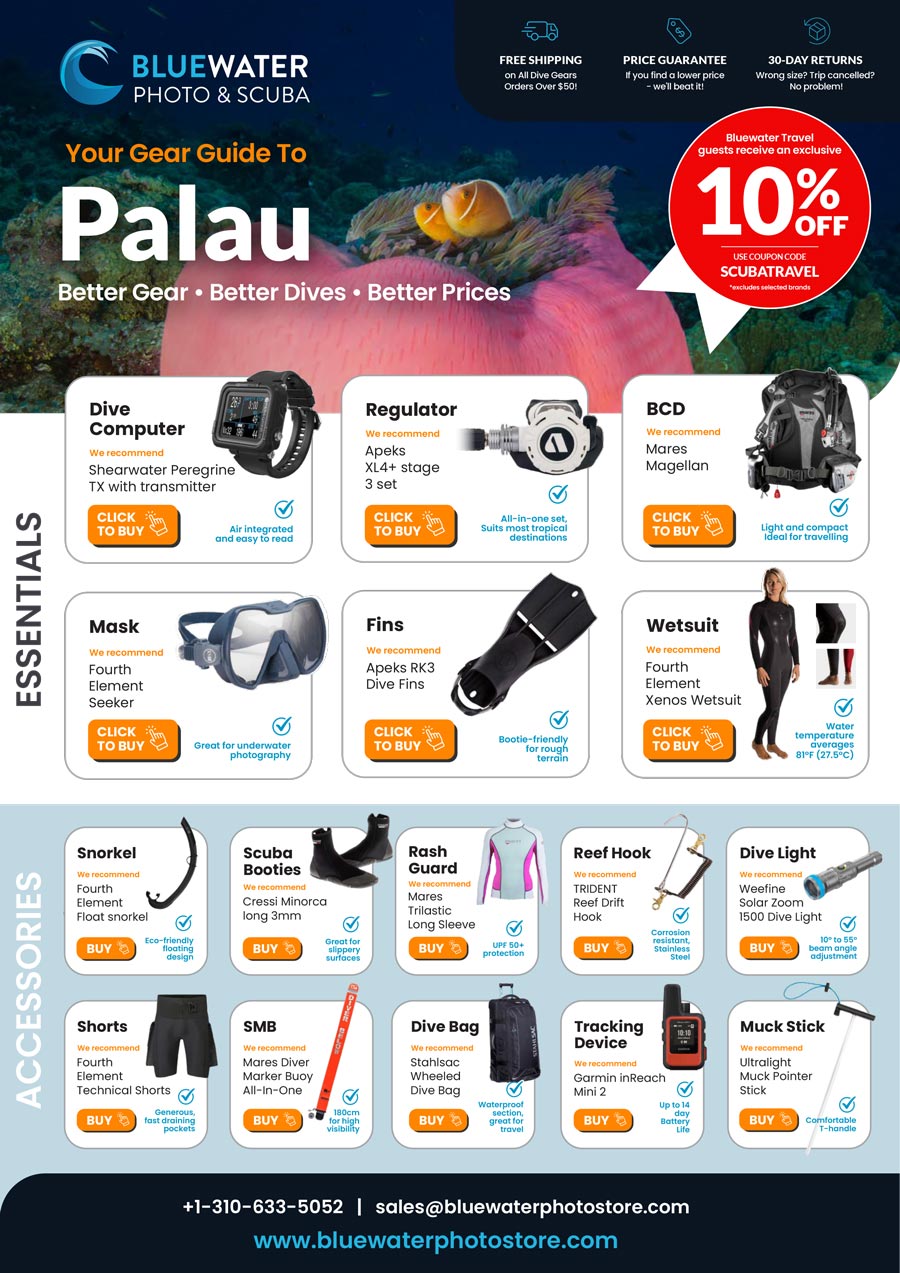
Recommended Scuba Gear
Download our full scuba gear guide to Palau, Bluewater Travel guests receive 10% OFF!
Join Bluewater's upcoming trip to Palau and experience the Bumphead Spawning in 2028!
Author


Jaime Smith
Jaime is originally from Coastal North Carolina and now resides in Riviera Maya, Mexico. Having been certified for over 30 years, she has worked in a variety of diving related positions from retail to education.
Jaime's best all-time dive experience: North Carolina wreck diving with big (and small) Sand Tiger Sharks
Jaime's bucketlist destination:
Indonesia and Micronesia
Scuba Diving in Palau Reviews
sonya karlsson
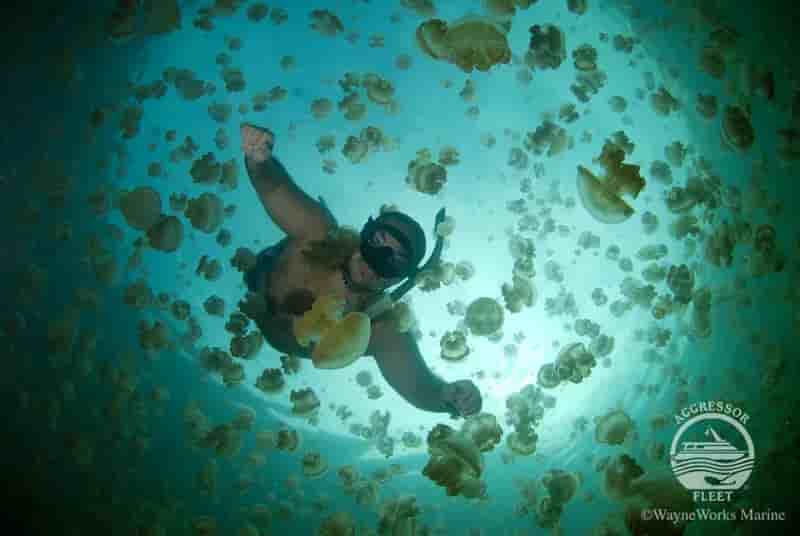
The most excellent dive conditions while we were in Palau. The weather was beautiful, the water was crystal clear, and the marine life was fantastic. Blue Corner had the reef sharks entertaining us every visit. My favourite swim was at jellyfish lake where I was surrounded by the most dense aggregation of jellies ever. The manta rays were always in the areas where we were guided, and the island surface intervals were heaven on Earth. This has so far been the most special of places dived in my travels.
Read Moresonya karlsson
The most excellent dive conditions while we were in Palau. The weather was beautiful, the water was crystal clear, and the marine life was fantastic. Blue Corner had the reef sharks entertaining us every visit. My favourite swim was at jellyfish lake where I was surrounded by the most dense aggregation of jellies ever. The manta rays were always in the areas where we were guided, and the island surface intervals were heaven on Earth. This has so far been the most special of places dived in my travels.
Read Moreseacreature
Palau is simply idyllic! As an archipelago of over 300 islands and numerous fringe reefs, the variety of dive sites and biodiversity of marine life is truly exceptional. A labyrinth of about 200 islands in its southern lagoon, known as the Rock Islands, includes a high concentration of great dive sites. These unique mushroom-shaped islands are gorgeous in a sort of magical way. Mantas, dolphins, and several species of shark are common pelagics at a number of sites; Napoleon (humphead) wrasse can be found. There are many different species of clownfish, and I often saw several types on each dive, patrolling their anemones. The anemones and myriad soft corals are quite spectacular themselves, colorful and distinctly shaped. Giant clams, some of which are endangered, are riotously beautiful, growing to over 3 feet and living to about 100 years; many are simply electric in their colorations. You can hunt for the elusive Mandarin fish. Palau is also famous for Jellyfish Lake, an isolated inland saltwater lake within the rock islands, in which abundant jellyfish who have lost their sting to evolution as they’ve been isolation from predators. In a separate and controlled outing, the Palau marine park allows you to snorkel Jellyfish Lake; this will forever remain a highlight of my life!Topside, I found several cultural attractions are very worthwhile. Around the main island, of which Koror is the capital (and where most dive resorts are located), you can tour either an authentic historic Bai, or a replica of one, which were the traditional meeting houses for village chiefs. These A-framed structures are elaborately decorated and painted, depicting local legends and history. If looking to bring something home, a local art form involves carved wooden storyboards, each of which describes a story or legend about Palauan culture or teachings; they are artistic treasures and purchasing one is a lovely way to remember your trip. Odd as it may sound, some of the best quality storyboards are found at the jail in Koror (inmates hand down the skills); it’s a mandatory stop in my opinion. Farther south in the islands is Peleliu, site of a horrific WWII battle between the Allies and Japan; a privately guided land tour was humbling and amazing. Tanks, machine guns, and other battle paraphernalia are slowly being reclaimed by the jungle, as if paying homage to the struggle. Peleliu is accessible only by boat, and most dive operators include this option, as there are several great dive sites there as well.You can also spend a day or afternoon kayaking around the Rock Islands.Land-based resort options are numerous and range from budget-conscious to luxury. Dive operators such as Neco Marine and Sam’s Fins cater to the resorts conveniently; many packages can be arranged with resort and diving combinations, and most resorts are on beaches with piers for mooring the dive boats. Dining options are plentiful, at the resorts and throughout Koror, including Palauan and Micronesian seafood, as well as Japanese, Indian, Thai, Italian, and many other cultural cuisines. Kramer’s is a fun, laid-back restaurant frequented by ex-pats and tourists alike, with more of a pub-grub style menu, very good food, and decent prices. One of the nicest things about land diversions, whether exploring, shopping, dining, or seeking some night excitement, is the public bus system on Koror: a hop-on, hop-off approach which is efficient, economical, and extensive in their hours of operation. Between the bus system and private taxis, I got around quite easily. There are a few live-aboard options as well.Favorite dive sites of mine include German Channel, where 3 of us were privileged to enjoy an extended private encounter with a couple of mantas one afternoon; Chandelier Caves, which are not so much caves as a series of caverns or “rooms” full of stalactites (you don’t need cave-diver certification for this), any of a number of walls, and most certainly Jellyfish Lake which is so other-worldly it is nearly impossible to describe.Getting to Palau can take 2 or 3 days, depending on your starting base. It’s notably hot, and quite humid. Rain showers are common but short and fleeting. Divers come from many countries, and especially from Japan, as it is close by. Dive operators typically separate divers into groups by language, with Japanese-speaking and English-speaking guides. Water temperature is warm enough that I became spoiled diving without a wetsuit, or just board shorts and a vest. Visibility is typically 100 feet plus. Dives can range from shallow to quite deep, with numerous walls, and some currents (a few of which involved reef hooks). I think Palau is ideal for experienced divers; novice divers may find some sites a bit challenging in terms of depth and currents. It ranks among my favorite dive locations in the world, and I can’t wait to go back!
Read Moreseacreature
Palau is simply idyllic! As an archipelago of over 300 islands and numerous fringe reefs, the variety of dive sites and biodiversity of marine life is truly exceptional. A labyrinth of about 200 islands in its southern lagoon, known as the Rock Islands, includes a high concentration of great dive sites. These unique mushroom-shaped islands are gorgeous in a sort of magical way. Mantas, dolphins, and several species of shark are common pelagics at a number of sites; Napoleon (humphead) wrasse can be found. There are many different species of clownfish, and I often saw several types on each dive, patrolling their anemones. The anemones and myriad soft corals are quite spectacular themselves, colorful and distinctly shaped. Giant clams, some of which are endangered, are riotously beautiful, growing to over 3 feet and living to about 100 years; many are simply electric in their colorations. You can hunt for the elusive Mandarin fish. Palau is also famous for Jellyfish Lake, an isolated inland saltwater lake within the rock islands, in which abundant jellyfish who have lost their sting to evolution as they’ve been isolation from predators. In a separate and controlled outing, the Palau marine park allows you to snorkel Jellyfish Lake; this will forever remain a highlight of my life!Topside, I found several cultural attractions are very worthwhile. Around the main island, of which Koror is the capital (and where most dive resorts are located), you can tour either an authentic historic Bai, or a replica of one, which were the traditional meeting houses for village chiefs. These A-framed structures are elaborately decorated and painted, depicting local legends and history. If looking to bring something home, a local art form involves carved wooden storyboards, each of which describes a story or legend about Palauan culture or teachings; they are artistic treasures and purchasing one is a lovely way to remember your trip. Odd as it may sound, some of the best quality storyboards are found at the jail in Koror (inmates hand down the skills); it’s a mandatory stop in my opinion. Farther south in the islands is Peleliu, site of a horrific WWII battle between the Allies and Japan; a privately guided land tour was humbling and amazing. Tanks, machine guns, and other battle paraphernalia are slowly being reclaimed by the jungle, as if paying homage to the struggle. Peleliu is accessible only by boat, and most dive operators include this option, as there are several great dive sites there as well.You can also spend a day or afternoon kayaking around the Rock Islands.Land-based resort options are numerous and range from budget-conscious to luxury. Dive operators such as Neco Marine and Sam’s Fins cater to the resorts conveniently; many packages can be arranged with resort and diving combinations, and most resorts are on beaches with piers for mooring the dive boats. Dining options are plentiful, at the resorts and throughout Koror, including Palauan and Micronesian seafood, as well as Japanese, Indian, Thai, Italian, and many other cultural cuisines. Kramer’s is a fun, laid-back restaurant frequented by ex-pats and tourists alike, with more of a pub-grub style menu, very good food, and decent prices. One of the nicest things about land diversions, whether exploring, shopping, dining, or seeking some night excitement, is the public bus system on Koror: a hop-on, hop-off approach which is efficient, economical, and extensive in their hours of operation. Between the bus system and private taxis, I got around quite easily. There are a few live-aboard options as well.Favorite dive sites of mine include German Channel, where 3 of us were privileged to enjoy an extended private encounter with a couple of mantas one afternoon; Chandelier Caves, which are not so much caves as a series of caverns or “rooms” full of stalactites (you don’t need cave-diver certification for this), any of a number of walls, and most certainly Jellyfish Lake which is so other-worldly it is nearly impossible to describe.Getting to Palau can take 2 or 3 days, depending on your starting base. It’s notably hot, and quite humid. Rain showers are common but short and fleeting. Divers come from many countries, and especially from Japan, as it is close by. Dive operators typically separate divers into groups by language, with Japanese-speaking and English-speaking guides. Water temperature is warm enough that I became spoiled diving without a wetsuit, or just board shorts and a vest. Visibility is typically 100 feet plus. Dives can range from shallow to quite deep, with numerous walls, and some currents (a few of which involved reef hooks). I think Palau is ideal for experienced divers; novice divers may find some sites a bit challenging in terms of depth and currents. It ranks among my favorite dive locations in the world, and I can’t wait to go back!
Read MoreSuperJolly
REVIEW ON DIVING PALAUBig reasons to go to Palau ….Daily flights from most European cities via South Korea or from North America via Guam make Palau one of the most accessible tropical islands to travel to no matter where you live.Made up of approximately 250 islands with a land mass of only 200 square miles, Palau is a Western Pacific Ocean nation located a few degrees north of the equator.Being a tropic holiday destination it’s best to check the weather patterns prior to booking a trip. The months of June, July and August have more rain than other times of the year, but pack a rain coat whenever you travel there so not to be caught out.The biggest draw for snorkelling and diving visitors are the Manta rays, which can reach widths of 7 meters and weigh up to 1.5 tones.In Palau, the south west opening of German channel is, in my opinion, the best place to see the manta and can be enjoyed by novice to experienced divers.German Channel is so called as it was created by the Germans during their administration of Palau in WWI in order for their boats to have a passage from the capital city of Koror to the islands in the south.Manta rays spend most of their time out in open ocean and can often be seen from boats as they cruise below the surface.During late afternoon the Manta move into the channel to feed on plankton and krill then visit the cleaning station where cleaner wrasse and butterfly fish remove parasites while the manta hovers above the coral outcrop.The best way to get the most out of this dive is to descend to the sand, approach the coral mound and keep very low to the sand, or even position yourself next to a rock as if you are part of that rock.You will see the cleaner wrasse above the coral obediently waiting, and then the manta arrive almost blocking out the light above with their immense wing span. The manta will remain for a moment and then swim off, they make an oval path and will be back within a few minutes for further cleaning following the same route as before.It takes about an hour to travel by day boat to German Channel, and is also accessible by Liveaboards. The maximum depths for a manta dive should be around 17 to 20 meters.I have used day boats from Fish n' Fins and from Sam's Tours and the Tropic Dancer liveaboard.My recommendation is to travel on a liveaboard, you will get many more dives and will be much more comfortable than the day boats, especially if it's raining and the water is choppy.
Read MoreSuperJolly
REVIEW ON DIVING PALAUBig reasons to go to Palau ….Daily flights from most European cities via South Korea or from North America via Guam make Palau one of the most accessible tropical islands to travel to no matter where you live.Made up of approximately 250 islands with a land mass of only 200 square miles, Palau is a Western Pacific Ocean nation located a few degrees north of the equator.Being a tropic holiday destination it’s best to check the weather patterns prior to booking a trip. The months of June, July and August have more rain than other times of the year, but pack a rain coat whenever you travel there so not to be caught out.The biggest draw for snorkelling and diving visitors are the Manta rays, which can reach widths of 7 meters and weigh up to 1.5 tones.In Palau, the south west opening of German channel is, in my opinion, the best place to see the manta and can be enjoyed by novice to experienced divers.German Channel is so called as it was created by the Germans during their administration of Palau in WWI in order for their boats to have a passage from the capital city of Koror to the islands in the south.Manta rays spend most of their time out in open ocean and can often be seen from boats as they cruise below the surface.During late afternoon the Manta move into the channel to feed on plankton and krill then visit the cleaning station where cleaner wrasse and butterfly fish remove parasites while the manta hovers above the coral outcrop.The best way to get the most out of this dive is to descend to the sand, approach the coral mound and keep very low to the sand, or even position yourself next to a rock as if you are part of that rock.You will see the cleaner wrasse above the coral obediently waiting, and then the manta arrive almost blocking out the light above with their immense wing span. The manta will remain for a moment and then swim off, they make an oval path and will be back within a few minutes for further cleaning following the same route as before.It takes about an hour to travel by day boat to German Channel, and is also accessible by Liveaboards. The maximum depths for a manta dive should be around 17 to 20 meters.I have used day boats from Fish n' Fins and from Sam's Tours and the Tropic Dancer liveaboard.My recommendation is to travel on a liveaboard, you will get many more dives and will be much more comfortable than the day boats, especially if it's raining and the water is choppy.
Read Morecjfigg23
Ok, so Palau was my first dive trip ever. Seriously, I left Guam with only 19 dives under my belt and went to tackle Palau. Palau is what inspired me to be more dedicated to exploring the ocean. My trip was only for 5 days during the Christmas holiday. So, I did 4 dives, a kayak trip, Jellyfish Lake, a visit to the prison to check out the store boards, and either 1 or 2 hikes.We went through Sam's Tours. Someone came and picked us up every morning at our resort. I dove the Siaes Tunnel, Ulong Channel, Blue Corner, and the German Channel. My first time doing a cave dive and my first time seeing a shark was Siaes Tunnel! It was a really cool experience for me. Ulong ended up being my absolute favorite dive of the trip! We reef hooked in and just sat and watched the sharks do their thing…AWESOME! Plus we ate lunch on Ulong island which is one of the places they filmed "Survivor". The Blue Corner was nice too. We saw a few sharks and other fish, but it wasn't like Ulong. Then the German channel is where I saw my first mantas! There were 2 big beautiful rays swimming next to each other…I'll never forget seeing all these wonderful creatures in Palau!The kayaking trip was great too! The day we did it, it was calm and sunny. We rowed around and under some the Rock Islands. We could look below us and see sharks and other need animals.Jellyfish Lake was unreal! Of course you are just snorkeling, no diving allowed. But you are snorkeling with hundreds, yay thousands of jellyfish that on't sting you! Again, just an unbelievable experience. One you can't have anywhere else as far as I know. Definitely a must!The days we did the hike(s), our lunch was pre-packed for us. We had a guide to take us and tell us the history behind any war relics or features of Palau that we might find interestingPalau does not have a lot of shopping or night life to offer, but I do remember there being a few restaurants to choose from. We did go to the prison and shop around for story boards.I stayed at the Rose Garden Resort. It was very nice. The view from our room was impeccable! We had 2 beds, a small bathroom, and a nice patio out front. They had a special dinner prepared for us on Christmas Day:)As I mentioned before, Palau was my inspiration to take diving more seriously. I went home to Guam and bought all my dive gear. Possibly the best investment I've ever made!
Read Morecjfigg23
Ok, so Palau was my first dive trip ever. Seriously, I left Guam with only 19 dives under my belt and went to tackle Palau. Palau is what inspired me to be more dedicated to exploring the ocean. My trip was only for 5 days during the Christmas holiday. So, I did 4 dives, a kayak trip, Jellyfish Lake, a visit to the prison to check out the store boards, and either 1 or 2 hikes.We went through Sam's Tours. Someone came and picked us up every morning at our resort. I dove the Siaes Tunnel, Ulong Channel, Blue Corner, and the German Channel. My first time doing a cave dive and my first time seeing a shark was Siaes Tunnel! It was a really cool experience for me. Ulong ended up being my absolute favorite dive of the trip! We reef hooked in and just sat and watched the sharks do their thing…AWESOME! Plus we ate lunch on Ulong island which is one of the places they filmed "Survivor". The Blue Corner was nice too. We saw a few sharks and other fish, but it wasn't like Ulong. Then the German channel is where I saw my first mantas! There were 2 big beautiful rays swimming next to each other…I'll never forget seeing all these wonderful creatures in Palau!The kayaking trip was great too! The day we did it, it was calm and sunny. We rowed around and under some the Rock Islands. We could look below us and see sharks and other need animals.Jellyfish Lake was unreal! Of course you are just snorkeling, no diving allowed. But you are snorkeling with hundreds, yay thousands of jellyfish that on't sting you! Again, just an unbelievable experience. One you can't have anywhere else as far as I know. Definitely a must!The days we did the hike(s), our lunch was pre-packed for us. We had a guide to take us and tell us the history behind any war relics or features of Palau that we might find interestingPalau does not have a lot of shopping or night life to offer, but I do remember there being a few restaurants to choose from. We did go to the prison and shop around for story boards.I stayed at the Rose Garden Resort. It was very nice. The view from our room was impeccable! We had 2 beds, a small bathroom, and a nice patio out front. They had a special dinner prepared for us on Christmas Day:)As I mentioned before, Palau was my inspiration to take diving more seriously. I went home to Guam and bought all my dive gear. Possibly the best investment I've ever made!
Read MoreEintoisht
Palau almost ruined Diving for me.I live on guam, and figured I need to take trips to some of the neighboring Islands before I leave here. I took a 7 day trip to Palau in the beginning of January, and WOW, it was so amazing that I almost don't want to dive Guam anymore because it pales in comparison. So, the flight into Palau was late at night, and the return flight left at 1am, so you really don't see anything as you arrive or leave. I only had pics to go by for seeing the layout of the archipelago. The hotel picked us up at the airport, and we checked in around 9pm. So, I like my technology, and palau is lacking in it seriously. we stayed at the west plaza Malakal, the only elevator was a tiny luggage elevator, the a/c was terrible, the bathroom would flood the room when we took showers, the room was very ...mildewy smelling there was no wifi, and it had a great view of a factory. If you don't care about 1st world amenities or the view, the location was great, it was within walking distance of both Sam's Tours and Fish and Fins (even though both companies pick you up every morning and drop you off when you want to leave.We dove through Sam's Tours, and I loved the place. they have a small shop to get any minor gear you might need (such as reef hooks if you haven't been to Palau before, you kinda need one for lots of the good dives), and a bar/grill with well....bar food, and like almost every bar on Palau, they sell Palau's own local brew Red Rooster, which as far as national beers go is phenomenal! With 5 days of diving, I don't think we were on the same boat more than twice....they have at least 6 boats that each fit about 8 people w/up to 3 tanks each rather comfortably Plus the 2 guides.The guides were VERY knowledgeable about each dive site, and they tried to keep groups of people together to the max extent possible day to day so you don't end up repeating the same dive site unless you want to. Most sites were about 20 min to an hour away from the shop, but it is through the rock islands with awesome views for the entire trip to/from the site.Visibility was usually 100'+, with the exception of the wrecks we dove. On the note of said wrecks, I am used to Guam's wrecks which really have very sparse life on them....The wrecks in Palau were brimming with life lots of hard/soft corals, lots of color everywhere. Schools of Jacks, a few anemones, nudibranches, a couple of lionfish, lots of the fish you normally see on wrecks, but I feel that what really made them stand out was the coral growth.Palau has AWESOME drift dives...New Drop Off, Siaes Corner, Blue Corner, Ulong Channel to name the ones we dove. Most of them were like riding a train, flying by in the current watching tons of pelagics...lots of turtles, and oh yeah the sharks I don't think we did a single (non-wreck/chandelier cave) dive where we didn't see at least a dozen sharks.There were also 2 VERY unique experiences that so far as I know are Palau specific: Jellyfish lake, which is a neat experience swimming with Jellyfish that don't sting, and Sams offers a "Nautilus dive" where the night before, they drop a cage off into the depths and in the morning, they pull up some Nautilus to look at, play with and get pics with. then once you are done, you put it back into the cage and they lower them back down to eventually find their way back out, and you enjoy a nice wall drift.And if you want to do something on the surface (or for the day you fly out), they have some great hiking/kayaking trips through the rock islands where you can learn a bit about the geology and history of the rock islands.With such a myriad of options, ....sharks, Mantas (at German channel), Sharks, Jellyfish, Mandarinfish along the wall of the dive shop, turtles, WWII Wrecks... every diver should add Palau to their dive book
Read MoreEintoisht
Palau almost ruined Diving for me.I live on guam, and figured I need to take trips to some of the neighboring Islands before I leave here. I took a 7 day trip to Palau in the beginning of January, and WOW, it was so amazing that I almost don't want to dive Guam anymore because it pales in comparison. So, the flight into Palau was late at night, and the return flight left at 1am, so you really don't see anything as you arrive or leave. I only had pics to go by for seeing the layout of the archipelago. The hotel picked us up at the airport, and we checked in around 9pm. So, I like my technology, and palau is lacking in it seriously. we stayed at the west plaza Malakal, the only elevator was a tiny luggage elevator, the a/c was terrible, the bathroom would flood the room when we took showers, the room was very ...mildewy smelling there was no wifi, and it had a great view of a factory. If you don't care about 1st world amenities or the view, the location was great, it was within walking distance of both Sam's Tours and Fish and Fins (even though both companies pick you up every morning and drop you off when you want to leave.We dove through Sam's Tours, and I loved the place. they have a small shop to get any minor gear you might need (such as reef hooks if you haven't been to Palau before, you kinda need one for lots of the good dives), and a bar/grill with well....bar food, and like almost every bar on Palau, they sell Palau's own local brew Red Rooster, which as far as national beers go is phenomenal! With 5 days of diving, I don't think we were on the same boat more than twice....they have at least 6 boats that each fit about 8 people w/up to 3 tanks each rather comfortably Plus the 2 guides.The guides were VERY knowledgeable about each dive site, and they tried to keep groups of people together to the max extent possible day to day so you don't end up repeating the same dive site unless you want to. Most sites were about 20 min to an hour away from the shop, but it is through the rock islands with awesome views for the entire trip to/from the site.Visibility was usually 100'+, with the exception of the wrecks we dove. On the note of said wrecks, I am used to Guam's wrecks which really have very sparse life on them....The wrecks in Palau were brimming with life lots of hard/soft corals, lots of color everywhere. Schools of Jacks, a few anemones, nudibranches, a couple of lionfish, lots of the fish you normally see on wrecks, but I feel that what really made them stand out was the coral growth.Palau has AWESOME drift dives...New Drop Off, Siaes Corner, Blue Corner, Ulong Channel to name the ones we dove. Most of them were like riding a train, flying by in the current watching tons of pelagics...lots of turtles, and oh yeah the sharks I don't think we did a single (non-wreck/chandelier cave) dive where we didn't see at least a dozen sharks.There were also 2 VERY unique experiences that so far as I know are Palau specific: Jellyfish lake, which is a neat experience swimming with Jellyfish that don't sting, and Sams offers a "Nautilus dive" where the night before, they drop a cage off into the depths and in the morning, they pull up some Nautilus to look at, play with and get pics with. then once you are done, you put it back into the cage and they lower them back down to eventually find their way back out, and you enjoy a nice wall drift.And if you want to do something on the surface (or for the day you fly out), they have some great hiking/kayaking trips through the rock islands where you can learn a bit about the geology and history of the rock islands.With such a myriad of options, ....sharks, Mantas (at German channel), Sharks, Jellyfish, Mandarinfish along the wall of the dive shop, turtles, WWII Wrecks... every diver should add Palau to their dive book
Read Moremedas2005
My first trip to Palau in late June of 2002 was a weather disaster. Two, not one, hurricanes hit and I never got to see the major dive sites.First, Jellyfish Lake is absolutely amazing. It is highlighted in a major ad campaign right now and it always makes me want to go back. It is a hard climb to get to, so you will get good exercise to get there.Blue Holes and Blue Corner are also great. Both of them live up to their world class status. I love the Blue Holes in particular although it was kind of crowded. I was a bit afraid of the Blue Corner given the current reputation, but it really was quite nice. The boat operators new how to get us to a great spot, we got hooked up with our reef hooks and then we were all set to watch gray tips patrol in front of us for 15 minutes.German Channel was also a wonderful dive site. We saw mantas both time we were. One time it turned and did a barrel roll right over my head.Peliliu Express was incredible the first time. We saw an annual aggregation of snappers that seemed to go on for miles. The second dive a few hours later was raked by currents and we pretty much held on to avoid being swept out to sea. Might be the scariest conditions that I have ever been in.We had a very small cabin on our liveaboard boat because we booked late. The main living area was very nice with a great home theater where we watched violent HBO shows most evening.The meals were great and the chef made beautiful carvings out of food that was very clever. I tell anyone who has only dived in the Caribbean, that Palau is the best place in the world to go to. You will see schools of fish, WWII wrecks, sharks, mantas and beautiful coral. I do recommend that you stay away in mid summer though. Being there during a hurricane is scary and no fun.
Read Moremedas2005
My first trip to Palau in late June of 2002 was a weather disaster. Two, not one, hurricanes hit and I never got to see the major dive sites.First, Jellyfish Lake is absolutely amazing. It is highlighted in a major ad campaign right now and it always makes me want to go back. It is a hard climb to get to, so you will get good exercise to get there.Blue Holes and Blue Corner are also great. Both of them live up to their world class status. I love the Blue Holes in particular although it was kind of crowded. I was a bit afraid of the Blue Corner given the current reputation, but it really was quite nice. The boat operators new how to get us to a great spot, we got hooked up with our reef hooks and then we were all set to watch gray tips patrol in front of us for 15 minutes.German Channel was also a wonderful dive site. We saw mantas both time we were. One time it turned and did a barrel roll right over my head.Peliliu Express was incredible the first time. We saw an annual aggregation of snappers that seemed to go on for miles. The second dive a few hours later was raked by currents and we pretty much held on to avoid being swept out to sea. Might be the scariest conditions that I have ever been in.We had a very small cabin on our liveaboard boat because we booked late. The main living area was very nice with a great home theater where we watched violent HBO shows most evening.The meals were great and the chef made beautiful carvings out of food that was very clever. I tell anyone who has only dived in the Caribbean, that Palau is the best place in the world to go to. You will see schools of fish, WWII wrecks, sharks, mantas and beautiful coral. I do recommend that you stay away in mid summer though. Being there during a hurricane is scary and no fun.
Read Moresddiverdude
I loved Palau !The shark and Manta encounters were constant and we also did the jellyfish lake, which was an awesome experience that should not be missed if you are there.Hooking into the reefs at Ulong Chanell and watching the sharks swim by grabbing the tangs for lunch was very exhilarating.After hanging there and watching, the drift dive up the channel was an experience I will not forget.This was a wide angle photographers dream trip with Manta's and sharks regularly within feet of me.We saw Manta's every time we went to German channel and it quickly became our favorite site which we requested almost every day.Chandelier cave was cool, but vis was limited and it was an overhead environment with pockets that you could pop up into .It was important to keep sight of the guide and his light as you went through.Blue holes/Blue corner has a cavern with sunlight streaming through the many holes in the reef and fantastic photo ops of divers with sunlight beams were available. After dropping through the cavern, we drifted over the Blue corner wall to the Ulong Chanell site and hooked in for the remaining bottom time , watching sharks.Visibility was an average of 75-100 ft and I was very comfortable in the 80-85º water wearing a full 3mm wetsuit .Some people wore less, but I don't like being cold after dive 2 or 3.The coral was not real healthy, probably due to currents, but this was all about the big animals.The boats seemed to know where we were and even if a few of us broke from the group (who? me??) they were in touch with all boats in the area and quickly found their divers.We had an hour ride every morning to get from the resort to the dive sites and it was raining frequently.This made a cold ride and I highly recommend bringing your rain slicker !There were 3 dives only because we were diving off a land based operator, but they did offer night dives .I would have preferred doing a live-aboard, and doing 5 dives a day, when I go back I will be on one !
Read Moresddiverdude
I loved Palau !The shark and Manta encounters were constant and we also did the jellyfish lake, which was an awesome experience that should not be missed if you are there.Hooking into the reefs at Ulong Chanell and watching the sharks swim by grabbing the tangs for lunch was very exhilarating.After hanging there and watching, the drift dive up the channel was an experience I will not forget.This was a wide angle photographers dream trip with Manta's and sharks regularly within feet of me.We saw Manta's every time we went to German channel and it quickly became our favorite site which we requested almost every day.Chandelier cave was cool, but vis was limited and it was an overhead environment with pockets that you could pop up into .It was important to keep sight of the guide and his light as you went through.Blue holes/Blue corner has a cavern with sunlight streaming through the many holes in the reef and fantastic photo ops of divers with sunlight beams were available. After dropping through the cavern, we drifted over the Blue corner wall to the Ulong Chanell site and hooked in for the remaining bottom time , watching sharks.Visibility was an average of 75-100 ft and I was very comfortable in the 80-85º water wearing a full 3mm wetsuit .Some people wore less, but I don't like being cold after dive 2 or 3.The coral was not real healthy, probably due to currents, but this was all about the big animals.The boats seemed to know where we were and even if a few of us broke from the group (who? me??) they were in touch with all boats in the area and quickly found their divers.We had an hour ride every morning to get from the resort to the dive sites and it was raining frequently.This made a cold ride and I highly recommend bringing your rain slicker !There were 3 dives only because we were diving off a land based operator, but they did offer night dives .I would have preferred doing a live-aboard, and doing 5 dives a day, when I go back I will be on one !
Read MoreNitroxjunkie
After a week of diving in the Philippines, I was able to take a non-stop flight directly from Manila to Palau for another week of spectacular diving. Palau is everything you may have heard about, and more. For scuba divers, Palau has just about everything you might be interested in: sheer walls, colorful reefs, drift diving, wrecks, caves and blue holes, big animals, macro life during blackwater diving, and jellyfish lake.There are so many different dive experiences, it's hard to choose a favorite. A few of the best wall dives are Peleliu Wall, New Drop Off, and Big Drop Off. These are full of life, including giant sea fans and pelagics are often seen. German Channel is considered one of the world’s best drift dives where mantas are frequently spotted. Peleliu Express is another exciting drift dive. There are many wrecks to explore including the Helmet Wreck and the Zeke fighter plane and other World War ll wrecks. There are several blue holes at the surface that lead to a large cavern with an exit onto the wall. Chandelier Cave is an easy dive where you are able to see stalactites and stalagmites and surface in air pockets inside the cave.Some of the big animals that can be seen while diving in Palau are: several species of sharks, mantas, dugongs, Napoleon wrasse, and giant clams. For macro diving, black water night dives are offered, where macro creatures are the main attraction. Jellyfish Lake is a unique snorkel dive where you share the water with thousands of non-stinging jellyfish. It was closed in 2017 due to a drastic population decline, but was reopened in 2019. Palau’s signature dive, and one that appears on every list of the world's best dives, is Blue Corner. There is a very strong current here, requiring a Reef hook, where you hook in and watch the parade of large numbers of Gray Reef Sharks and White Tip Reef Sharks. This is a must-dive site for experienced divers. On the boat rides to many of the dive locations, you will weave your way through the Rock Islands, a beautiful trip among mushroom-shaped limestone outcroppings. There are many dive operators to choose from that dive all the best spots.There are plenty of things to do when not diving. World War ll history in on display during a land tour of Peleliu, where there are still many relics left on the island after one of the fiercest battles of the war. Palau has a rich culture, which can be explored at the local cultural center. A wonderful souvenir is a storyboard, which is a hand-carved wood plank that tells the story of one of many legends unique to Palau. Some of the local islanders also chew betel nut, which gives them an energy boost. It turns their teeth red after chewing. Everyone here is super friendly and warmly welcomes visitors.There are lots of resorts and hotels to choose from and many restaurants, some of which serve a local favorite, fruit bat soup, prepared using a whole bat which is served in the soup. It can be washed down with one of the local beers, Red Rooster.Bottom line: Palau is a destination with world class diving, a rich culture, restaurants offering many different cuisines, and a warm and friendly population. Add Palau to your bucket list, you won't regret it.
Read MoreNitroxjunkie
After a week of diving in the Philippines, I was able to take a non-stop flight directly from Manila to Palau for another week of spectacular diving. Palau is everything you may have heard about, and more. For scuba divers, Palau has just about everything you might be interested in: sheer walls, colorful reefs, drift diving, wrecks, caves and blue holes, big animals, macro life during blackwater diving, and jellyfish lake.There are so many different dive experiences, it's hard to choose a favorite. A few of the best wall dives are Peleliu Wall, New Drop Off, and Big Drop Off. These are full of life, including giant sea fans and pelagics are often seen. German Channel is considered one of the world’s best drift dives where mantas are frequently spotted. Peleliu Express is another exciting drift dive. There are many wrecks to explore including the Helmet Wreck and the Zeke fighter plane and other World War ll wrecks. There are several blue holes at the surface that lead to a large cavern with an exit onto the wall. Chandelier Cave is an easy dive where you are able to see stalactites and stalagmites and surface in air pockets inside the cave.Some of the big animals that can be seen while diving in Palau are: several species of sharks, mantas, dugongs, Napoleon wrasse, and giant clams. For macro diving, black water night dives are offered, where macro creatures are the main attraction. Jellyfish Lake is a unique snorkel dive where you share the water with thousands of non-stinging jellyfish. It was closed in 2017 due to a drastic population decline, but was reopened in 2019. Palau’s signature dive, and one that appears on every list of the world's best dives, is Blue Corner. There is a very strong current here, requiring a Reef hook, where you hook in and watch the parade of large numbers of Gray Reef Sharks and White Tip Reef Sharks. This is a must-dive site for experienced divers. On the boat rides to many of the dive locations, you will weave your way through the Rock Islands, a beautiful trip among mushroom-shaped limestone outcroppings. There are many dive operators to choose from that dive all the best spots.There are plenty of things to do when not diving. World War ll history in on display during a land tour of Peleliu, where there are still many relics left on the island after one of the fiercest battles of the war. Palau has a rich culture, which can be explored at the local cultural center. A wonderful souvenir is a storyboard, which is a hand-carved wood plank that tells the story of one of many legends unique to Palau. Some of the local islanders also chew betel nut, which gives them an energy boost. It turns their teeth red after chewing. Everyone here is super friendly and warmly welcomes visitors.There are lots of resorts and hotels to choose from and many restaurants, some of which serve a local favorite, fruit bat soup, prepared using a whole bat which is served in the soup. It can be washed down with one of the local beers, Red Rooster.Bottom line: Palau is a destination with world class diving, a rich culture, restaurants offering many different cuisines, and a warm and friendly population. Add Palau to your bucket list, you won't regret it.
Read Moresamatye
Palau is the dive destination vacation. You really shouldn't be going to Palau unless you really want to be spending your time underwater. The walls are ridiculously vertical. I mean, *nothing* below you. Awesome. Drift dives are fantastic - you get to see a larger area underwater, and stop to explore what you want to, when you want to.The soft corals here are unreal - everywhere - all colors - it's just so colorful underwater! Fishes everywhere too - and not to mention sharks! I was expecting more different sharks - we only saw Grey reef sharks and whitetip reef sharks - but we saw TONS. Blue corner was my favorite place to chill - but the best dives I have had were at Peleliu. Peleliu was epic. super clear water (150' viz) - strong currents, and just the most gorgeous blue you can imagine.Topside was very quiet. Nothing really open after 8pm, and not too many food and nightlife options. My suggestion is to find a favorite watering hole/restaurant and stick with it. We drove around the island - but Koror really was all we needed to see. The dirt roads to the northwest were fun to get lost on though - make sure not to get lost after dark with no cell reception and out on a forgotten dirt road….If you can afford it, the live aboard option is the way to go - and frankly, if you're traveling to Palau - you can afford it. If you stay extra days before or after, hit up the other charter companies which are also worthwhile.OH! Almost all the wrecks in Palau are INSIDE the lagoon (didn't know that going there) so visibility is pretty low. I think the Chuyo Maru had about 20' viz while we were there, which added an odd eerie green to the wreck. Teshio Maru was probably my favorite wreck - huge, lots of areas to explore, and seeing the damage of a bomb on the ship really was mind-blowing. Helmet Wreck had about 40' Viz and Iro Maru had about 60' - but once you start wall diving, the visibility opens up substantially to over 100'.
Read Moresamatye
Palau is the dive destination vacation. You really shouldn't be going to Palau unless you really want to be spending your time underwater. The walls are ridiculously vertical. I mean, *nothing* below you. Awesome. Drift dives are fantastic - you get to see a larger area underwater, and stop to explore what you want to, when you want to.The soft corals here are unreal - everywhere - all colors - it's just so colorful underwater! Fishes everywhere too - and not to mention sharks! I was expecting more different sharks - we only saw Grey reef sharks and whitetip reef sharks - but we saw TONS. Blue corner was my favorite place to chill - but the best dives I have had were at Peleliu. Peleliu was epic. super clear water (150' viz) - strong currents, and just the most gorgeous blue you can imagine.Topside was very quiet. Nothing really open after 8pm, and not too many food and nightlife options. My suggestion is to find a favorite watering hole/restaurant and stick with it. We drove around the island - but Koror really was all we needed to see. The dirt roads to the northwest were fun to get lost on though - make sure not to get lost after dark with no cell reception and out on a forgotten dirt road….If you can afford it, the live aboard option is the way to go - and frankly, if you're traveling to Palau - you can afford it. If you stay extra days before or after, hit up the other charter companies which are also worthwhile.OH! Almost all the wrecks in Palau are INSIDE the lagoon (didn't know that going there) so visibility is pretty low. I think the Chuyo Maru had about 20' viz while we were there, which added an odd eerie green to the wreck. Teshio Maru was probably my favorite wreck - huge, lots of areas to explore, and seeing the damage of a bomb on the ship really was mind-blowing. Helmet Wreck had about 40' Viz and Iro Maru had about 60' - but once you start wall diving, the visibility opens up substantially to over 100'.
Read More